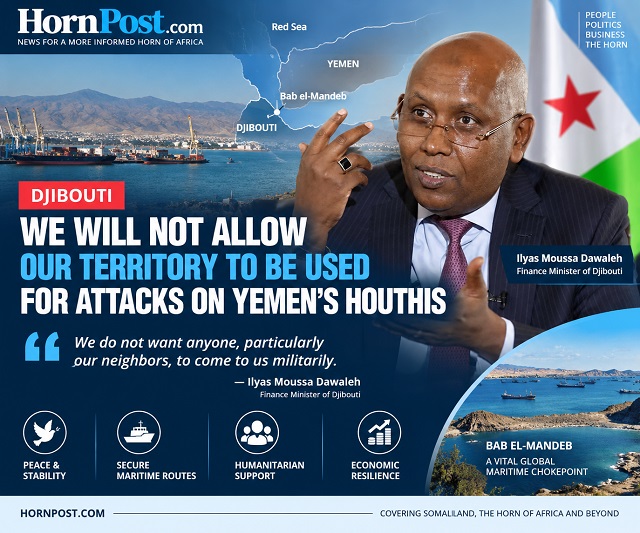
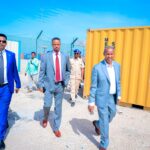
DJIBOUTI CITY, Djibouti (HornPost)— Djibouti will not allow its territory or military facilities to be used for military operations against Yemen’s Houthi movement, Djibouti Finance Minister Ilyas Moussa Dawaleh told BBC Somali, reaffirming the government’s position amid continued tensions across the Red Sea region.
Dawaleh said Djibouti’s position had not changed when asked whether the government had reconsidered an earlier refusal of a U.S. request to use military facilities in the country for operations against the Houthis.
“I don’t think that question is relevant at this time,” Dawaleh said, according to BBC Somali. He added that Djibouti did not want to become militarily involved in the conflict.
“We do not want anyone, particularly our neighbors, to come to us militarily,” he said.
Djibouti lies across the Gulf of Aden from Yemen and is adjacent to the Bab el-Mandeb Strait, one of the world’s most important maritime chokepoints linking the Red Sea with the Gulf of Aden and the wider Indian Ocean.
Djibouti Finance Minister Dawaleh said maintaining the security and free navigation of Bab el-Mandeb remains a central priority for Djibouti.
“Bab el-Mandeb must remain open,” he said, repeating the point during the interview.
Djibouti faces growing humanitarian pressure
Dawaleh also warned that renewed fighting in Yemen could increase humanitarian pressure on Djibouti as people flee across the Gulf of Aden.
He said many of those arriving from Yemen are women and children who have been forced to leave their homes because of the conflict.
Djibouti has historically received people fleeing conflict in the region despite its limited territory and resources, Dawaleh said.
“We have always opened our hearts and our hands as much as God and our capacity allow us,” he said.
The new arrivals from Yemen are adding to existing migration and refugee pressures, he said. Djibouti is also a transit point for people from other parts of the region traveling toward Arab countries.
Dawaleh said Yemenis fleeing the conflict face a different situation because they are being forced to leave their country by the fighting.
Yemen’s proximity increases Djibouti’s exposure
Djibouti’s geographic proximity to Yemen makes it particularly vulnerable to developments across the Gulf of Aden.
Djibouti Finance Minister Dawaleh said the two countries are separated by roughly 70 to 80 kilometers at their closest general points, while some sections of the coastline are only about 22 to 23 kilometers apart.
The short maritime distance means small boats can make the journey from Yemen to Djibouti in less than an hour, potentially facilitating the arrival of people fleeing conflict.
The situation has also created economic challenges for Djibouti, according to Dawaleh.
Red Sea disruptions hit Djibouti’s economy
As finance minister, Dawaleh said regional instability and disruptions to maritime traffic are affecting Djibouti’s economy and trade.
He said trade with Gulf countries has declined and that disruptions affecting shipping and maritime transportation are putting pressure on government revenues.
“Anything that affects trade affects our revenues,” Dawaleh said.
He also warned that higher transportation costs could increase the prices of essential goods and place additional pressure on households.
Dawaleh cited the cost of transporting containers to Djibouti as an example. He said the cost of a container, which previously ranged from about 200,000 to 250,000 Djibouti francs, has risen to between 1 million and 1.4 million Djibouti francs.
Small businesses and people dependent on local trade are particularly vulnerable to rising transportation costs, he said.
The government is monitoring the situation and working to limit the economic impact of regional instability on the population, Dawaleh said.
Djibouti rejects military involvement
On security, Dawaleh said the government’s primary responsibility is to protect Djibouti’s peace and stability.
He said authorities remain alert to the possibility that developments in Yemen could affect Djibouti but emphasized that the government does not want the conflict to spread to Djiboutian territory.
Djibouti is prepared to provide humanitarian assistance to people fleeing the conflict, he said, while calling for greater international support.
Djibouti Finance Minister Dawaleh said Djibouti has previously appealed to the international community for assistance, arguing that refugees and displaced people arriving in the country cannot be left without adequate support.
He also called on neighboring countries, particularly Gulf states, to contribute to efforts to find a political solution to the Yemen conflict.
Djibouti, he said, does not want to become a base or launch point for military operations by regional or international powers against Yemen.
Instead, the government intends to continue supporting the security and free navigation of Bab el-Mandeb while urging the parties involved in the Yemen conflict to exercise restraint and pursue a peaceful resolution.
Source: BBC Somali
by prepared and translated by Hornpost.com
Horn post staff
info@hornpost.com
www.hornpost.com