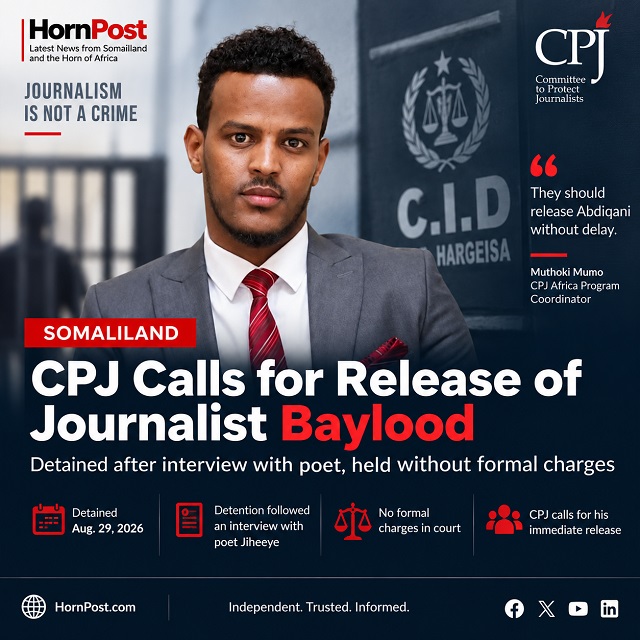
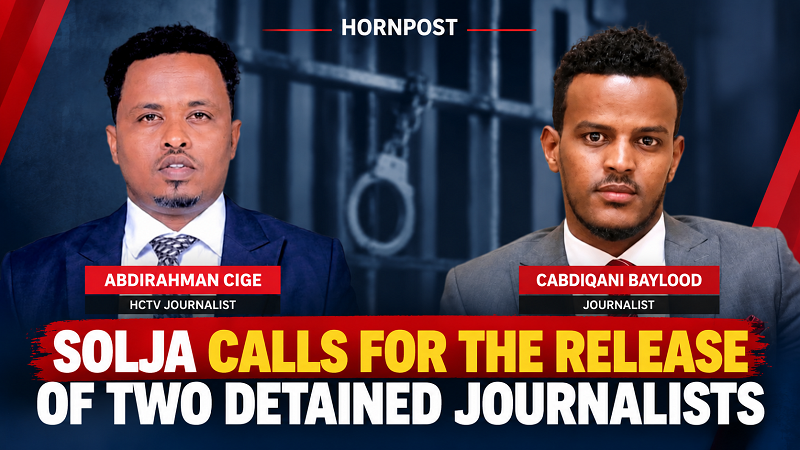
HARGEISA, Somaliland (HornPost) CPJ has called for the release of Somaliland journalist Baylood, detained since Aug. 29 after publishing an interview with poet Jiheeye.
The Committee to Protect Journalists (CPJ) has called for the immediate release of Somaliland journalist Abdiqani Hussein Abokor, widely known as Baylood, who has been held since Aug. 29 after publishing an interview with Somali poet Ismail Yusuf Abdi, also known as Jiheeye. Committee to Protect Journalists
In a statement published Sept. 7, CPJ said Baylood had been detained without formal charges after responding to a summons from the Criminal Investigation Department (CID) in Hargeisa. The international press-freedom organization said authorities had not formally presented charges against the journalist in court at the time of its report. Committee to Protect Journalists
CPJ Africa Program Coordinator Muthoki Mumo called for Baylood’s release, saying authorities had failed to formally present charges after his detention.
“They should release Abdiqani without delay,” Mumo said. Committee to Protect Journalists
Journalist Detained After Publishing Poet’s Interview
The case began on Aug. 27, when Baylood published a video interview with poet Ismail Yusuf Abdi, known as Jiheeye.
During the interview, Jiheeye recited a poem directed at Somaliland President Abdirahman Mohamed Abdillahi, warning that the president could face consequences if he did not intervene over what the poet described as the illegal seizure of two plots of land belonging to him. Committee to Protect Journalists
According to information provided to CPJ by Baylood’s lawyer, Tawakal Ibrahim Mohamed, and the Somaliland Journalists Association (SOLJA), security forces arrested Jiheeye the following day.
Baylood was subsequently summoned to the CID headquarters in Hargeisa. He went to the police facility on Aug. 29 and was detained there, according to the same sources. Committee to Protect Journalists
The sequence of events has raised concerns among press-freedom organizations because Baylood’s detention followed his publication of an interview involving criticism of government authorities.
Baylood Appeared Briefly Before Court
Baylood appeared before the Marodi-Jeh Regional Court in Hargeisa on Aug. 29, according to CPJ.
The court reportedly remanded him for seven days while authorities conducted an investigation. He was expected to return to court on Sept. 5, but according to his lawyer, that hearing did not take place. Committee to Protect Journalists
The case has therefore remained a significant concern for press-freedom advocates, particularly because CPJ said no formal charges had been presented in court when it published its report.
Two Possible Charges Reportedly Considered
Baylood’s lawyer told CPJ that he had been informally informed by a CID officer that police intended to pursue two charges against the journalist.
The first concerns offending the honor or prestige of the president, which the lawyer said could carry a maximum sentence of three years in prison under the penal code.
The second concerns the dissemination of anti-state propaganda, which could carry a maximum sentence of five years, according to the information provided to CPJ. Committee to Protect Journalists
However, CPJ emphasized that these charges had not been formally presented to the journalist in court at the time of its Sept. 7 report.
This distinction is important because an informal indication of possible charges is not the same as a formal indictment or court proceeding.
CPJ Raises Wider Press Freedom Concerns
CPJ described Baylood’s detention as part of broader concerns about the treatment of journalists in Somaliland.
The organization said Baylood had joined a wider group of journalists detained in Somaliland in recent months under circumstances it considers questionable. Committee to Protect Journalists
CPJ has previously reported on arrests and detention of journalists in Somaliland, including cases involving journalists detained without formal charges. Its latest statement places Baylood’s case within that broader press-freedom context. Committee to Protect Journalists
For media organizations, the central concern is whether journalists can publish interviews and report on issues of public interest without facing detention or criminal prosecution.
At the same time, authorities have the right to investigate alleged offenses. The key issue in Baylood’s case is whether any investigation is conducted according to law, with clear charges, judicial oversight and due process.
Government Has Not Responded to CPJ
CPJ said it contacted the Somaliland presidency and Ministry of Information by email, and contacted the police commission through a messaging application, seeking comment on Baylood’s detention.
According to CPJ, it did not receive responses from those authorities when its report was published. Committee to Protect Journalists
The lack of an official response leaves several questions unanswered, including the precise legal basis for Baylood’s continued detention and whether prosecutors intend to formally charge him.
Why the Case Matters
Baylood’s case has become significant because it involves the intersection of journalism, freedom of expression and political criticism in Somaliland.
The journalist did not merely publish a written political statement. He published an interview with a poet who used the platform to raise allegations concerning a property dispute and criticize government authorities.
The case therefore raises a broader question about the responsibility of journalists who publish statements made by interviewees.
In a functioning media environment, journalists may be expected to follow professional standards, verify allegations and provide relevant parties with an opportunity to respond. But press-freedom organizations also generally argue that journalists should not be criminally punished simply for conducting interviews or facilitating public discussion, particularly where authorities have other legal mechanisms for addressing disputed claims.
The appropriate balance depends on the specific evidence and the legal framework applied in the case.
What Happens Next?
The immediate issue is whether Baylood will be formally charged and brought before a court or released.
If authorities proceed with the reported charges, the case could become an important test of how Somaliland’s legal system handles journalism involving criticism of senior government officials.
If he is released without charge, questions will remain about why he was detained and why his expected court appearance did not take place.
For now, CPJ is calling for his release and urging Somaliland authorities to respect press freedom and journalists’ rights. Committee to Protect Journalists
Baylood’s case also comes amid a wider debate over press freedom in Somaliland, particularly following the detention of other journalists and media workers.
As international and local press organizations continue to monitor the case, attention will remain focused on whether Somaliland authorities provide a clear legal explanation for Baylood’s detention and ensure that any proceedings comply with due process.
Key Facts
- Journalist: Abdiqani Hussein Abokor, known as Baylood
- Location: Hargeisa, Somaliland
- Date detained: Aug. 29, 2026
- Reason reported: Detention followed the publication of an interview with poet Ismail Yusuf Abdi, known as Jiheeye
- Interview published: Aug. 27, 2026
- Court: Marodi-Jeh Regional Court
- Reported possible charges: Offending the honor or prestige of the president and disseminating anti-state propaganda
- Press freedom organization: Committee to Protect Journalists (CPJ)
- CPJ’s position: Calling for Baylood’s immediate release
- Government response: CPJ said it had not received a response from Somaliland authorities when its report was published
Source: Committee to Protect Journalists
Prepared by:
HornPost staff
info@hornpost.com
HARGEISA, Somaliland