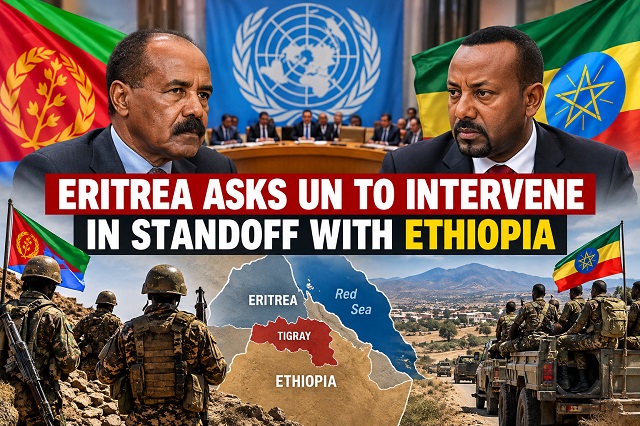
ADDIS ABABA, Ethiopia (HornPost) Eritrea has asked the United Nations Security Council to act against Ethiopia, accusing its neighbor of making allegations of a military incursion to justify a possible war, as tensions between the two Horn of Africa countries continue to escalate.
In a letter to the Security Council on Saturday, Eritrean Foreign Minister Osman Saleh urged the UN to condemn what he described as Ethiopia’s “declaration of war” and take deterrent measures under Chapter VII of the UN Charter, which allows the council to impose sanctions and authorize other measures to address threats to international peace and security.
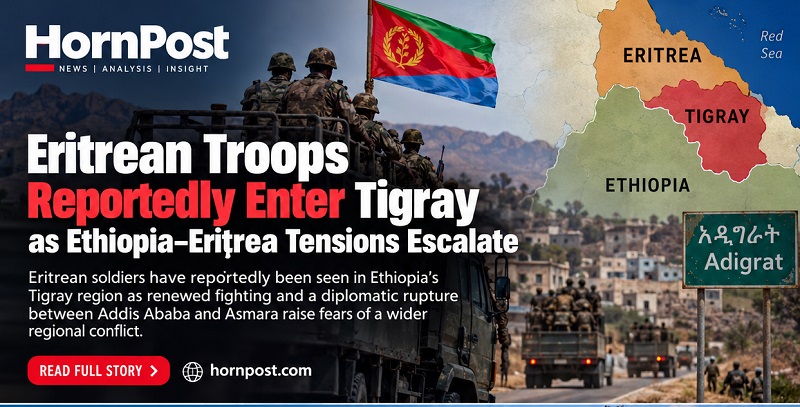
The diplomatic appeal followed an Ethiopian complaint to the council accusing Eritrean forces of crossing into the northern Ethiopian region of Tigray and advancing as far as 60 kilometers into the country.
Eritrea denied the allegations, describing them as an attempt by Addis Ababa to justify military aggression. The reported troop movements could not be independently verified by Reuters.
Ethiopia cites right to self-defense
In a letter dated Friday, Ethiopian Foreign Minister Gedion Timothewos accused Eritrea of deploying military units inside Ethiopian territory and supporting armed groups fighting the federal government.
Timothewos invoked Article 51 of the UN Charter, which recognizes a state’s right to self-defense in the event of an armed attack. He warned that Ethiopia would defend its territory against what his government described as foreign military aggression.
The Ethiopian letter also accused Eritrea of supporting, financing and arming insurgent groups. It did not provide detailed evidence for the allegations, and the Associated Press said it could not independently verify them. Eritrea has denied supporting antigovernmental rebels.
The exchange of letters highlights the growing risk of direct confrontation between the neighbors, whose relations have deteriorated following renewed fighting in northern Ethiopia and a breakdown in diplomatic ties.
Fighting intensifies in Tigray
The diplomatic dispute comes amid renewed fighting in Tigray, where Ethiopian government forces and allied militia groups have reported advances against opposition forces.
On Saturday, Ethiopian government troops and allied fighters entered Adigrat, a strategic town near the Eritrean border, according to residents cited by Reuters. The development followed reports of Eritrean troop movements in the area and drone strikes targeting military vehicles. The precise circumstances surrounding the reported movements remain disputed.
The renewed violence has raised fears of a wider conflict in a region still recovering from the devastating 2020–2022 Tigray war.
The United Nations has expressed serious concern about the latest fighting in Tigray, Afar and Amhara. Secretary-General António Guterres called for an immediate cessation of hostilities and urged the parties to return to dialogue under the Pretoria Agreement, which helped end the previous Tigray war.
Guterres also expressed concern about reports of Eritrean forces inside Ethiopia and called on countries in the region to avoid actions that could further fuel the conflict.
Red Sea access remains a major point of tension
Beyond the fighting in Tigray, the dispute is linked to Ethiopia’s demand for direct access to the Red Sea.
Ethiopia, a landlocked country since Eritrea gained independence in 1993, has repeatedly described maritime access as a strategic economic and security priority. Eritrea has interpreted Ethiopia’s demands for sovereign access to the sea as a potential threat to its territorial integrity, particularly around the port of Assab. Addis Ababa has said it seeks access through peaceful arrangements and dialogue.
The two countries restored relations in 2018 after decades of hostility, but their partnership deteriorated following the Tigray war and renewed disagreements over regional security and maritime access.
Ethiopia recently expelled 10 Eritrean diplomats and closed Eritrea’s embassy in Addis Ababa. Eritrea subsequently announced a break in diplomatic relations, according to the Associated Press
UN faces calls to prevent a wider conflict
Eritrea’s request places renewed pressure on the Security Council to address the escalating dispute. However, the diplomatic appeals do not themselves amount to a UN decision to impose sanctions or authorize military action.
Both governments have accused the other of threatening regional stability, while reports of troop movements and clashes near the border remain contested in important respects.
The immediate challenge for international mediators is to prevent confrontation from developing into another major war in the Horn of Africa, a region already affected by conflict, displacement and wider geopolitical competition.
HornPost News | Horn of Africa and international affairs
Prepared by:
HornPost staff
info@hornpost.com
www.hornpost.com