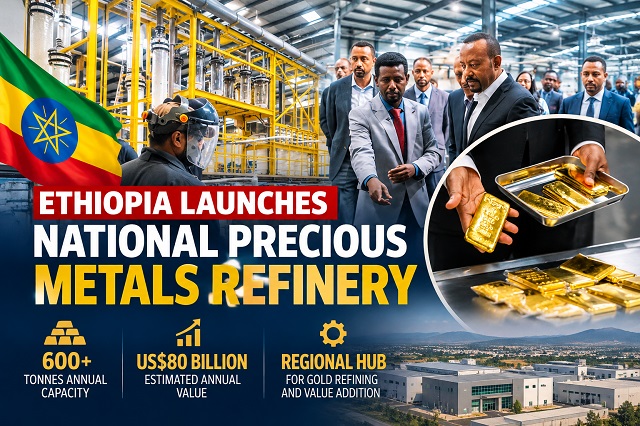
ADDIS ABABA, Ethiopia (HornPost) Ethiopia has inaugurated its National Precious Metals Refinery at the Bole Lemi Special Economic Zone in Addis Ababa, a project the government says will expand domestic mineral processing and strengthen the country’s role in the regional precious-metals industry.
Prime Minister Abiy Ahmed announced the launch on Saturday, October 10, saying the facility was established through a partnership between state-owned Ethiopian Investment Holdings (EIH) and international investor Sam Precious Metals.
The refinery is designed to process more than 600 tones of precious metals annually at full capacity. Its planned operations include testing and assessing metal purity, refining gold into export-ready bullion, and producing cast and minted gold and silver bars in different purities, according to information released by Ethiopian authorities.
Abiy said the facility was intended to help Ethiopia retain more value from its mineral resources by expanding domestic processing and manufacturing.
“From resource extraction to industrial transformation, we are creating greater value at home,” the prime minister said in his announcement.
The government expects the project to support export earnings, create skilled jobs, serve the jewelry industry and improve transparency and confidence in gold valuation. It also aims to attract precious metals from neighboring countries and other African markets for refining and certification.
Government targets regional refining role
The refinery forms part of Ethiopia’s broader effort to strengthen industrial capacity and diversify economic activity through the processing of locally available resources.
By refining gold domestically, Ethiopia aims to capture more of the value generated along the supply chain rather than relying solely on the export of unprocessed minerals.
The facility could also provide refining and testing services to regional mining companies, although its ability to attract international customers will depend on operational performance, commercial arrangements and confidence in its certification processes.
Reports citing the prime minister’s remarks have put the refinery’s potential annual export value at up to US$80 billion. That figure should be treated as a projected potential, not guaranteed revenue.
The government has not publicly detailed in the announcement how much of the refinery’s capacity will be used for gold, how quickly it will reach full operation, or what its actual annual export earnings will be.
The launch marks a new step in Ethiopia’s attempt to move further into mineral processing and precious-metals manufacturing. Its longer-term economic impact will depend on the facility’s ability to secure a reliable supply of metals, meet international quality and traceability standards, and operate at commercially sustainable levels.