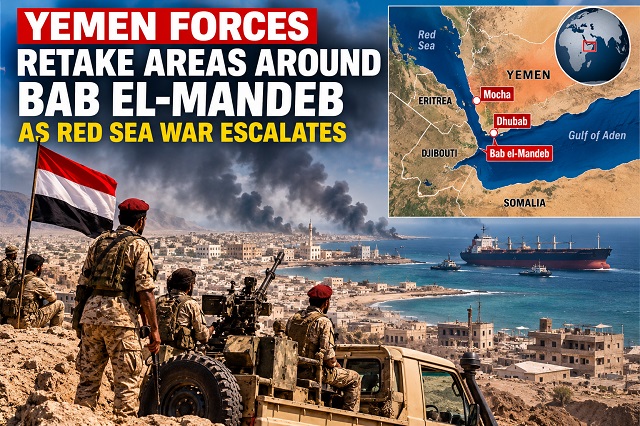
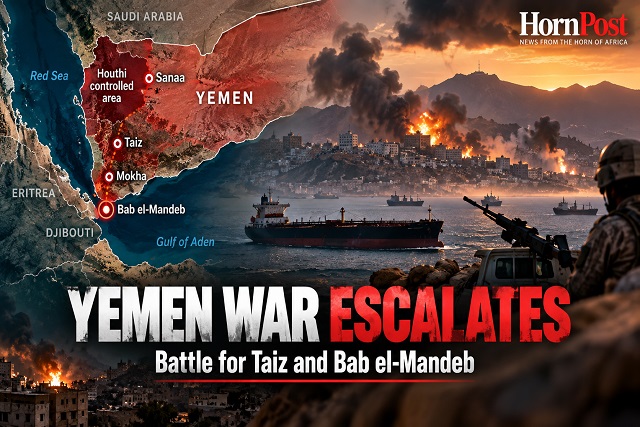
HARGEISA, Somaliland (HornPost) Fighting in Yemen has sharply intensified around the Bab el-Mandeb Strait, with Saudi-backed government forces launching a major counteroffensive against Houthi fighters while the Iran-aligned group has retaliated with missile and drone attacks on Saudi Arabia.
The escalation has placed one of the world’s most important maritime chokepoints at the center of a renewed regional confrontation, raising concerns over commercial shipping, energy supplies and security across the Red Sea and Gulf of Aden.
The latest offensive began Monday as forces aligned with Yemen’s internationally recognized government, backed by Saudi air power, moved to retake territory captured by the Houthis in recent weeks. Yemeni officials said government forces had regained the Dhubab area and other positions near Bab el-Mandeb and advanced toward the strategic port city of Mocha.
The Houthis have disputed the extent of the advances of the government, and Reuters said it could not independently verify the full scale of the territorial gains. Business Recorder
Battle for Bab el-Mandeb
The fighting is significant because Bab el-Mandeb connects the Red Sea with the Gulf of Aden and the wider Indian Ocean, making it a critical passage for international trade and energy shipments.
The Houthis captured Mocha and nearby territory and islands in September, according to the Associated Press, strengthening their position around the Yemeni side of the strait. The Saudi-backed counteroffensive is now attempting to reverse those gains.
Saudi Arabia has provided extensive air support to the operation. The Saudi-led coalition said its aircraft were providing protection around Bab el-Mandeb and striking Houthi targets. AP News reported that more than 100 Saudi aircraft were involved in the initial operation.
The fighting continued Tuesday as government forces sought to consolidate their positions and push Houthi fighters away from the coastal corridor. Reuters reported that government forces were also battling around Taiz, where the conflict has opened another important front.
Houthis Retaliate Against Saudi Arabia
The Houthi response has extended the conflict beyond Yemen’s borders.
Saudi Arabia said Tuesday that attacks had struck airports in Jazan and Najran, near the Yemeni border, injuring three people and damaging airport facilities. Saudi authorities also reported that another missile targeting Khamis Mushait was intercepted.
The Houthis have claimed responsibility for attacks against Saudi targets, including military and infrastructure sites, although some individual claims have not been independently verified.
The attacks demonstrate the risks of the conflict expanding into a broader regional confrontation involving Saudi territory and critical infrastructure.
Reports on Abuses During the Fighting
The latest fighting has also produced allegations of serious violations.
Reuters verified video footage showing fighters aligned with the Yemeni government driving armored vehicles over Houthi fighters near Bab el-Mandeb. Some of those shown in the footage appeared to be unarmed or had raised their hands. The Houthis accused the government-backed forces of war crimes.
The forces involved did not directly respond to Reuters’ questions about the footage, although the Homeland Shield Forces issued a directive instructing troops to treat prisoners according to legal and ethical standards.
The incident highlights the increasingly brutal character of the renewed fighting as both sides compete for control of territory around the strategic waterway.
What Conflict Means for Shipping
The renewed battle is taking place at a particularly sensitive moment for international shipping.
Bab el-Mandeb is already under heightened scrutiny because of attacks and disruptions affecting other major maritime routes, including the Strait of Hormuz.
The latest escalation has increased concern among governments and shipping companies that prolonged instability could raise insurance costs, increase security requirements and encourage vessels to take longer alternative routes.
The wider energy market is already responding to the disruption of major maritime corridors.
Reuters reported on Tuesday that oil executives are increasingly calling for alternative export routes and greater investment in infrastructure that can bypass vulnerable chokepoints.
Brent crude was trading around $100 a barrel on Tuesday as markets balanced continuing geopolitical risks against recovering Middle Eastern oil exports.
Saudi Arabia Seeks Alternative Energy Routes
Saudi Arabia is also strengthening its ability to move oil without relying exclusively on vulnerable maritime chokepoints.
Saudi Energy Minister Prince Abdulaziz bin Salman said Tuesday that flows through the kingdom’s East-West pipeline to the Red Sea export hub at Yanbu had reached 5.8 million barrels. The pipeline provides an alternative route for Saudi oil exports when shipping through the Gulf faces disruption.
The development illustrates a broader shift in regional energy strategy: maritime insecurity is encouraging states to invest in alternative infrastructure rather than relying on a single route.
Why It Matters for the Horn of Africa
The consequences of the Yemen conflict extend directly across the Gulf of Aden.
For Djibouti, the crisis increases the security importance of a country positioned immediately opposite Yemen and heavily involved in regional logistics.
For Somalia, insecurity around Bab el-Mandeb could affect the cost and reliability of imported goods while increasing the importance of maritime surveillance and coastal security.
For Somaliland, the developments reinforce the strategic relevance of its Gulf of Aden coastline and the location of Berbera, particularly as governments and commercial operators consider the resilience and diversification of regional supply chains.
For Ethiopia, the crisis comes as Prime Minister Abiy Ahmed again calls for access to the Red Sea. On October 5, Abiy said Ethiopia would continue seeking an outlet to the sea through negotiation and mutual benefit.
That statement came only days after Egypt, Eritrea, Sudan and Somalia met and said responsibility for the Red Sea rests with its coastal states. Ethiopia has argued that discussions about the Red Sea must also take account of its legitimate interests and geographic relationship with the region.
The timing makes the issue increasingly relevant to the wider strategic debate over maritime access in the Horn of Africa.
A New Phase in Yemen’s War?
The immediate battle is over territory around Bab el-Mandeb, but the consequences could be much broader.
The Saudi-backed government’s counteroffensive represents a significant attempt to reverse the Houthi gains of September. However, the Houthis still control large parts of Yemen, and the fighting around Taiz and elsewhere shows that retaking the coastal areas will not necessarily bring a rapid end to the conflict. Reuters quoted Yemen analyst Ahmed Nagi of the International Crisis Group as describing the operation as a potential turning point, while warning that the more difficult test could come as government forces move toward mountainous areas.
The Houthis have also demonstrated their ability to retaliate beyond the battlefield by targeting Saudi infrastructure and airports.
That means the security of Bab el-Mandeb cannot be separated from the wider military balance inside Yemen.
Regional and Global Implications
The renewed conflict is creating a chain of interconnected risks:
Yemen fighting → Houthi attacks → Saudi military response → maritime insecurity → higher shipping risks → pressure on energy and trade routes.
For the Horn of Africa, another chain is emerging:
Bab el-Mandeb insecurity → pressure on maritime trade → demand for secure ports and alternative corridors → greater strategic importance of the Gulf of Aden.
That dynamic could increase the economic and strategic value of ports such as Berbera and Djibouti, while also increasing the security responsibilities facing coastal states.
The developments also strengthen the argument that maritime infrastructure can no longer be viewed solely as a commercial issue. Ports, pipelines, shipping lanes and naval security are increasingly interconnected components of regional power.
Conclusion
The renewed fighting in Yemen has transformed Bab el-Mandeb once again into a central arena of regional competition.
The immediate objective of Saudi-backed forces is to push the Houthis away from the Red Sea coast and regain control of territory around the strategic strait. For the Houthis, maintaining their ability to threaten Saudi Arabia and influence the maritime environment remains an important source of leverage.
For international trade, the key concern is whether the fighting remains geographically contained or develops into a sustained threat to commercial shipping.
For the Horn of Africa, the significance is even broader.
As security risks around Bab el-Mandeb increase, the strategic value of the African coastline, alternative ports and diversified trade corridors is also rising.
The Yemen conflict is therefore no longer only a Yemeni or Gulf security issue. It is increasingly part of a wider contest over maritime security, energy resilience, trade routes and strategic access across the Red Sea and the Horn of Africa.
Prepared by:
HornPost staff
info@hornpost.com
www.hornpost.com
HARGEISA, Somaliland