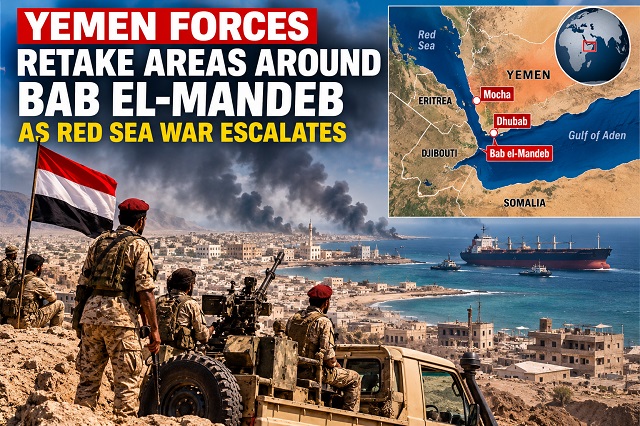
ADEN, Yemen (HornPost) Saudi-backed forces of Yemen’s internationally recognized government have launched a major offensive along the country’s western coast, reporting significant territorial gains around the Bab el-Mandeb Strait and the strategic port city of Mocha, in a renewed escalation of Yemen’s long-running conflict.
Yemeni government forces said they had retaken large parts of Dhubab district, which overlooks the narrow waterway linking the Red Sea with the Gulf of Aden. Government forces, backed by heavy Saudi air support, also advanced toward Mocha, with Yemen’s Defense Ministry saying the city had fallen.
Reuters said it could not independently verify the full extent of the reported gains, while the Houthis rejected the government’s claims.
The offensive represents a significant attempt by the internationally recognized government and its Saudi allies to reverse Houthi advances made along Yemen’s Red Sea coast in recent weeks. The Houthis had seized positions around the Bab el-Mandeb area, including strategically important coastal territory and islands, raising concerns over the security of one of the world’s major maritime routes.
Government Forces Advance Toward Mocha
Yemeni government forces moved rapidly along the coast on Monday, supported by Saudi airstrikes. Four government sources told Reuters that forces had reached the outskirts of Mocha and that Houthi fighters were withdrawing toward the highlands. Yemen’s Defense Ministry said the city had been captured.
Government forces had already taken key positions in Dhubab, including an airstrip near the mouth of Bab el-Mandeb. However, fighting was still reported in parts of the area, and the extent of government control remained contested.
The Houthis, who control the capital Sanaa and much of northern Yemen, denied the reported territorial losses and described the government’s claims as unfounded. The conflicting claims underline the difficulty of independently establishing battlefield developments in the rapidly changing conflict.
At the same time, Houthi forces have reportedly made advances around Taiz, where government forces have faced pressure along important mountain roads. One government source disputed reports that a key road had been cut off, highlighting the fluid nature of the fighting.
Bab el-Mandeb Raises Global Shipping Concerns
The battle for Bab el-Mandeb has consequences far beyond Yemen.
The strait is a major maritime chokepoint connecting the Red Sea and Gulf of Aden, providing an important route for commercial shipping between Europe, Asia and the Middle East. Its strategic importance has increased further as shipping and energy markets have already been affected by disruption around the Strait of Hormuz.
The Houthi advance toward the waterway last month raised concerns that the group could exert greater pressure on commercial shipping and energy flow through the Red Sea.
The latest government counteroffensive is therefore being closely watched by shipping and energy markets. A sustained restoration of government control along the Yemeni side of the strait could reduce some of the immediate risks to maritime traffic, although the Houthis retain missile and drone capabilities that could allow them to threaten shipping from other positions.
The strategic importance of Bab el-Mandeb is particularly significant because disruptions in the waterway can force commercial vessels to consider longer routes around the Cape of Good Hope, increasing transit times, fuel consumption and insurance costs.
Saudi Arabia Intensifies Military Support
Saudi Arabia has played a central role in supporting the Yemeni government offensive.
The Saudi-led coalition has provided extensive air support for forces operating along the Red Sea coast. Riyadh said its aircraft had struck hundreds of targets in Yemen as part of efforts to protect the Bab el-Mandeb area and support Yemeni ground forces.
Saudi Arabia has also faced attacks attributed to the Houthis. The Houthis said they targeted locations in Saudi Arabia, including King Khalid International Airport in Riyadh, an Aramco facility in Rabigh, Abha International Airport and the Khamis Mushait military base. Reuters said those claims could not immediately be independently verified.
The escalation has consequently widened the conflict beyond Yemen’s borders and increased concerns about the security of Saudi energy infrastructure and regional airspace.
New Defense Cooperation Adds Regional Dimension
The fighting comes as Saudi Arabia, Türkiye and Pakistan have moved to strengthen military cooperation under the Makkah Defense Alliance.
The three countries agreed at an emergency meeting in Riyadh on Monday to rapidly implement collective-defense commitments and make agreed military capabilities available for deployment in Saudi Arabia. The decision followed the escalation in Yemen and attacks targeting Saudi territory.
The development adds another regional dimension to the Yemen conflict, as the security of Saudi Arabia, the Red Sea and Bab el-Mandeb becomes increasingly linked to broader defense arrangements involving regional powers.
Humanitarian Crisis Deepens
The renewed fighting is also worsening Yemen’s humanitarian situation.
The International Organization for Migration (IOM) said on Oct. 5 that more than 184,000 people had been displaced between Aug. 1 and Oct. 4, with most of the displacement occurring since early September as fighting intensified. International Organization for Migration
The latest escalation has particularly affected communities around the western coast and Taiz, where fighting has disrupted access to roads, health services and other essential infrastructure.
The renewed conflict follows years of relative calm after a 2022 truce significantly reduced large-scale fighting between the Houthis and forces aligned with Yemen’s internationally recognized government. The latest escalation has reopened several major front lines.
Implications for the Red Sea and Horn of Africa
The battle around Bab el-Mandeb is also significant for countries on the opposite side of the waterway, including Djibouti, Somalia and Somaliland.
The strait lies directly across from the Horn of Africa, making developments on the Yemeni coast relevant to maritime security and commercial shipping throughout the Gulf of Aden.
For Djibouti, which hosts major port and logistics facilities, prolonged instability around Bab el-Mandeb could increase security and shipping costs while also increasing the strategic importance of secure regional ports.
Somalia’s long coastline places it directly within the wider maritime security environment, while Berbera in Somaliland sits along the southern Gulf of Aden and could become increasingly relevant to regional logistics if shipping companies seek secure and efficient alternatives.
The broader crisis therefore links Yemen’s battlefield developments with the economic and strategic interests of the Horn of Africa.
What Happens Next?
The immediate question is whether Yemeni government forces can consolidate their gains around Bab el-Mandeb and Mocha.
The reported advance has pushed the front line away from parts of the strategic waterway, but the Houthis retain significant military capabilities and continue to operate across large parts of northern and western Yemen.
The fighting around Taiz also demonstrates that control of Bab el-Mandeb alone will not determine the wider outcome of the conflict.
For international shipping, the key issue will be whether the latest offensive produces a sustained improvement in maritime security or whether fighting continues to threaten commercial vessels and energy flows.
For Yemen, the developments mark another major escalation in a conflict that remains unresolved. For the wider Red Sea region, the battle for Bab el-Mandeb has become a test of whether one of the world’s most important maritime corridors can remain open and secure amid a rapidly expanding regional security crisis.
Prepared by:
HornPost staff
info@hornpost.com
www.hornpost.com