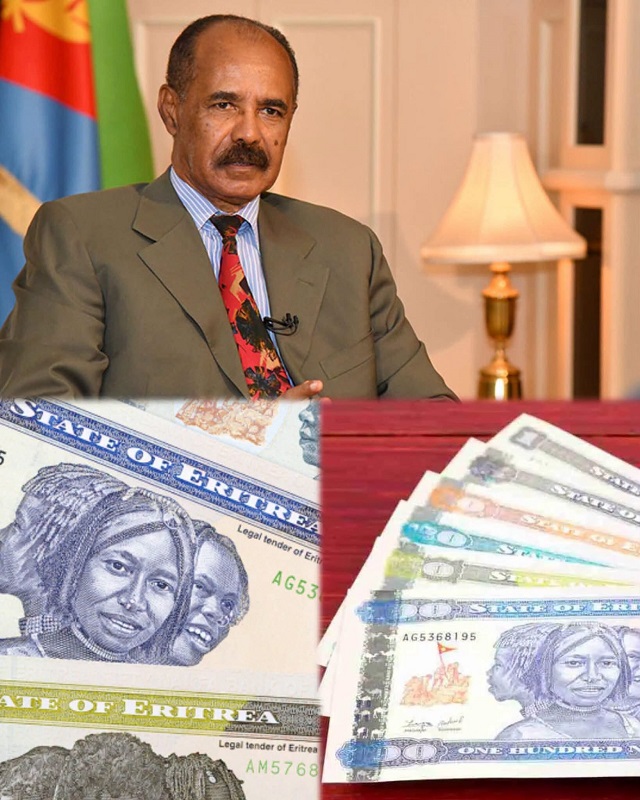
ASMARA, Eritrea —(HornPost) The Bank of Eritrea has introduced new restrictions on the amount of cash individuals and private businesses can hold outside the banking system, requiring large cash holdings to be deposited or otherwise brought within the formal financial system.
Under Legal Notice No. 134/2026, published in Eritrea’s Official Gazette on September 9, the central bank said individuals may not hold more than 25,000 Nakfa in cash for more than 15 days.
The rule also sets different limits for private businesses depending on their classification. Eritrea Ministry Of Information
Private businesses classified under Category C may hold up to 50,000 Nakfa, while those in Category B may hold up to 100,000 Nakfa. Businesses classified under Category A may hold up to 150,000 Nakfa.
However, amounts above these limits cannot be held for more than 15 days without an acceptable justification. The Bank of Eritrea warned that legal action may be taken against individuals or private businesses that violate the new requirements. Eritrea Ministry of Information
The new regulation takes effect from the date it was published in Eritrea’s Official Gazette, according to the central bank’s announcement. Eritrea Ministry of Information
At the individual level, the 25,000 Nakfa limit is roughly equivalent to US$1,667 at the commonly cited official exchange rate of 15 Nakfa to the U.S. dollar. The figure is therefore approximately $1,700, as stated in the original information.
The new regulation follows an earlier Bank of Eritrea directive issued in July 2026 that required citizens and organizations to deposit cash holdings into bank accounts by July 31. That directive also warned that failure to comply could lead to legal measures.
The latest measure appears to further strengthen Eritrea’s effort to move cash transactions into the formal banking system.
The country has historically maintained tight controls over cash and banking transactions, including restrictions introduced during the 2015 currency replacement.
The new rules are likely to have a significant impact on how individuals and businesses manage cash, particularly in an economy where access to banking services and cash transactions have historically been subject to strict government controls.
Key figures:
– Individuals: Maximum 25,000 Nakfa for more than 15 days
– Category C private businesses: 50,000 Nakfa
– Category B private businesses: 100,000 Nakfa
– Category A private businesses: 150,000 Nakfa
– Maximum period: 15 days
– Legal Notice: No. 134/2026
– Effective date: September 9, 2026
Analysis: What Eritrea’s New Cash Rule Means
The new regulation is significant because it goes beyond simply setting a cash limit. Legal Notice No. 134/2026 effectively pushes more Nakfa into Eritrea’s formal banking system by limiting how long individuals and private businesses can keep large amounts of physical cash outside banks. The Bank of Eritrea says currency movement should be conducted through banks and financial institutions.
The distinction is important: the rule does not mean that an individual is absolutely prohibited from possessing more than 25,000 Nakfa. Rather, an individual cannot hold more than 25,000 Nakfa in cash for longer than 15 days without an acceptable justification. Similar thresholds apply to private businesses, rising to 50,000 Nakfa for Category C, 100,000 Nakfa for Category B and 150,000 Nakfa for Category A businesses.
Why the Bank May Be Tightening Cash Controls
One possible economic objective is to increase the amount of money circulating through the formal banking system. Eritrea has historically maintained strict controls over cash withdrawals and foreign currency, while its banking and digital-payment infrastructure remains relatively limited. A 2026 economic assessment also describes the Nakfa as being officially pegged at 15 Nakfa to the U.S. dollar and notes longstanding restrictions on access to cash. BTI 2026
Bringing larger cash holdings into banks gives monetary authorities greater visibility over money in circulation. It can also make it more difficult for large transactions to take place entirely outside the formal financial system.
However, the policy also creates an important practical question: what happens if people are required to deposit their cash but still face difficulties accessing that money through banks?
That question matters particularly in an economy where cash remains important for everyday transactions. If banking access, withdrawals or payment infrastructure remain constrained, forcing more money into bank accounts could increase dependence on the banking system without necessarily making financial services more accessible.
The 15-Day Rule Is Particularly Significant
The 15-day provision gives the new regulation a different character from a simple cash ceiling.
The rule creates a continuing obligation. An individual or business that temporarily holds more than the permitted must either reduce its physical cash holdings, deposit the excess into the banking system, or provide an acceptable justification for keeping it beyond the 15-day period. Failure to comply can result in legal action.
For businesses, this could affect companies that routinely handle substantial cash, for example, retailers, wholesalers and other businesses where cash receipts accumulate before being deposited.
The regulation therefore has implications not only for monetary policy, but also for how businesses manage working capital and daily transactions.
Eritrea’s Monetary History Adds Context
The announcement also comes against the background of Eritrea’s previous currency controls. In 2015, the government introduced a major currency replacement exercise. At that time, individuals and entities faced limits on the amount of new Nakfa that could be withdrawn in cash, with larger transactions required to go through bank instruments.
That history explains why any new restriction on physical Nakfa is likely to attract close attention.
It would be premature, however, to conclude that the latest regulation signals an imminent currency replacement or redenomination. The current legal notice itself is about regulating the movement and holding of Nakfa cash; it does not announce a new currency.
What to Watch Next
The most important question now is how the rules will be implemented.
Key developments to watch include:
– Whether banks receive additional instructions on enforcing the 15-day rule.
– How authorities define an “acceptable justification” for holding cash above the limits.
– Whether businesses experience difficulties depositing or withdrawing funds.
– Whether cash withdrawal rules are changed.
– Whether the government introduces additional restrictions on Nakfa circulation.
– Whether the measure affects informal cash transactions and foreign-currency activity.
The broader significance is therefore not simply that Eritrea has set a 25,000 Nakfa threshold. The bigger story is that the government is seeking to exercise tighter control over where money is held, how cash moves through the economy and how much economic activity takes place inside the formal banking system.
For Eritrea’s citizens and businesses, the practical test will be whether tighter monetary control produces a more transparent and manageable financial system—or simply makes access to cash more difficult.
Prepared by:
HornPost staff
info@hornpost.com
HARGEISA, Somaliland