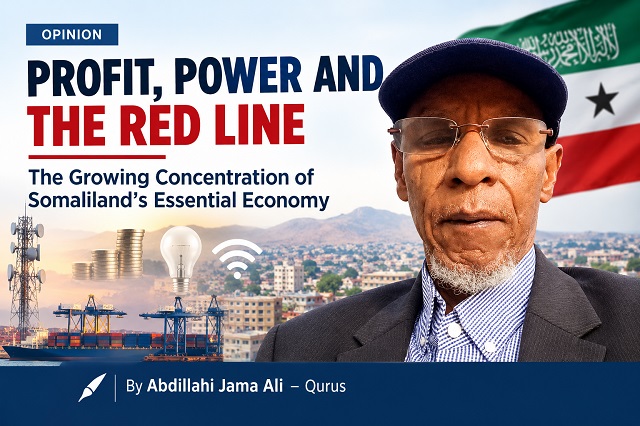
HARGEISA, Somaliland (HornPost) PROFIT, POWER AND THE RED LINE, The Growing Concentration of Somaliland’s Essential Economy Author: Abdillahi Jama Ali – Qurus
“Indho ribix arkayaa, rixin ma eegaan.”
“They see the profit, but they do not see their kin.”
Somaliland has built much of its modern economy through private initiative. In the absence of a fully developed state economic infrastructure, entrepreneurs stepped forward, invested their capital and created services that millions of people depend upon every day. From telecommunications and banking to money transfers, electricity and other essential services, the private sector has become a central pillar of the Somaliland economy.
That achievement should be recognised. But economic success also creates a greater responsibility. As private companies grow and their influence expands across essential sectors, a fundamental question deserves serious public discussion: How much economic power should be concentrated in the hands of a very small number of corporate groups before that concentration begins to threaten competition, consumers and the authority of the state?
This is no longer simply a question about business. It is a question about economic power, market competition and the future structure of Somaliland’s economy.
The Power of Two
One of the most striking features of Somaliland’s economy is the enormous reach of its largest corporate groups. The same major players have developed powerful positions across sectors fundamental to everyday life, including telecommunications, banking, money transfer, foreign exchange, fuel, electricity and other essential services.
There may be legitimate economic reasons for this concentration. Investment requires capital. Large infrastructure projects often require companies with substantial financial capacity. Economies of scale can also reduce operating costs and allow businesses to provide services across a wider market.
However, when a small number of companies become dominant across several essential sectors, the economic environment changes. The issue is no longer simply whether individual businesses are successful. The larger question becomes whether consumers and smaller businesses have enough meaningful alternatives.
Two companies do not automatically create effective competition. A genuinely competitive market exists when consumers can choose between providers, businesses compete on price and quality, and no single company—or small group of companies—can effectively determine the terms of the market.
For that reason, Somaliland should not ask only, “How many companies are operating?”
It should ask the more important question:
“How much real choice does the consumer have?”
That distinction is at the heart of any serious discussion about competition, market concentration and consumer protection in Somaliland.
When Competition Becomes Coordination
The concern becomes more serious when dominant companies appear to move in similar directions on prices, fees or service charges.
It is important, however, to distinguish between proven collusion and public suspicion of coordination. An allegation of price-fixing should never be treated as established fact without evidence and a proper investigation. At the same time, public concern cannot simply be dismissed when consumers repeatedly experience higher costs for essential services while having few meaningful alternatives.
If dominant companies are independently responding to the same economic pressures, that is one matter. If competitors are communicating or coordinating in ways that undermine genuine competition, that is an entirely different matter.
Determining the difference should not be left to public speculation, political rumours or the companies themselves. It requires an independent, credible and effective regulatory process.
That is precisely why regulatory institutions matter. A functioning competition system should be capable of examining market behaviour, investigating complaints, assessing pricing practices and determining whether companies are operating within the rules.
The Internet Price Shock
The recent increase in the cost of internet services demonstrated how closely telecommunications are connected to the wider Somaliland economy.
When internet services become more expensive, the effect does not stop with an individual consumer’s monthly bill. Internet access has become part of education, business, banking, communication, government services, journalism and international commerce.
For young people, entrepreneurs and small businesses, reliable and affordable connectivity is no longer a luxury. It is economic infrastructure.
This is why a public reaction to higher internet prices should not be viewed simply as consumer anger. For policymakers, it should also be treated as a warning signal about affordability, competition and the wider cost of doing business.
The same principle applies to another essential service: electricity.
Electricity Is Not an Ordinary Commodity
Electricity is fundamental to almost every productive activity. A rise in electricity prices affects households, shops, restaurants, manufacturers, schools, offices, water services and small enterprises.
The impact then moves through the wider economy.
A business facing higher electricity costs must either absorb the additional expense, reduce its operations or increase the prices of its goods and services. As a result, rising electricity prices can contribute to higher operating costs and create additional inflationary pressure across the Somaliland economy.
Therefore, when electricity prices rise, the issue is not merely the size of an individual’s electricity bill. It can become a broader question of economic competitiveness, household affordability and the cost of doing business.
This is why essential utilities should not always be treated exactly like ordinary consumer products. Where a service is indispensable to households and businesses, effective regulation and consumer protection become particularly important.
The State Must Not Become a Spectator
There is nothing inherently wrong with powerful private companies. Somaliland needs strong companies. It needs investment, innovation, infrastructure and entrepreneurs capable of building businesses that can compete regionally and internationally.
But strong companies require strong rules.
A government that allows private economic power to become so concentrated that dominant providers can dictate terms to consumers—or challenge the authority of regulators—risks weakening the very market system that allowed those companies to succeed.
The state does not need to run every business. Its role is to establish clear rules, protect competition, safeguard consumers and enforce those rules fairly.
An effective regulator should therefore be able to ask fundamental questions:
- Is there genuine competition?
- Are prices justified by costs and market conditions?
- Are consumers adequately protected?
- Are dominant companies abusing their market position?
- Are competitors communicating in ways that undermine competition?
- Can new companies realistically enter these markets?
- Are essential services being priced in the public interest?
- Are regulatory decisions respected and enforced?
These are not anti-business questions.
They are pro-market questions.
A healthy private sector does not depend on the absence of regulation. It depends on predictable rules that allow businesses to compete fairly and consumers to make meaningful choices.
The Red Line
There is a point at which economic strength becomes economic power, and economic power can eventually become political power.
That is where the red line begins.
No private company should be above the law. No corporation should become so powerful that it can influence public policy simply because the government and the public depend heavily upon its services.
And no regulator should exist merely on paper.
If a regulatory authority is legally responsible for supervising a sector, its decisions must carry real authority. Otherwise, the public is left with the appearance of regulation without the substance of it.
That is dangerous for Somaliland because effective institutions are essential to maintaining public confidence in the Somaliland economy, private sector and regulatory system.
This Is Not an Attack on Business
This argument should not be misunderstood as an attack on Somaliland’s private sector.
The private sector has achieved things that the state alone could not have achieved. It has connected people, facilitated commerce, transferred money across borders, provided electricity, financed businesses and helped keep the economy functioning through difficult circumstances.
Those achievements deserve recognition.
But precisely because these companies are so important to society, their responsibilities are greater—not smaller.
Economic success should create social responsibility, transparency and accountability, not exemption from them. The larger a company becomes, the greater its potential impact on consumers, workers, competitors and the wider economy.
And the greater its impact, the stronger the case for effective oversight and fair competition.
A Market Needs More Than Sellers
A functioning market requires more than companies selling products and services. It requires choice, competition, information and enforceable rules.
Above all, it requires an authority capable of applying those rules independently and consistently.
Without these conditions, a market can gradually become a system in which consumers have little choice but to accept whatever terms powerful providers offer. When essential services are concentrated among a small number of dominant companies, consumers may have limited ability to respond to price increases or changes in service conditions.
That is not the kind of competitive capitalism Somaliland should aspire to build.
It is concentrated economic power.
The Somali Proverb
This is where the old Somali wisdom becomes remarkably relevant:
“Indho ribix arkayaa, rixin ma eegaan.”
“They see the profit, but they do not see their kin.”
Profit is legitimate. Business is legitimate. Investment is legitimate.
But an economy is ultimately about people.
The consumer is not merely a source of revenue. The electricity user is not merely a monthly payment. The internet subscriber is not merely a number on a company balance sheet.
They are citizens. They are families. They are students. They are workers. They are entrepreneurs.
They are also the society that created the market in which these businesses became successful.
That is why the debate about profit, economic power and market concentration in Somaliland should ultimately be a debate about how economic growth can serve society without allowing concentrated power to undermine consumer choice or public authority.
Before the Red Line Is Crossed
Somaliland does not need to choose between private enterprise and government.
It needs both.
It needs strong private companies and strong public institutions. It needs investment and regulation. It needs profit and responsibility. Most importantly, it needs a competitive market in which successful businesses can grow while consumers retain meaningful choices.
The objective should not be to weaken successful companies. It should be to prevent economic success from becoming unchecked economic power.
The time has come for Somaliland to look carefully at the concentration of its essential economy—not with hostility, not with ideology, but with courage, evidence and independent regulation.
Because once economic power becomes powerful enough to challenge public authority, the question is no longer simply how much consumers are paying.
The question becomes:
Who ultimately sets the rules of Somaliland’s economy—the state, or the market giants?
That is the red line.
And Somaliland should address it before it is crossed.
“Indho ribix arkayaa, rixin ma eegaan.”
“They see the profit, but they do not see their kin.”
By Abdillahi Jama Ali – Qurus
abdillahijamac9@gmail.com
Hargeisa, Somaliland