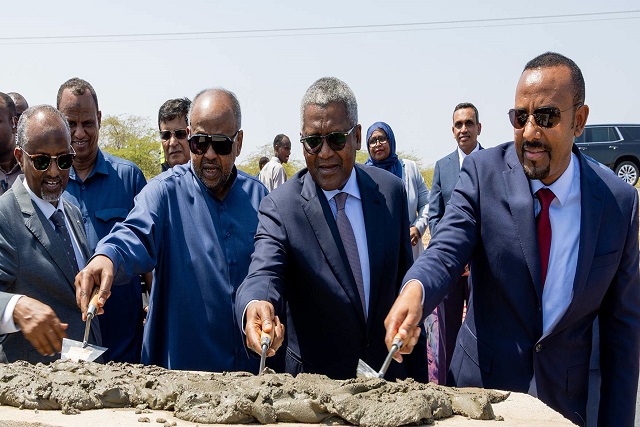
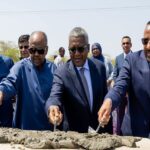
DJIBOUTI — (HornPost) Ethiopia, Djibouti and the Dangote Group have launched a project to build a 120-kilometer petroleum products pipeline linking Djibouti’s Damerjog area with Ethiopia, alongside new fuel storage infrastructure.
The project was presented as a major infrastructure investment aimed at improving fuel transportation, strengthening energy security and supporting trade between the two countries.
Speaking at the groundbreaking ceremony, Ethiopian Prime Minister Abiy Ahmed said the pipeline would address challenges along the Ethiopia-Djibouti trade corridor, where fuel transportation by road can take several days.
“Together Djibouti, Ethiopia and the Dangote Group will develop a 120-kilometer pipeline,” Abiy said, adding that the project would connect Damerjog with Dewele and include more than 1 million cubic meters of combined storage capacity at the two ends.
Abiy said the pipeline could reduce the transportation time for fuel from about five days to roughly one day, while strengthening reserves and protecting supplies during periods of global uncertainty.
Red Sea security and regional trade
Abiy also linked the investment to disruptions affecting global shipping routes and energy markets.
“For our two countries whose trade is closely tied to the Red Sea, resilience is a necessity,” Abiy said.
He argued that the pipeline should operate as part of a wider logistics network connecting ports, highways, railways, storage terminals and the Mojo Modern Logistics Centre.
“When they work together, journeys shorten, trade expands and the entire region becomes more competitive,” he said.
For Ethiopia, he said, the project would support industries, transportation, agriculture and cities. For Djibouti, he said, it would increase transit volumes, improve the use of energy infrastructure and strengthen the country’s position as a regional logistics hub.
Dangote: Pipeline to strengthen energy security
Dangote Group President and Nigerian billionaire Aliko Dangote said the project includes a 120-kilometer pipeline and a combined 400-million-liter storage facility.
He described the project as important for infrastructure, trade and industrial development in Africa.
Dangote said Ethiopia is one of Africa’s major economies, with growing demand for energy, transportation, logistics, construction and industrial inputs, while Djibouti has become a strategic gateway for Ethiopia and the wider region.
The pipeline will connect coastal storage facilities in Damerjog with inland storage and distribution facilities in Dewele, allowing refined petroleum products to be transported through a dedicated system.
According to Dangote, the first phase will handle products including jet fuel, automotive gas oil and premium motor spirit.
He said the project would improve inventory management and strategic fuel reserves while reducing pressure on existing road transportation.
“This is not just a pipeline project. It is a transformative project that expands the economy and entrenches energy security,” Dangote said.
He also said the project could support industries including aviation, transportation, agriculture and construction, while create jobs and transfer technical skills to local workers.
Djibouti highlights regional integration
Djibouti President Ismaïl Omar Guelleh said the project has national, regional and strategic significance and described it as part of efforts to turn cooperation between Djibouti and Ethiopia into concrete infrastructure projects.
Guelleh said the project would strengthen Djibouti’s logistics capacity and help secure energy supplies for the region.
He said the planned facility would include a 375,000-cubic-meter storage terminal capable of handling up to 5 million tons of petroleum products annually.
The terminal will serve as the starting point for the multi-product pipeline, which Guelleh said would help reduce pressure on road corridors and improve fuel supply.
Guelleh also linked the project to broader efforts to increase African energy independence and develop infrastructure connecting African markets.
“Africa does not need to be built. Africa needs to build,” Guelleh said.
He said Djibouti’s location near the Bab el-Mandeb gives the country both an opportunity and a responsibility to contribute to regional stability, prosperity and integration.
Dangote outlines wider African investment plans
Dangote also used the ceremony to highlight the Dangote Group’s broader investments across Africa.
He said Dangote Cement currently has a production capacity of 55 million tons and is expected to reach 100 million tons within about four years. He said the group operates in 11 countries.
Dangote also referred to the Dangote Petroleum Refinery in Nigeria, saying the company plans to increase its capacity to 1.4 million barrels per day.
He said the group’s fertilizer business is also expanding and argued that greater local production could help African countries reduce dependence on imports.
Dangote said the group’s Vision 2030 is backed by $50 billion in planned investment across Africa between now and 2030.
He also praised the Djibouti and Ethiopian governments, the Djibouti Ports and Free Zones Authority, Ethiopian Investment Holdings, financiers, contractors and technical teams involved in the pipeline project.
The project is expected to strengthen the Ethiopia-Djibouti trade corridor by providing dedicated infrastructure for the movement and storage of petroleum products between the two countries.
here you can watch Links to the speeches by the Prime Minister of Ethiopia, the President of Djibouti, and businessman Dangote.
Abdikarim Saed Salah is Editor-in-Chief and Founder of HornPost.com, an independent Hargeisa-based news platform covering Somaliland, the Horn of Africa, East Africa, the Red Sea and international affairs.
A journalist, television presenter, producer and geopolitical analyst, he has more than 15 years of experience in broadcast journalism, digital media, reporting and diplomacy. He works with Horn Cable TV and focuses on politics, elections, security, foreign policy and conflict.
He holds a BA in Journalism and an MA in International Relations.