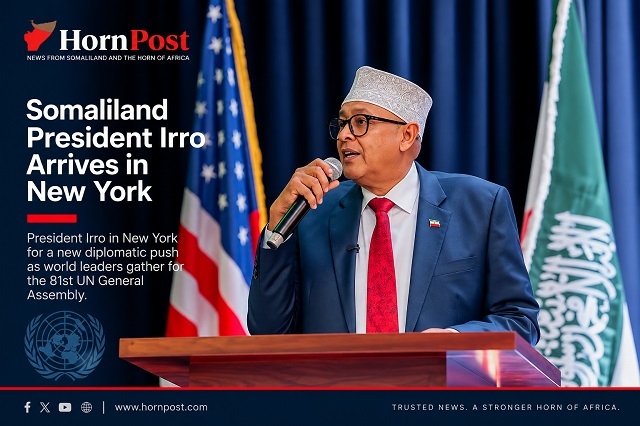
NEW YORK (HornPost) Somaliland President Abdirahman Mohamed Abdullahi “Irro” has arrived in New York as the United Nations General Assembly begins its high-level week, moving the Somaliland president’s U.S. visit from Washington into a broader international diplomatic setting.
The 81st session of the United Nations General Assembly opened on Sept. 8, with the high-level general debate scheduled for Sept. 22-28. The United Nations says nearly 130 heads of state and government are expected to attend the high-level week in person.
For Somaliland, President Irro’s presence in New York provides an opportunity to engage with diplomats, government officials, policymakers and other international actors gathered around the U.N. General Assembly, even though Somaliland is not a member state of the United Nations.
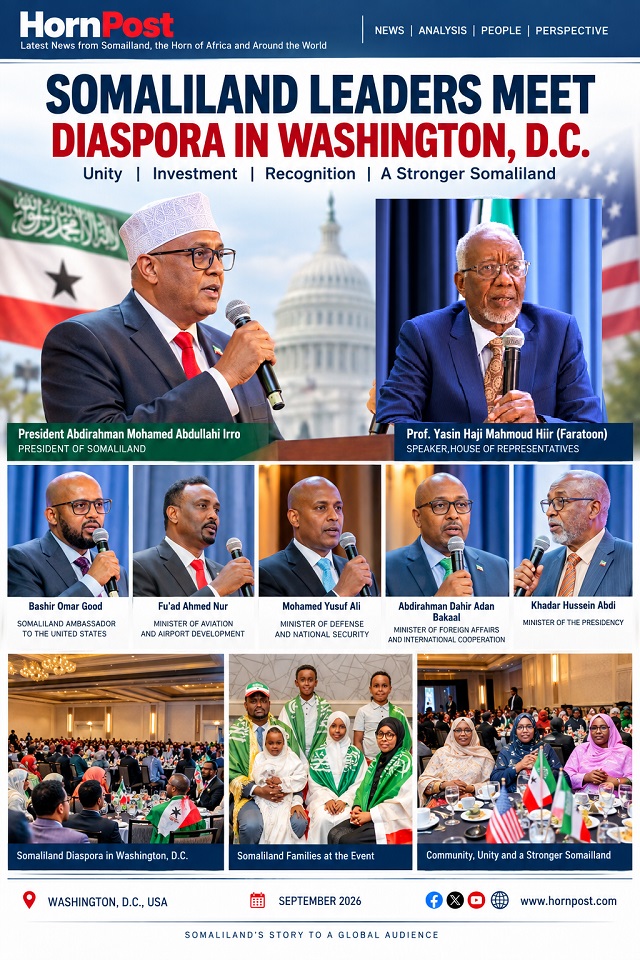
The New York leg follows Irro’s meetings in Washington, where his government placed Somaliland’s international recognition campaign alongside issues of regional security, economic cooperation and strategic interests in the Horn of Africa.
From Washington to New York
Irro’s Washington meetings have been presented by Somaliland officials as part of an effort to deepen relations with the United States and frame Somaliland’s case within broader strategic interests.
On Sept. 19, Irro met U.S. Sen. Ted Cruz on Capitol Hill. According to Somaliland’s Ministry of Foreign Affairs, the discussions covered international recognition, stronger U.S.-Somaliland strategic cooperation, security, economic cooperation and regional stability, including developments in the Horn of Africa, Red Sea and Gulf of Aden.
The Washington phase therefore placed emphasis on the bilateral relationship with the United States. New York offers a different diplomatic environment, where representatives from numerous countries and international organizations converge during the General Assembly’s high-level week.
The United Nations describes the annual gathering as a forum where heads of state and government present their positions and priorities on major international challenges.
Somaliland Seeks to Broaden Its Diplomatic Message
The significance of Irro’s New York visit extends beyond the question of formal recognition.
Somaliland has increasingly sought to present its strategic importance through several interconnected issues: its location along the Gulf of Aden, the importance of Berbera Port, maritime security, international trade, investment and stability in the Horn of Africa.
This approach seeks to connect Somaliland’s political aspirations with interests shared by international governments and businesses.
The argument is that Somaliland’s geographic position can have implications for maritime security and commercial routes linking the Red Sea, Gulf of Aden and Indian Ocean. Berbera Port is central to that narrative because of its location on the southern side of the Gulf of Aden and its potential role in regional trade.
Analysis: Why New York Matters
The timing of Irro’s visit is significant because the international diplomatic community is concentrated in New York during the General Assembly’s high-level week.
Unlike Washington, where the focus was primarily on the U.S.-Somaliland relationship, New York provides access to a wider diplomatic audience.
The challenge for Somaliland is to convert that access into sustained political and economic relationships.
Diplomatic visibility alone does not automatically produce recognition or formal agreements. Recognition remains a political decision for individual states, while Somaliland must also navigate the position of Somalia and the broader regional diplomatic environment.
The practical value of the New York visit could therefore depend on the meetings held around the General Assembly, the relationships established and whether those contacts develop into continued diplomatic engagement.
Berbera and Red Sea Security
Somaliland’s geographic position is likely to remain an important component of its international messaging.
The Gulf of Aden connects the Indian Ocean with the Red Sea and the Suez Canal, making security in the area relevant to international shipping and global trade. Recent instability around the Red Sea and Gulf of Aden has further increased international attention on maritime security.
For Somaliland, this creates an opportunity to emphasize Berbera and its wider coastline as part of discussions about regional trade, maritime security and investment.
The government has sought to portray Somaliland as a potential strategic partner capable of contributing to regional stability while pursuing closer international economic and security relationships.
A Broader Diplomatic Strategy
The transition from Washington to New York illustrates two complementary dimensions of Somaliland’s current foreign-policy approach.
Washington provides a platform for strengthening relations with U.S. policymakers and institutions, while New York places Somaliland’s message within a much broader international diplomatic environment.
The objective is not simply to increase the number of meetings but to build relationships that could support cooperation in security, trade, investment and diplomacy.
For President Irro, the New York visit therefore represents an important stage in Somaliland’s international engagement. Its significance will ultimately be measured not only by public appearances during the General Assembly week, but also by whether the outreach produces lasting diplomatic contacts and concrete areas of cooperation.
As nearly 130 world leaders gather in New York for the 81st U.N. General Assembly, Somaliland is using the moment to present its case on recognition while emphasizing its geographic, economic and security relevance to the Horn of Africa and the wider Red Sea region.
In that sense, Washington has served as a platform for deepening the U.S. relationship, while New York provides a wider international stage for Somaliland’s diplomatic message.
Prepared by:
Horn post staff
info@hornpost.com
www.hornpost.com