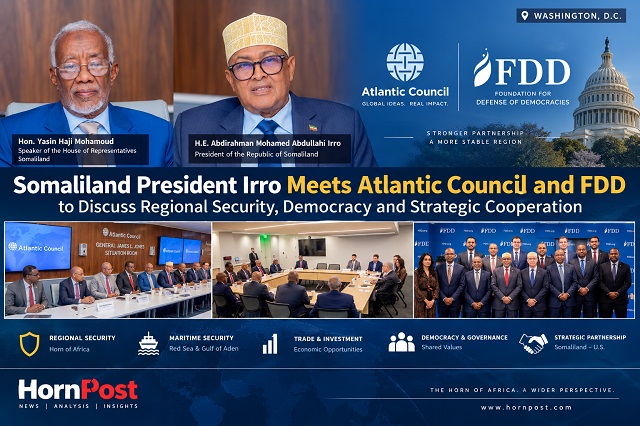
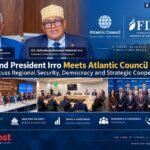
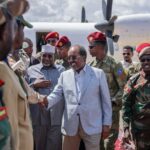
WASHINGTON, D.C. (HornPost) —President of the Republic of Somaliland Abdirahman Mohamed Abdullahi Irro met with experts and senior officials from the Atlantic Council and the Foundation for Defense of Democracies (FDD) in Washington, D.C., as his government seeks to deepen strategic engagement with the United States.
According to the Somaliland presidency, the discussions focused on security and stability in the Horn of Africa and the Gulf of Aden, maritime security, international trade and opportunities to strengthen strategic cooperation between Somaliland and the United States.
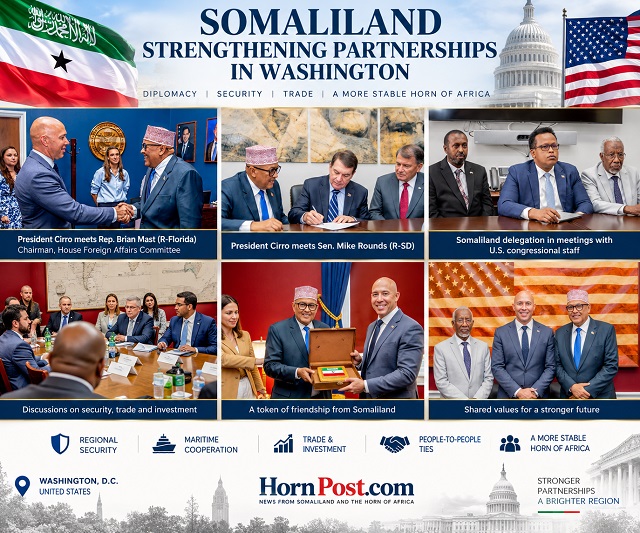
The meetings formed part of Irro’s broader Washington visit, which has included engagements with U.S. lawmakers and policy institutions. His delegation has been promoting Somaliland’s strategic position along the Gulf of Aden and its potential role in regional maritime security.
Irro Highlights Somaliland’s Democratic Record
During the meetings, Irro emphasized Somaliland’s political system, highlighting what his administration described as a record of competitive elections, peaceful political transitions and public participation in governance.
The president also pointed to Somaliland’s constitutional institutions and argued that the territory’s experience demonstrates how democratic governance, political stability and functioning state institutions can contribute to regional security and development.
“Somaliland has spent more than three decades building a state based on the will of its people, democracy, free elections and peaceful political transitions,” Irro said in a message posted on his official Facebook page.
He said Somaliland’s experience shows that democracy, statehood and stability can reinforce one another and serve as foundations for peace and development in the wider region.
Somaliland has held multiple elections since declaring that it had restored its independence from Somalia in 1991. The territory operates its own executive, legislature, judiciary, security forces and currency, while Somalia and most of the international community continue to regard Somaliland as part of Somalia.
Berbera Port and Red Sea Security
A central element of Irro’s message in Washington was Somaliland’s geographic location and the strategic importance of Berbera Port.
Located on the Gulf of Aden, Berbera sits close to one of the major maritime corridors connecting the Indian Ocean with the Red Sea and the Suez Canal. The wider region has gained increased international attention amid disruptions to commercial shipping and broader security tensions around the Red Sea.
Irro said Somaliland was prepared to work with the United States and its partners on maritime security, regional stability, trade and investment.
“Somaliland is ready to work with the United States and its partners on maritime security, regional stability, trade and investment,” he said.
The president’s emphasis on Berbera also reflects Somaliland’s broader effort to present the port as an economic and strategic asset. Berbera has undergone major infrastructure development and has become an important component of Somaliland’s plans to expand regional trade and attract international investment.
A Broader U.S.-Somaliland Strategic Relationship
The Washington meetings come as Somaliland seeks to expand its relationship with U.S. policymakers and foreign-policy institutions.
The Atlantic Council is a Washington-based international affairs think tank whose work includes security, geopolitics and transatlantic relations. FDD is a Washington-based policy institute focused on national security and foreign policy.
Engagement with such institutions provides Somaliland an opportunity to present its security and foreign-policy priorities to analysts and policymakers who contribute to debates in Washington.
The meetings also come during a period of heightened international attention to the Horn of Africa and Red Sea. Maritime security, competition among regional powers and the protection of international shipping routes have become increasingly important elements of U.S. policy discussions concerning the region.
Somaliland Presents Itself as a Potential U.S. Partner
Irro used the Washington meetings to frame Somaliland as a potential strategic partner rather than solely as an entity seeking diplomatic recognition.
In his statement, the president said Somaliland was sending Washington a clear message that it has functioning institutions, a democratic political system and a strategic geographic position.
“Somaliland today is sharing a clear message with Washington: We are a democratic, stable country with functioning institutions, located in a strategic position,” Irro said.
He added that Somaliland was seeking cooperation based on trust, shared interests and shared responsibility.
The meetings did not result in any publicly announced formal agreement between Somaliland and the United States.
Instead, they represent another round of diplomatic and policy engagement during Irro’s Washington visit, which has included meetings with U.S. lawmakers and appearances before American policy audiences.
For Somaliland, the strategy combines several priorities: expanding diplomatic engagement, strengthening security cooperation, attracting investment and emphasizing the territory’s role in the security of the Gulf of Aden and Red Sea.
The latest meetings with the Atlantic Council and FDD add another dimension to that campaign by putting Somaliland’s strategic and democratic arguments before influential U.S. foreign-policy audiences.
Prepared by:
HornPost staff
info@hornpost.com