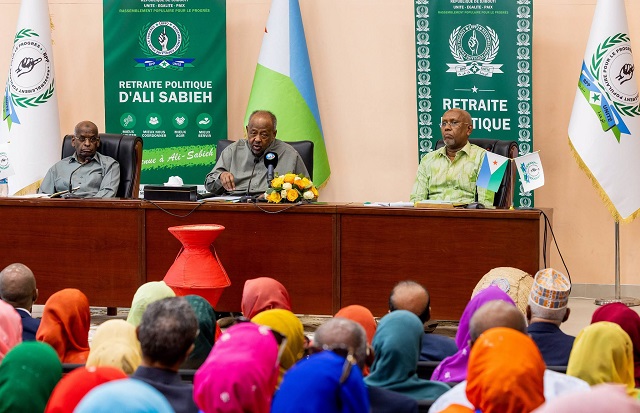
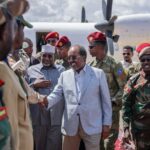
DJIBOUTI CITY, Djibouti (HornPost)— The Intergovernmental Authority on Development (IGAD) Council of Ministers opened its 74th Extraordinary Session in Djibouti on Tuesday, bringing together foreign ministers and senior representatives from member states to discuss regional peace, security, humanitarian challenges and the future of regional cooperation.
The high-level meeting, held on Sept. 15 in Djibouti City, comes as the Horn of Africa continues to face a complex combination of armed conflicts, political tensions, humanitarian pressures and economic challenges.
IGAD Council Opens 74th Extraordinary Session in Djibouti as Horn of Africa Faces Regional Challenges
IGAD said the session is focused on reviewing developments affecting peace and security across the region and strengthening collective responses among member states. The organization had announced ahead of the meeting that ministers would also consider institutional matters, including implementation and strengthening of the IGAD Treaty.
Regional peace and security at the center of talks
Peace and security are expected to remain among the main issues before the Council as IGAD members assess conflicts and political developments across the Horn of Africa.
The organization has increasingly sought to coordinate regional responses to crises that cross national borders, including armed conflicts, displacement, food insecurity and other humanitarian emergencies.
The Council provides a platform for member states to exchange views, develop common positions and coordinate diplomatic and regional responses to issues affecting stability in the region.
The meeting is being held at a critical time, with humanitarian and security concerns placing additional pressure on governments and regional institutions.
Recent reporting from the session said IGAD Executive Secretary Dr. Workneh Gebeyehu highlighted the scale of the humanitarian situation facing the region and stressed the need for urgent collective action. citeturn1search10
Sudan and humanitarian crisis
The continuing conflict in Sudan is expected to feature prominently in discussions over regional peace and security.
Sudan has been at the center of one of the Horn of Africa’s most severe humanitarian emergencies, with the conflict generating large-scale displacement and placing additional pressure on neighboring countries.
IGAD has previously played a role in regional diplomatic efforts aimed at supporting peace processes and addressing the humanitarian consequences of conflicts in the region.
The organization’s current focus on collective action reflects the interconnected nature of the crises facing the Horn of Africa, where instability in one country can have consequences for neighboring states through refugee movements, trade disruptions and security threats.
Somalia, South Sudan and wider regional stability
The Council’s discussions also come as IGAD continues to engage on political and security developments in Somalia and South Sudan.
Somalia’s Foreign Minister Abdisalam Abdi Ali participated in the 74th Extraordinary Session in Djibouti, according to Somalia’s state news agency. The meeting is addressing regional peace and security, institutional reform and shared priorities among IGAD members.
South Sudan’s Foreign Minister James Pitia Morgan also attended the meeting in Djibouti, joining counterparts from across the region.
For IGAD, maintaining diplomatic engagement among member states remains a central part of its mandate as the organization seeks coordinated approaches to conflicts, political transitions and humanitarian challenges.
IGAD Treaty and institutional reform
Beyond immediate security concerns, ministers are also discussing institutional issues related to the implementation and strengthening of the IGAD Treaty.
The Council of Ministers is one of IGAD’s principal policy organs. It brings together ministers designated by member states, primarily foreign ministers, to provide strategic direction and coordinate collective action.
According to IGAD, the Council reviews political, security, humanitarian and development matters; recommends strategic priorities to the Assembly of Heads of State and Government; oversees implementation of decisions; and provides guidance to the Secretariat.
The institutional discussions are therefore significant for the organization’s ability to respond to changing regional priorities and coordinate joint initiatives.
Djibouti’s role in regional diplomacy
Djibouti is hosting the ministerial session as IGAD continues to use the country as a center for regional diplomatic engagement.
The country’s strategic position near the Red Sea and Gulf of Aden has made Djibouti an important venue for discussions involving the Horn of Africa, maritime security and regional cooperation.
The 74th Extraordinary Session provides another opportunity for IGAD members to coordinate their positions on challenges that affect both the Horn of Africa and the wider Red Sea region.
Communiqué expected
IGAD said the Council is expected to issue a communiqué outlining the outcomes and decisions of the meeting.
The final document could provide further details on the ministers’ positions regarding regional peace and security, humanitarian concerns, institutional priorities and the implementation of the IGAD Treaty.
The outcome will be closely watched by governments, regional organizations and international partners seeking greater coordination on the Horn of Africa’s political and security challenges.
For IGAD, the central challenge remains translating political commitments into coordinated action capable of improving peace, stability and prosperity across the region.
The 74th Extraordinary Session therefore comes at a pivotal moment for the regional bloc, as member states confront interconnected security, humanitarian and institutional challenges that require sustained regional cooperation.
Prepared by:
Horn post staff
info@hornpost.com
www.hornpost.com
HARGEISA, Somaliland