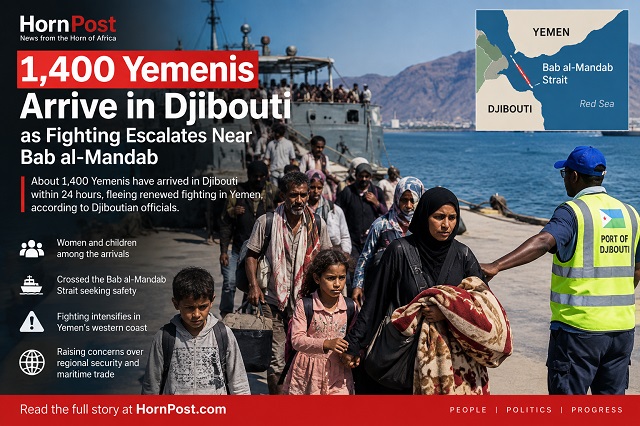
DJIBOUTI CITY, Djibouti (HornPost) About 1,400 Yemenis arrived in Djibouti within 24 hours after fleeing renewed fighting in Yemen, Djiboutian officials said Sunday, as escalating violence along Yemen’s western coast raised fresh concerns about security around the strategic Bab al-Mandab Strait.
Djibouti’s Economy and Finance Minister Ilyas Moussa Dawaleh said on social media that about 1,400 Yemeni refugees had arrived in the country during the 24-hour period. The latest arrivals include women and children seeking safety from the conflict across the narrow waterway separating Yemen from the Horn of Africa.
The arrivals were reported in the northern Djiboutian coastal area of Obock, one of the country’s main entry points for people crossing from Yemen. Obock lies directly across the Bab al-Mandab Strait from Yemen and has previously received large numbers of Yemenis fleeing war and economic hardship.
The new influx comes as fighting between Houthi forces and forces aligned with Yemen’s internationally recognized government has intensified after years of relative calm following a U.N.-backed truce.
Fighting raises fears over Red Sea security
The conflict in Yemen has broader implications because of the country’s location along the Red Sea and its proximity to one of the world’s most important maritime chokepoints.
The Bab al-Mandab Strait connects the Red Sea with the Gulf of Aden and serves as a critical passage for ships traveling between the Indian Ocean, the Suez Canal and European markets. Millions of barrels of oil and large volumes of commercial goods pass through the wider Red Sea shipping corridor each year.
Any prolonged disruption around the strait could increase shipping costs, delay deliveries and put additional pressure on already vulnerable regional economies.
The latest fighting has also raised concerns about the safety of civilians living along Yemen’s western coastline. Years of conflict have already left Yemen facing one of the world’s largest humanitarian crises, with millions of people dependent on humanitarian assistance.
The International Organization for Migration has reported a significant increase in displacement inside Yemen in recent months, with tens of thousands of people forced from their homes as fighting and insecurity spread.
For civilians living close to the coast, crossing the Bab al-Mandab to Djibouti can represent one of the few available routes to safety.
Djibouti faces new humanitarian pressure
Djibouti, despite its relatively small population and limited territory, has played an important role in responding to displacement from Yemen.
The country has hosted Yemeni refugees since the conflict escalated in 2015. Its geographical position makes it one of the closest safe destinations for people fleeing Yemen by sea.
The arrival of another 1,400 people in a single day, however, could place additional pressure on local authorities, humanitarian organizations and communities in the Obock region.
New arrivals require temporary accommodation, food, water, medical assistance and protection services. Women, children and other vulnerable people can face additional risks during dangerous sea crossings and after arriving in an unfamiliar country.
Djiboutian authorities and international humanitarian agencies are therefore likely to face growing demands if the latest escalation continues.
The situation also highlights Djibouti’s strategic importance in the Horn of Africa. The country sits at the entrance to the Red Sea and hosts major commercial ports as well as military facilities operated by several international powers.
Its location has made Djibouti a central hub for international maritime security operations, humanitarian activities and regional diplomacy.
Impact on regional trade
The developments in Yemen are being closely watched by governments and shipping companies across the Horn of Africa.
Djibouti’s economy is heavily linked to port activity and regional trade. Its ports serve not only Djibouti but also landlocked Ethiopia, one of Africa’s most populous countries.
Any deterioration in security around Bab al-Mandab could therefore have consequences far beyond Yemen and Djibouti.
Shipping companies could face higher insurance premiums and increased operating costs if vessels are forced to avoid dangerous areas. Longer alternative routes around the southern tip of Africa can add significant time and fuel costs to journeys between Asia and Europe.
The effects could eventually reach consumers through higher prices for imported food, fuel and manufactured goods.
The crisis also has implications for Somalia, Somaliland and Eritrea because all three are located along the Gulf of Aden and western Indian Ocean approaches to the Red Sea.
A wider regional security concern
The renewed violence comes at a sensitive time for the Horn of Africa and the wider Red Sea region.
Governments in the region are already dealing with political tensions, armed conflicts, displacement and economic pressures. The continued instability in Yemen adds another layer to those challenges.
For Djibouti, the immediate priority is managing the humanitarian consequences of the new arrivals while maintaining security along its coastline.
For international organizations, the focus will be on helping displaced Yemenis and monitoring whether the flow of refugees increases in the coming days.
The latest arrivals also serve as a reminder that instability on one side of the Bab al-Mandab can quickly affect communities and economies on the other side.
If fighting continues to intensify along Yemen’s western coast, Djibouti could see further arrivals, while regional governments and international shipping operators will closely monitor developments around the strategic waterway.
The Bab al-Mandab remains one of the world’s most important links between the Red Sea and the Indian Ocean. Continued instability there could have humanitarian consequences for Yemenis while also creating wider economic and security risks for the Horn of Africa and international trade.
Prepared by
Hornpost staff
info@hornpost.com
www.hornpost.com