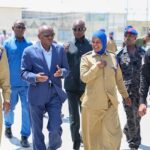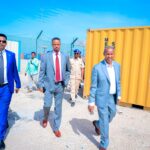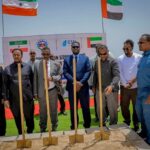



MOGADISHU, Somalia —(HornPost) — Somalia President and Commander-in-Chief Hassan Sheikh Mohamud has inspected the headquarters of the First Division of the Gorgor Commando Brigade, highlighting the government’s continued emphasis on strengthening elite military units as Somalia prepares its forces for counterterrorism operations.
According to the Somali government, Hassan Sheikh visited the Gorgor headquarters in Mogadishu, where he received briefings from military commanders and officers and met members of the 21st Gorgor Brigade, who recently completed advanced military training.
The president also inspected the command offices, soldiers’ facilities, the unit’s hospital and logistics centers. He was briefed on the condition of the troops, the services available to them and their operational readiness.
Hassan Sheikh praised the Gorgor forces for their role in Somalia’s security operations and in the fight against al-Shabaab, which the Somali government routinely refers to as Khawaarij. He instructed the troops to maintain a high level of readiness and fulfill their constitutional responsibilities.
The visit comes as Mogadishu seeks to build a more capable national army and gradually increase the ability of Somali forces to conduct operations with less dependence on international security missions.
The president also specifically thanked the government and people of Türkiye for their continuing support for the rebuilding, training and professionalization of the Somali National Army, particularly the development of specialized units such as Gorgor.
Turkey’s central role in building Gorgor
Turkey has become one of Somalia’s most important military partners over the past decade.
Ankara’s modern relationship with Mogadishu accelerated after then-Prime Minister Recep Tayyip Erdoğan’s historic visit to Somalia in August 2011, when Turkey expanded humanitarian and development assistance to the country. Turkey’s Foreign Ministry says Turkish humanitarian and technical assistance to Somalia has since exceeded $1 billion.
The security relationship later developed into a major military partnership.
In September 2017, Turkey opened its largest overseas military training facility in Mogadishu. The facility, commonly known as TURKSOM, was designed to train thousands of Somali soldiers and became a central institution in Ankara’s effort to help rebuild Somalia’s national security forces.
Gorgor has been one of the principal beneficiaries of that partnership. Turkish-trained Gorgor commandos have been deployed in Somalia’s counterterrorism campaign, including operations against al-Shabaab. Turkey has continued to train and equip Somali elite forces, while Somali officials have repeatedly described Ankara as a strategic security partner.
The partnership has also expanded beyond training.
In February 2024, Somalia and Türkiye signed a 10-year Defense and Economic Cooperation Framework Agreement under which Turkey committed to help build, train and equip the Somali navy and strengthen maritime security along Somalia’s coastline. The agreement deepened an already extensive defense relationship.
A partnership facing a new political test
The president’s praise for Turkey comes at a sensitive moment for Ankara’s relationship with parts of Somali society.
In early September, protests erupted in Gedo region and other parts of Jubaland following an explosion at the residence of former Somali Custodial Corps commander Gen. Mahad Abdirahman Aden, widely known as Gen. Shub, in Doolow.
Jubaland officials and supporters of the general alleged that the incident involved a Turkish military aircraft. The Federal Government of Somalia rejected that interpretation, saying preliminary information indicated that explosives being prepared inside the house caused the blast and announcing that an investigation would be conducted.
The dispute quickly developed into a broader political controversy.
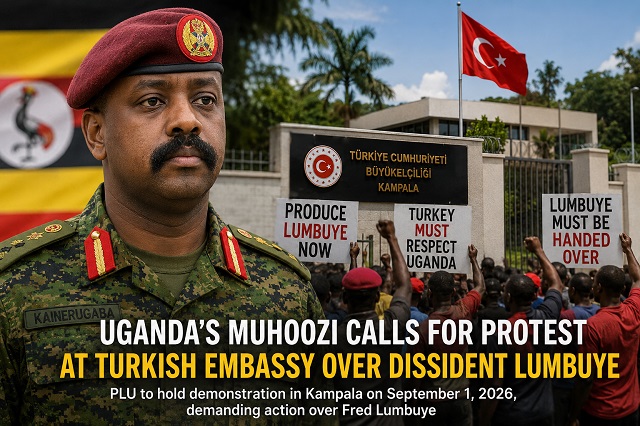
Reports from Gedo and Jubaland said protesters carried Turkish flags to express opposition to Ankara’s alleged involvement, while some demonstrators burned Turkish flags. An independent regional assessment by the FIKIR Institute described the protests as occurring in several Jubaland towns and linked the demonstrations to growing accusations that Turkey was becoming involved in Somalia’s internal political disputes.
The symbolism is significant.
For years, Turkey has cultivated an image in Somalia as one of the country’s most reliable international partners, combining humanitarian assistance, infrastructure projects, education, health services and military support.
The public burning of Turkish flags represents a sharp contrast with that image and suggests that Turkey’s increasingly prominent security role is becoming politically contested in some parts of Somalia.
It would, however, be premature to interpret the protests as evidence of a nationwide rejection of Turkey. The demonstrations were concentrated in areas affected by Somalia’s broader federal-regional political tensions, particularly Jubaland. They also followed a highly disputed security incident whose circumstances remain contested.
Ankara denies political interference
The controversy comes after Turkey itself rejected accusations earlier this year that its military presence was being used to influence Somalia’s internal political affairs.
In May, Turkish authorities dismissed allegations that Ankara was supporting particular Somali political actors, saying Turkey’s military activities were focused on restructuring the Somali National Army, strengthening security institutions and improving counterterrorism capabilities.
Ankara said its personnel had no involvement in Somalia’s electoral or domestic political processes.
That distinction is increasingly important for Turkey.
As Ankara’s military footprint has expanded, its relationship with Somalia is no longer limited to conventional training assistance. Turkey has become an important actor in Somalia’s defense architecture, maritime security and military modernization.
That gives Ankara considerable influence — but it also creates political exposure.
The strategic value of Turkey to Mogadishu
For the Federal Government, the advantages of the relationship remain substantial.
Somalia needs trained personnel, military equipment, command structures and logistics capabilities as it attempts to build a national security force capable of taking over responsibilities previously carried by international forces.
Gorgor is particularly important because elite units can provide the government with forces capable of conducting offensive and specialized operations against al-Shabaab.
Turkey also offers Somalia something that many international partners do not: a long-term military training infrastructure inside the country.
The establishment of TURKSOM has allowed Ankara to train successive generations of Somali soldiers and commanders. Turkish-supported Gorgor units have therefore become part of a broader effort to create a national military institution rather than simply supply temporary foreign assistance.
That model is strategically valuable for Mogadishu.
But it also means that any controversy involving Turkish military assets can quickly become a controversy involving the Somali government’s own security strategy.
Gorgor and the question of national military autonomy
Hassan Sheikh’s visit therefore carries significance beyond a routine inspection.
The president was not simply visiting a military headquarters. He was reinforcing the importance of a specialized force at the center of Somalia’s effort to create a stronger national army.
The challenge is whether Somalia can transform foreign-supported units into genuinely national institutions whose legitimacy extends across the country.
That question is especially important because Somalia’s political structure remains highly decentralized, with federal and regional authorities sometimes disagreeing over security, elections, constitutional issues and the use of military force.
A national army can only become truly national if communities and regional administrations view it as accountable to national institutions rather than as an instrument of one political faction.
This is where Turkey’s role becomes complicated.
Ankara can help Somalia build military capacity, but the political legitimacy of that capacity ultimately depends on how Somali institutions use it.
A broader shift in Turkey-Somalia relations
The timing is also notable because Somali officials are publicly describing the relationship with Turkey as entering a new strategic phase.
On Sept. 10, Somalia’s information minister argued that strategic communication and countering disinformation should become a new component of the Türkiye-Somalia partnership, reflecting the government’s concern about narratives surrounding Ankara’s role in the country.
That development illustrates the changing nature of the relationship.
Turkey is no longer simply a donor, humanitarian partner or military trainer. It has become an important geopolitical actor in Somalia, with interests spanning defense, maritime security, infrastructure, agriculture and economic cooperation.
The deeper the relationship becomes, the more closely Turkey’s actions will be scrutinized by Somali political actors and communities.
For Mogadishu, the immediate priority remains strengthening the national army and defeating al-Shabaab. For Turkey, the challenge is maintaining its influence while avoiding the perception that its military capabilities are being used to shape Somalia’s internal political competition.
What comes next
The Gorgor visit underscores President Hassan Sheikh’s continued reliance on specialized forces as Somalia seeks to strengthen its security institutions.
But the protests in Gedo offer a warning that military partnerships can carry political costs.
The government’s official position remains that Turkey is a strategic partner and a major contributor to Somalia’s military reconstruction. Ankara maintains that its military presence is designed to strengthen Somalia’s security institutions rather than interfere in domestic politics.
The dispute surrounding Doolow, however, shows how quickly that distinction can become blurred when foreign military capabilities are alleged to have been used in a politically sensitive area.
For Somalia, the long-term test will be whether foreign assistance can help create security institutions that are capable, professional and broadly trusted.
For Turkey, the test will be whether it can maintain one of its most important partnerships in Africa without becoming identified with Somalia’s increasingly contested domestic political struggles.
The future of the Gorgor force may therefore depend not only on the quality of its Turkish training, but also on the credibility, accountability and national legitimacy of the institutions that command it.
Prepared by:
Horn post staff
MOGADISHU, Somalia
Horn post staff
Horn Post Staff is a team of professional journalists and editors responsible for researching, writing, and publishing accurate, timely, and independent news coverage on HornPost.com. The team includes reporters based in Hargeisa, Mogadishu, Addis Ababa, and Nairobi, World, Africa, and middle east providing on-the-ground reporting and regional insights. Horn Post covers developments across Somaliland, Somalia, Ethiopia, Djibouti, and the wider Horn of Africa, as well as major global news. All reporting is fact-based and produced in line with the organization’s editorial standards for accuracy, fairness, and independence. Articles published under the byline “Horn Post Staff” represent collaborative newsroom work or reports filed by correspondents whose individual bylines may not be used on the website. Abdikarim Saed Salah is the Editor and Founder of Horn Post, overseeing editorial direction, standards, and content across the platform.