Hargeisa, Somaliland (HornPost) The Analogy
Building a house is relatively simple compared with building a state. Yet even the simplest house requires a site, ownership, measurements, a design, a blueprint, materials, builders and an inspector.
Before the first brick is laid, someone has to answer a basic question:
What are we building?
And before anything else:
Who owns it?
If the house belongs to the people, then the people are not merely occupants. They are the owners. They have a right to know what is being built, where it is being built and who is designing it.
The architect designs.
The builder constructs.
The inspector checks.
The occupant moves in.
These are different responsibilities.
A politician may become president, minister or member of parliament. He may occupy the most powerful room in the building. But an occupant is not an architect.
And an occupant certainly does not become the owner simply because he has acquired the keys to one of the rooms.
This distinction matters enormously when examining Somalia’s federal system.
Who Designed the Somali House?
Building a state is infinitely more complicated than building a house.
An architect considers the entire structure. He thinks about the foundations, walls, doors, load-bearing structures and how one part of the building affects another.
An occupant naturally thinks differently.
He wants his room.
He wants the key.
He wants the furniture arranged according to his preferences.
And if an occupant is allowed to redesign the house every time he changes his mind, sooner or later the structure itself is placed at risk.
This is where Somalia’s federal experiment deserves a harder look.
Who designed the Somali house?
Who drew the blueprint?
Who decided where the walls should stand?
Who determined which rooms belong to the center and which belong to the states?
Who decided where the doors should be placed?
And most importantly:
Were the owners properly consulted?
Not merely politicians.
Not merely government officials.
Not merely conferences of political elites.
Were ordinary Somalis systematically asked what kind of state they wanted?
Was there extensive national research and public consultation before the basic architecture of federalism was established?
Did the people choose the blueprint?
These are not merely academic questions.
They are questions of ownership.
If the people own the house, they have a right to know who designed it—and a right to object when someone begins changing its structure without their consent.
The Case of Puntland
This distinction becomes particularly important when we look at Puntland.
Puntland did not simply wait for Mogadishu to build a house for it.
In 1998, Puntland established its own autonomous administration, developing institutions of governance, security and public administration at a time when there was no effective central government exercising authority across Somalia.
In other words, Puntland built its house before the federal house at the center had been properly constructed.
It cleared its site.
It laid its foundations.
It put up its walls.
It installed its doors.
It developed institutions.
It created a political and administrative order of its own.
Then came the federal project.
The argument was that Somalia could be reconstructed as a federal state, with a central government and federal member states sharing constitutionally defined powers.
Fine.
But federalism does not mean that the center builds every room and then hands them out to the states.
Nor does it mean that once a state has built and administered its own institutions, the center automatically acquires the right to take control of them.
Federalism is supposed to define the relationship between the rooms.
It is supposed to tell us where the walls are, where the doors are and which occupant has authority over which part of the house.
This is where the present dispute becomes so revealing.
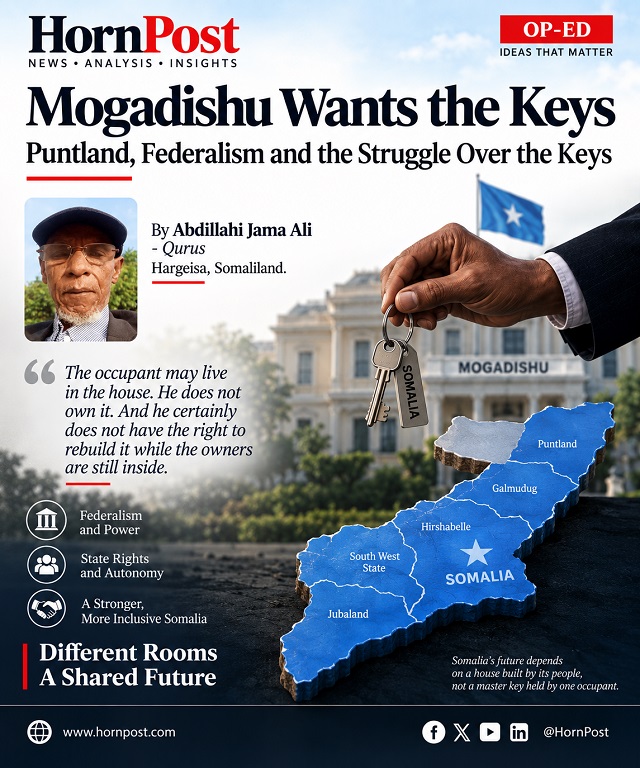
When Mogadishu Wants the Keys
Puntland has its own political institutions, security structures and administrative system. It has developed a political identity and governing order over decades.
Now imagine someone arriving from the central room and saying:
“Your doors are inconvenient. I will remove them.”
Then:
“Your walls are not arranged correctly. I will move them.”
And finally:
“I don’t like the color of your house. I will repaint it.”
Would that be federalism?
Or would it be centralization?
That is the question.
The center may argue that there must be one national constitutional order.
Of course there must.
But a national house does not require every room to be identical.
Federalism exists precisely because different parts of the country retain defined areas of authority within a common constitutional structure.
The door of Puntland’s room is therefore not necessarily a rejection of Somalia.
It is a protection against arbitrary intrusion.
The wall is not necessarily a wall against the nation.
It can be a constitutional boundary within the nation.
And the key is not necessarily a symbol of separation.
It is a symbol of jurisdiction.
The Problem With the Master Key
The danger begins when the occupant of the central room starts believing that because his room is larger, he has acquired the keys to everybody else’s rooms.
That is not federalism.
That is the logic of central government becoming central authority—and eventually central ownership.
The Federal Government of Somalia may occupy the central room, but occupation is not ownership.
The Somali people are the owners of the house.
The Constitution is supposed to be the blueprint.
The federal government is an occupant.
Puntland is an occupant of its own constitutional space.
Neither occupant owns the entire building.
And neither should be allowed to redesign the building unilaterally.
A functioning federation is not a house in which the center possesses a master key to every room.
It is a house in which every door has a constitutional lock—and even the occupant of the central room must respect it.
Who Has the Right to Remove the Doors?
This brings us back to the questions with which we began.
Who designed the Somali house?
Were the owners properly consulted?
Who decided how much authority should belong to Mogadishu and how much should belong to the states?
Who approved the doors?
Who approved the walls?
And who has the authority to remove them?
These questions cannot be settled simply because one politician happens to occupy the presidential room today.
Hassan Sheikh Mohamud will eventually leave that room.
Another politician will occupy it.
Then another.
Governments come and go.
Ministers come and go.
Parliaments come and go.
But Puntland will remain.
The federal states will remain.
And the Somali people—the owners—will remain.
That is why the issue should not be reduced to Hassan Sheikh Mohamud personally.
The deeper issue is whether the occupant of the center has begun behaving like the architect—and whether the center is gradually treating federalism as a house whose rooms it can redesign at will.
Puntland’s Message
Puntland’s message, in essence, is simple:
We built this room. We have lived in it. We have maintained it. We have our institutions. You cannot simply demand the keys. You cannot remove our doors and tell us that you are improving the house.
There is no single-key-holder theory in federalism.
A federation cannot function as a house where the center owns the master key to every room.
Its purpose is to establish boundaries of authority and provide a constitutional framework within which different levels of government can coexist.
The question is therefore not whether Somalia should have a national government.
It should.
The question is whether the national government should exercise authority within a constitutional framework or whether the framework itself can be repeatedly reshaped according to the preferences of whoever occupies the central government.
That is a fundamentally different question.
The Constitution Must Be Stronger Than the Occupant
A constitution is supposed to be stronger than the occupant.
A federal government is supposed to operate within the constitutional structure—not continually redraw that structure around itself.
The center is not the owner.
The states are not the owners either.
The Somali people are the owners.
And the political class is not the architect simply because it has occupied the building.
That is the distinction Somalia needs to recover.
Before arguing about who should occupy the house, Somalis should ask whether the house was properly designed.
Before fighting over who holds the keys, they should ask who owns the building.
Before an occupant starts removing doors, they should ask who gave him permission to change the structure.
Because there is a simple principle that applies to every house—and perhaps even more strongly to every state:
The occupant may live in the house.
He does not own it.
And he certainly does not have the right to rebuild it while the owners are still inside.
Author: Abdillahi Jama Ali – Qurus
abdillahijamac9@gmail.com
Hargeisa, Somaliland