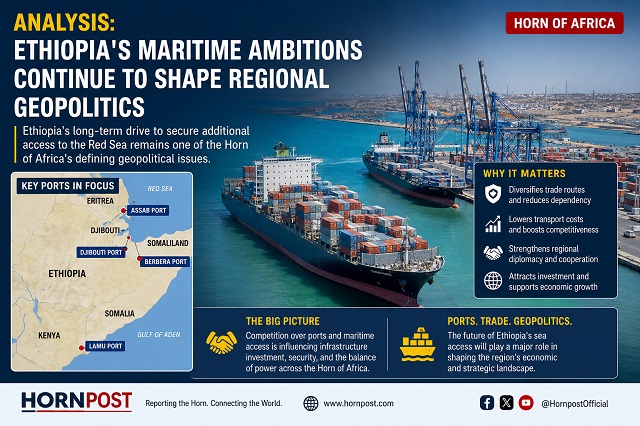
HARGEISA, Somaliland (Horn Post) Analysis: Ethiopia’s pursuit of additional access to the Red Sea is influencing regional diplomacy, infrastructure investment, security cooperation, and geopolitical competition across the Horn of Africa.
Analysis
Ethiopia’s long-term effort to secure reliable and diversified access to the Red Sea remains one of the most consequential geopolitical issues in the Horn of Africa. For Africa’s second-most populous nation and one of the continent’s largest economies, maritime access is not only an economic necessity but also a strategic priority that continues to shape regional diplomacy and infrastructure development.
As a landlocked country since Eritrea’s independence in 1993, Ethiopia depends heavily on neighboring states for access to international markets. Today, most of its imports and exports move through the Port of Djibouti, creating a high level of dependence on a single trade corridor.
Why Ethiopia Wants Additional Sea Access
Diversifying maritime access has become a key objective of Ethiopia’s economic strategy.
Expanding access to multiple ports could:
- Reduce transport costs.
- Strengthen supply chain resilience.
- Improve export competitiveness.
- Support industrial growth.
- Reduce dependence on a single maritime gateway.
For Addis Ababa, securing additional trade routes is increasingly viewed as essential to sustaining long-term economic growth.
Regional Ports at the Center of Competition
Several ports have become central to Ethiopia’s maritime strategy:
- Berbera Port (Somaliland) has emerged as an important alternative corridor linking Ethiopia to international markets through the Berbera Corridor.
- Djibouti Port remains Ethiopia’s principal maritime gateway and a critical logistics partner.
- Assab Port (Eritrea) continues to feature in regional discussions because of its geographic proximity, although there is currently no active agreement restoring Ethiopian commercial access.
- Lamu Port (Kenya) forms part of broader regional connectivity initiatives that could diversify trade options over the long term.
Each corridor offers different economic, political, and strategic opportunities.
A Diplomatic Challenge
Ethiopia’s maritime ambitions are closely linked to sensitive regional diplomacy.
Any discussions involving port access, infrastructure agreements, or logistics partnerships require careful coordination with neighboring countries and have implications for sovereignty, regional cooperation, and long-term stability.
Because the Horn of Africa remains one of the world’s most strategically important regions, maritime negotiations often attract international attention.
Strategic Importance of the Red Sea
The Red Sea and the Bab el-Mandeb Strait remain critical to global commerce.
A substantial share of international container traffic and energy exports passes through these waters every year.
As geopolitical competition intensifies, countries including the United States, China, the United Arab Emirates, Saudi Arabia, Turkey, and the European Union continue expanding their diplomatic, economic, and security engagement across the region.
This growing international interest further elevates Ethiopia’s search for diversified maritime access.
Economic Implications
For Ethiopia, improved maritime connectivity could:
- Lower logistics costs.
- Increase export capacity.
- Attract additional foreign investment.
- Support manufacturing and industrial parks.
- Improve regional trade integration.
However, progress depends on stable political relations, infrastructure investment, and mutually beneficial agreements with neighboring states.
Prepared by:
Horn Post Staff
info@hornpost.com
www.hornpost.com
HARGEISA, Somaliland