Hargeisa, Somaliland (Horn Post) Analysis: The Horn of Africa is emerging as one of the world’s most strategically contested regions, with Red Sea security, port investments, and great-power competition reshaping diplomacy, trade, and regional stability.
The Horn of Africa has evolved into one of the world’s most strategically significant regions, driven by its location along the Red Sea, expanding port infrastructure, and growing competition among global and regional powers.
As geopolitical tensions intensify across the Middle East and the Indo-Pacific, the region is increasingly viewed as a critical crossroads linking Africa, Europe, and Asia.
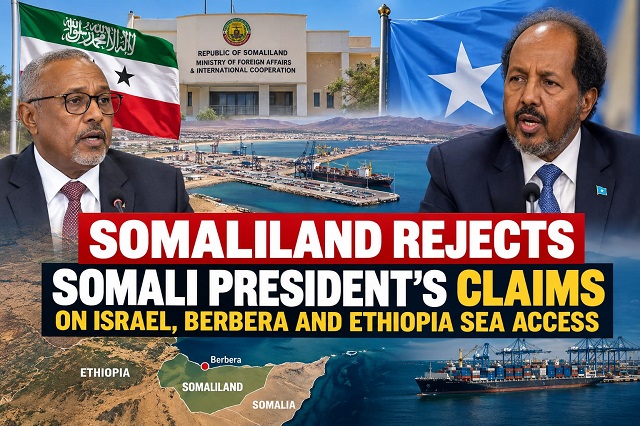
From Somaliland’s Berbera Port to Djibouti’s military and logistics hub, the Horn has become a focal point for diplomacy, trade, security cooperation, and infrastructure investment.
Red Sea: A Strategic Maritime Lifeline
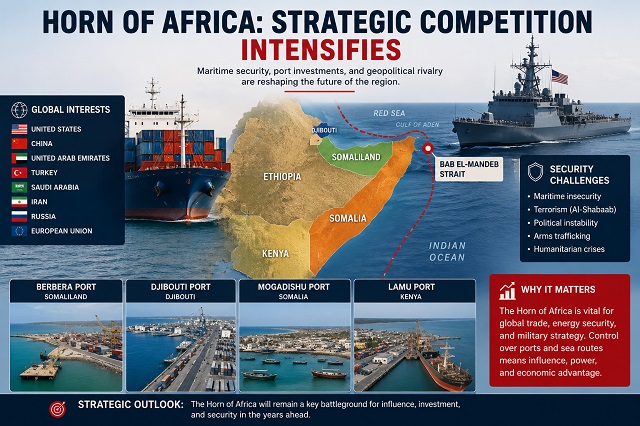
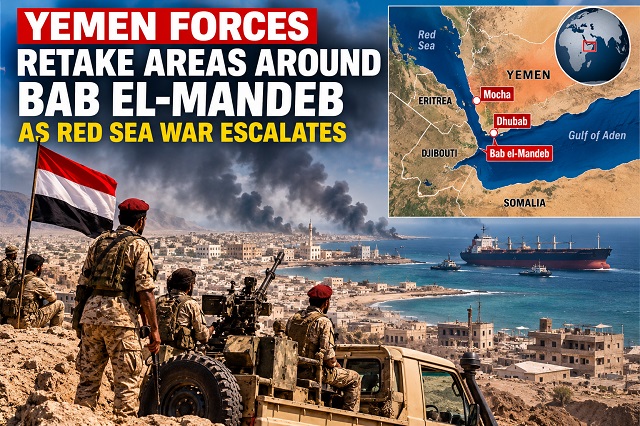
At the heart of the region lies the Bab el-Mandeb Strait, one of the world’s most important maritime chokepoints. The waterway connects the Red Sea with the Gulf of Aden and the Indian Ocean, serving as a gateway to the Suez Canal.
A substantial share of global container traffic, oil exports, and liquefied natural gas shipments passes through this corridor each year.
Any disruption—from regional conflict, attacks on commercial shipping, or political disputes—can rapidly increase freight costs, delay supply chains, and affect global energy markets.
As a result, securing freedom of navigation has become a strategic priority for governments and international shipping companies alike.
Ports Are No Longer Just Commercial Infrastructure
Across the Horn of Africa, ports have become strategic assets with geopolitical value extending far beyond trade.
- Berbera Port (Somaliland) is expanding into a regional logistics hub serving Ethiopia and the wider Horn of Africa.
- Djibouti Port hosts multiple foreign military bases while remaining one of Africa’s busiest transshipment centers.
- Mogadishu Port continues to modernize as Somalia seeks to strengthen economic recovery.
- Lamu Port (Kenya) is central to Kenya’s long-term transport and regional connectivity ambitions.
Competition over port investments increasingly reflects broader strategic interests, with governments seeking influence over trade corridors, supply chains, and regional connectivity.
Global Powers Are Expanding Their Influence
The Horn of Africa has become a meeting point for competing international interests.
The United States continues to prioritize counterterrorism cooperation, maritime security, and freedom of navigation.
China has strengthened its presence through infrastructure financing, commercial investments, and its overseas military base in Djibouti, supporting the Belt and Road Initiative.
The United Arab Emirates has invested heavily in ports, logistics, and transport infrastructure across the Red Sea corridor.
Turkey has expanded defense cooperation and political engagement, particularly in Somalia.
Saudi Arabia, Iran, and Russia are also seeking to expand their diplomatic, economic, and security influence as competition for access and partnerships intensifies.
This convergence of interests has transformed the Horn of Africa into one of the world’s most closely watched geopolitical theaters.
Ethiopia’s Maritime Ambitions Continue to Shape Regional Diplomacy
As Africa’s second-most populous country, Ethiopia remains heavily dependent on external ports for international trade.
Its long-term strategy to diversify maritime access has become a defining issue in regional diplomacy, influencing infrastructure projects, bilateral agreements, and political relations throughout the Horn of Africa.
Future negotiations over trade corridors and port access are expected to remain among the region’s most consequential geopolitical developments.
Persistent Security Challenges
Despite growing international investment, the Horn continues to face complex security threats, including:
- Maritime insecurity in the Red Sea.
- Terrorism linked to Al-Shabaab.
- Political instability.
- Civil conflicts and humanitarian crises.
- Arms trafficking and transnational crime.
- Threats to international shipping.
These challenges have reinforced the importance of multinational naval operations, intelligence sharing, and regional security cooperation.
Strategic Outlook
The Horn of Africa is no longer viewed solely through the lens of regional politics. It has become a global strategic arena where economic interests, military deployments, diplomatic partnerships, and infrastructure investments intersect.
As competition for influence continues to intensify, decisions made in Hargeisa, Mogadishu, Addis Ababa, Djibouti, Nairobi, Abu Dhabi, Washington, Beijing, and Ankara will increasingly shape the future of regional stability and international commerce.
For governments, investors, and policymakers, the Horn of Africa has become indispensable to the security of global maritime trade and the balance of power in the Red Sea.
Analysis | Horn post
Prepared by:
Horn Post Staff
info@hornpost.com
www.hornpost.com
HARGEISA, Somaliland