By Abdikarim Salah
Hargeisa, Somaliland (Horn Post) A recent policy paper published by Ethiopia’s Institute of Foreign Affairs (IFA) offers an important glimpse into how strategic thinking in Addis Ababa is evolving regarding Somaliland and the geopolitics of the Red Sea.
Although the paper does not represent an official policy statement by the Ethiopian government, it is significant because the IFA is a state-affiliated foreign policy think tank whose research often reflects ideas under discussion within Ethiopia’s diplomatic and security establishment.
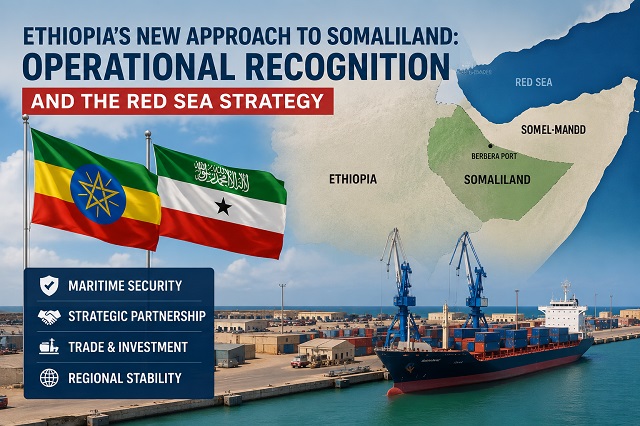
Rather than arguing directly for formal diplomatic recognition of Somaliland, the paper introduces a different concept: “Operational Recognition.” This approach suggests that Somaliland’s growing strategic importance should be measured not by whether it has received international recognition, but by the extent to which foreign governments engage with it through security cooperation, trade, infrastructure investment and maritime partnerships.
The paper argues that Somaliland has already become an active security and economic partner for regional and international actors, regardless of its unresolved political status.
Shifting the Recognition Debate
For decades, the central question surrounding Somaliland has been whether it would eventually receive formal international recognition.
The IFA paper attempts to redefine that debate.
Instead of asking whether Somaliland will be recognized, it asks whether international actors are already treating Somaliland as a functional partner in areas such as maritime security, logistics, trade and regional stability.
This marks a notable shift in narrative—from legal recognition to practical engagement.
Berbera at the Center of Ethiopia’s Strategic Vision
One of the paper’s strongest themes is the growing strategic value of Berbera Port.
Rather than portraying Berbera simply as a commercial gateway, the analysis presents it as an increasingly important component of the emerging security architecture of the Red Sea.
For landlocked Ethiopia, access to reliable maritime infrastructure has become a long-term national priority. The paper therefore frames cooperation with Somaliland as part of a broader strategy aimed at securing supply chains, diversifying port access and responding to growing geopolitical competition in the Red Sea corridor.
A Message Beyond Ethiopia
The analysis appears to target not only Ethiopian policymakers but also regional and international partners.
By emphasizing the Red Sea’s growing geopolitical importance, including maritime security challenges, global shipping routes and competition among major powers, the paper argues that Somaliland can no longer be ignored in discussions about regional security.
Its central message is that practical cooperation with Somaliland is likely to continue expanding, even in the absence of formal diplomatic recognition.
Somalia Remains a Political Constraint
The paper acknowledges that the Federal Government of Somalia continues to reject any arrangement that could be interpreted as recognizing Somaliland’s sovereignty.
However, it also argues that political disagreements need not prevent governments from pursuing operational partnerships with Somaliland where mutual strategic interests exist.
That position reflects a broader argument that functional cooperation and diplomatic recognition are separate issues.
What the Paper Really Signals
The IFA publication should not be interpreted as an announcement that Ethiopia is preparing to formally recognize Somaliland.
Instead, it represents an effort to reshape the policy conversation.
Its broader objective appears to be encouraging governments and international partners to evaluate Somaliland primarily through the lens of strategic utility rather than unresolved legal status.
If these thinking gains traction, Somaliland’s international engagement could continue expanding through security cooperation, trade agreements and infrastructure partnerships—even without formal recognition.
Whether this concept of “Operational Recognition” influences regional diplomacy remains to be seen. However, the publication suggests that at least within parts of Ethiopia’s foreign policy community, the debate is gradually moving beyond the traditional question of recognition toward Somaliland’s practical role in the evolving security and economic landscape of the Red Sea.
Prepared by:
Horn post staff
info@hornpost.com
www.hornpost.com
Hargeisa, Somaliland