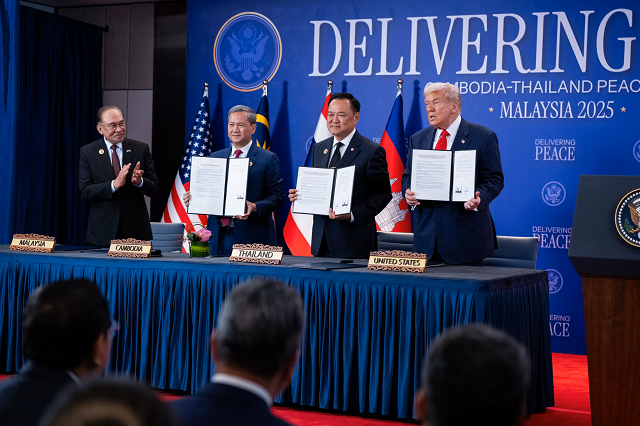
KUALA LUMPUR, Malaysia (HornPost) — U.S. President Donald Trump joined Malaysian Prime Minister Anwar Ibrahim in witnessing the signing of a joint declaration by Thailand and Cambodia on Oct. 26, 2025, as the two Southeast Asian countries sought to reduce tensions following deadly border clashes.
The agreement was signed by Thai Prime Minister Anutin Charnvirakul and Cambodian Prime Minister Hun Manet on the sidelines of the 47th Association of Southeast Asian Nations (ASEAN) Summit in Kuala Lumpur.
The declaration followed five days of fighting along the countries’ disputed border in July 2025. The clashes killed dozens of people and displaced hundreds of thousands of civilians, prompting diplomatic efforts involving Malaysia, the United States and China.
Trump said his administration had worked with regional leaders to persuade both countries to stop fighting and pursue negotiations.
The agreement marked a further step toward reducing hostilities, although it did not resolve the long-running territorial dispute between the neighboring countries.
Key Terms of the Agreement
Under the joint declaration, Thailand and Cambodia committed to reducing military tensions along their shared border.
The measures included withdrawing heavy weapons from border areas, strengthening cease-fire monitoring through an ASEAN observer mechanism and addressing border disputes through established bilateral channels.
The declaration also provided for Thailand to begin releasing 18 Cambodian soldiers held in custody, subject to the agreed implementation process.
Both governments committed to avoiding actions that could undermine the cease-fire and to pursuing peaceful solutions to outstanding border issues.
Malaysia played a central role in facilitating negotiations, with Anwar hosting talks between the two countries. The United States supported the diplomatic effort, including through Trump’s engagement with the two governments.
A Fragile Path to Peace
The agreement was presented by Trump and other leaders as an important diplomatic achievement. However, the document was formally titled a joint declaration, reflecting the continuing need for further negotiations and implementation.
The two countries have a longstanding dispute over sections of their approximately 817-kilometer land border. Questions of territorial sovereignty and border demarcation have repeatedly contributed to tensions.
Subsequent developments showed the limits of the agreement. Fighting resumed later, and the two governments continued to face challenges in maintaining a durable cease-fire.
The accord therefore represented a step toward de-escalation rather than a final settlement of the dispute.
For ASEAN, the agreement highlighted the regional bloc’s role in supporting dialogue and conflict management. For Washington, it also formed part of broader efforts to strengthen U.S. diplomatic and economic engagement in the Indo-Pacific.
The long-term impact of the agreement depends on whether Thailand and Cambodia can sustain the cease-fire, rebuild confidence and resolve their outstanding border disagreements through negotiations.
HornPost International Desk
info@hornpost.com
www.hornpost.com