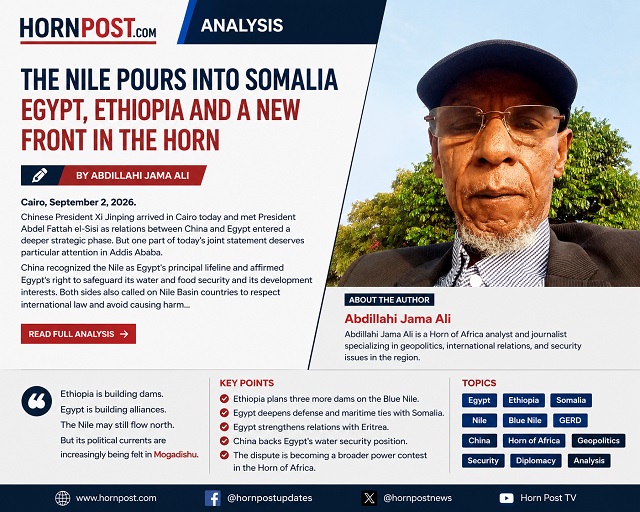
Cairo, Egypt — (HornPost) Chinese President Xi Jinping arrived in Cairo on Wednesday and met with Egyptian President Abdel Fattah el-Sisi as relations between China and Egypt entered a deeper strategic phase.
But one element of the two countries’ joint statement deserves particular attention in Addis Ababa: China’s position on the Nile and Egypt’s water-security concerns.
Beijing recognized the Nile as Egypt’s principal lifeline and affirmed Egypt’s right to safeguard its water and food security, as well as its development interests. China and Egypt also called on Nile Basin countries to respect international law and avoid causing harm.
China has not formally taken sides in the long-running dispute between Egypt and Ethiopia over the Nile. But the timing and language of the statement are significant.
The statement comes only months after Ethiopia announced plans to build three additional major dams on the Blue Nile — Karadobi, Mandaya and Beko Abo. The projects are expected to add approximately 5,700 megawatts of generating capacity, on top of the enormous power potential of the Grand Ethiopian Renaissance Dam (GERD).
For Egypt, the announcement represented a major escalation.
The GERD had already transformed the strategic balance between Cairo and Addis Ababa. Egypt spent years attempting to prevent Ethiopia from constructing the dam, but Ethiopia completed the project and inaugurated it in 2025.
Now Addis Ababa is effectively signaling that the GERD was not the end of Ethiopia’s ambitions on the Nile.
It was the beginning.
That is why Ethiopia’s announcement of three additional dams has once again intensified the dispute.
For Ethiopia, the argument is straightforward: the Blue Nile represents a major source of energy and economic development, and Addis Ababa insists on its right to utilize its natural resources.
For Egypt, however, the calculation is fundamentally different.
The Nile is not simply a development resource. It is the country’s principal source of freshwater and, therefore, a matter of national survival.
The disagreement has consequently moved beyond the question of a single dam.
It is increasingly becoming a contest over the future balance of power between Egypt and Ethiopia.
Ethiopia Builds Dams. Egypt Builds Alliances.
Unable to stop the GERD, Egypt has increasingly looked beyond the Nile itself.
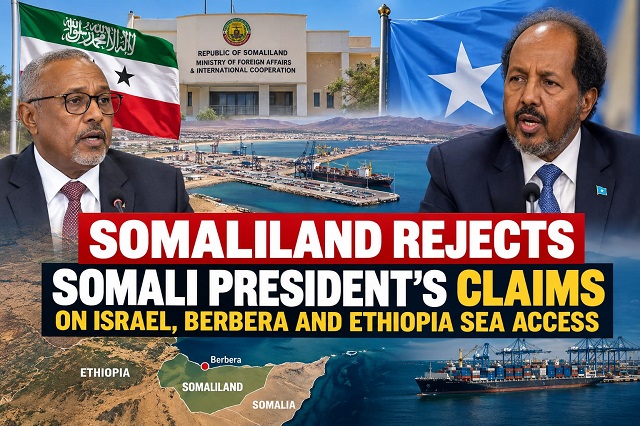
Its relationship with the Federal Government of Somalia has deepened considerably, particularly in the areas of defense and security. Egypt’s participation in the African Union’s mission in Somalia has brought Egyptian military involvement into Ethiopia’s immediate neighborhood.
Cairo has also expanded its cooperation with Mogadishu into the maritime sphere.
This is where the title of this analysis acquires its meaning.
The Nile dispute has not physically moved into Somalia. Its political consequences have.
Mogadishu has its own reasons for drawing closer to Cairo. Somalia has significant security needs and its own strategic disagreements with Ethiopia.
Egypt, for its part, gains a stronger relationship on Ethiopia’s eastern flank.
Neither country needs to describe this relationship as an alliance against Ethiopia for its strategic implications to be understood in Addis Ababa.
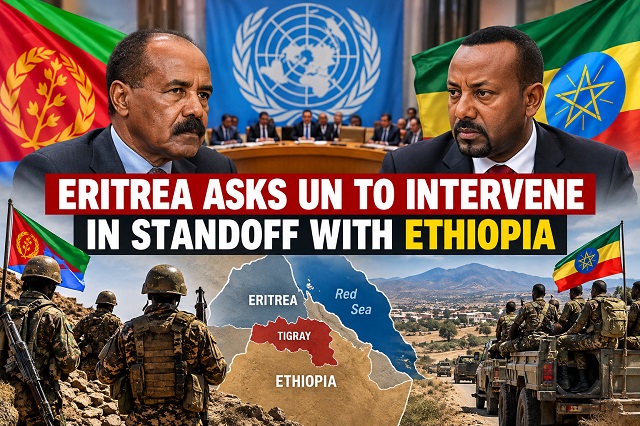
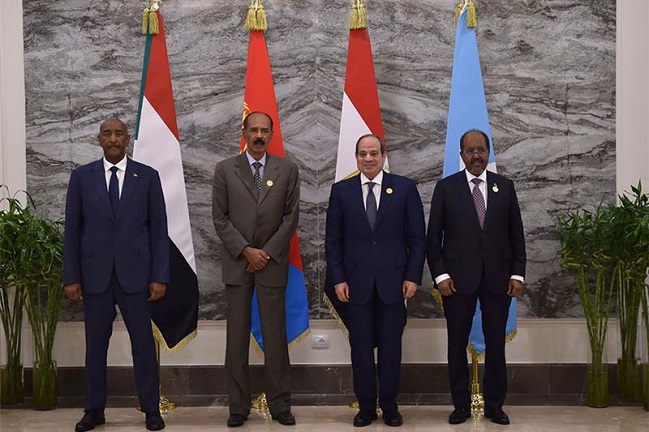
Egypt has also strengthened its relationship with Eritrea, another country bordering Ethiopia.
The result is that the Egypt-Ethiopia rivalry is no longer confined to negotiations over water. It is increasingly intertwined with the broader balance of power in the Horn of Africa.
This does not mean that every Egyptian relationship in the region is driven by the Nile dispute. Each country has its own national interests.
But the overlap is becoming increasingly difficult to ignore.
Ethiopia is simultaneously seeking economic development through the Nile and greater strategic freedom as a landlocked state.
Egypt, meanwhile, is seeking to ensure that Ethiopia’s growing economic strength does not translate into broader regional power.
That is the real tug of war.
China Enters the Picture
Xi Jinping’s visit to Cairo adds another important layer to the evolving strategic picture.
China has enormous economic and strategic interests in Egypt, particularly because of the Suez Canal and Egypt’s geographic position connecting Africa, the Middle East and global trade.
During Xi’s visit, China and Egypt also agreed to deepen security, economic and other forms of cooperation.
Against that backdrop, Beijing’s support for Egypt’s water-security position deserves close attention.
China also maintains important relations with Ethiopia. Beijing therefore has no obvious interest in allowing the Nile dispute to develop into an armed confrontation.
Nevertheless, the language of the China-Egypt statement gives Cairo an important diplomatic boost.
And Addis Ababa will have noticed.
The timing could hardly be more striking.
Ethiopia is planning three more dams.
Egypt is strengthening its regional partnerships.
China is deepening its strategic relationship with Cairo while publicly recognizing the exceptional importance of the Nile to Egypt.
The long-running Egypt-Ethiopia dispute is therefore entering a new phase.
From a Nile Dispute to a Horn of Africa Power Struggle?
The GERD changed the balance on the Nile.
The three proposed dams could change it further.
And Egypt’s response is increasingly extending beyond the river itself.
The strategic implications are becoming broader.
Ethiopia is using the Nile to pursue energy production and economic development while seeking greater strategic autonomy.
Egypt is responding not only through diplomacy over water but also by strengthening relationships across the Horn of Africa.
Somalia has its own security and strategic interests. Eritrea has its own relationship with Ethiopia. China has significant economic and strategic interests in both Egypt and Ethiopia.
These overlapping interests are creating a much wider geopolitical landscape around what began as a dispute over the management and use of Nile waters.
The central question now is whether the struggle over the Nile will remain primarily a dispute about water and development, or whether it will evolve into a much broader contest for political and strategic influence across the Horn of Africa.
For Egypt, the stakes extend beyond the volume of water flowing downstream. For Ethiopia, they extend beyond electricity generation and dam construction.
And for Somalia, the growing involvement of Egypt introduces another dimension to an already complex regional strategic environment.
The Nile may still flow north. But its political currents are increasingly being felt in Mogadishu.
Prepared by:
HornPost staff
info@hornpost.com
HARGEISA, Somaliland
Egypt, Ethiopia, Somalia, Nile, Horn of Africa, China,