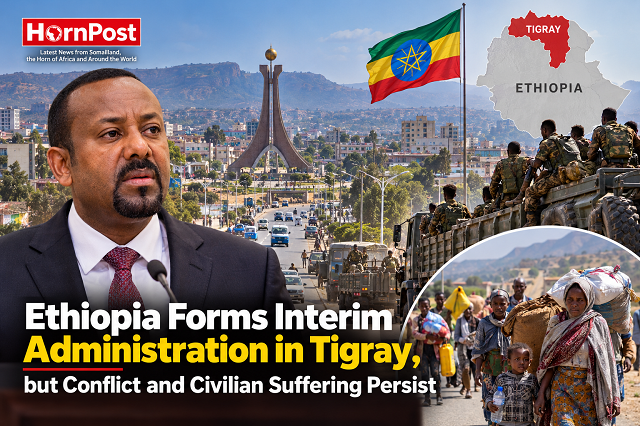
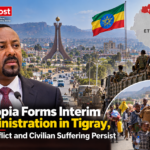
ADDIS ABABA, Ethiopia (HornPost) Ethiopia’s federal government has established a six-month interim administration in the northern Tigray region following renewed fighting, but the move does not mean the conflict has ended or that civilians can safely return to normal life.
The administration, announced by Prime Minister Abiy Ahmed’s office on Friday, is tasked with restoring public services, rebuilding damaged infrastructure, helping displaced residents return home and preparing for regional elections within six months.
The announcement followed the entry of government-aligned forces into Mekelle, Tigray’s regional capital, on October 4, after the Tigray People’s Liberation Front (TPLF) withdrew from the city. The renewed fighting has undermined the November 2022 peace agreement that ended a devastating two-year war.
However, the establishment of a new administration does not resolve the underlying political and security disputes. Analysts have cautioned that losing control of major towns does not necessarily mean armed resistance has ended, particularly in rural areas where fighters may regroup.
Civilians Face Uncertainty
For civilians in Tigray, the immediate concerns include security, access to essential services, displacement and the ability to return home safely.
The region is still recovering from the previous war, which caused widespread destruction and a severe humanitarian crisis. According to Reuters, approximately 750,000 people from Tigray remained internally displaced as of February 2026.
The new administration has promised to facilitate the return of displaced communities and restore services disrupted by conflict. Those commitments, however, will depend on security conditions, functioning public institutions and the availability of humanitarian assistance.
Human Rights Watch has also reported civilian casualties and the closure of health facilities amid shelling in southern Tigray, underscoring the risks facing communities as hostilities resume.
Former Fighters Seek a Return to Civilian Life
The renewed conflict has also complicated efforts to implement the disarmament and reintegration provisions of the 2022 peace agreement.
The Associated Press reported that hundreds of former combatants began registering in Mekelle for a program intended to help them return to civilian life. Authorities did not disclose the total number of people who had registered.
Some former fighters said they did not want to return to combat and instead wanted to support their families. Their efforts to reintegrate highlight the challenges of restoring stability after years of conflict and renewed military confrontation.
Regional Tensions Add to the Risks
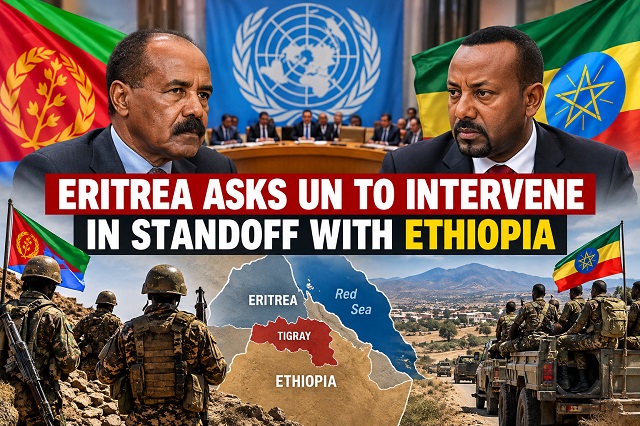
The situation in Tigray is unfolding alongside escalating tensions between Ethiopia and neighboring Eritrea.
Ethiopia has accused Eritrean forces of occupying parts of its territory and supporting armed opponents. Eritrea has rejected Ethiopia’s accusations and described Addis Ababa’s statements as a declaration of war. The competing claims have not been independently verified in full.
U.S. Secretary of State Marco Rubio has urged de-escalation, according to the Associated Press, as concerns grow that the tensions could lead to a wider regional confrontation.
A New Administration, but No Guaranteed Peace
The six-month interim administration faces a series of challenges: improving security, restoring essential services, addressing displacement and creating conditions for credible regional elections.
Its establishment marks a significant political development, but the durability of any progress will depend on whether fighting subsides, civilians are protected and the parties find a way to address their disputes.
For residents of Tigray, the key question is not only who administers the region, but whether the change brings lasting security, access to basic services and a realistic opportunity to rebuild their lives.
Sources: Associated Press, Reuters and Human Rights Watch.
Prepared by:
HornPost staff
info@hornpost.com
www.hornpost.com
ADDIS ABABA, Ethiopia