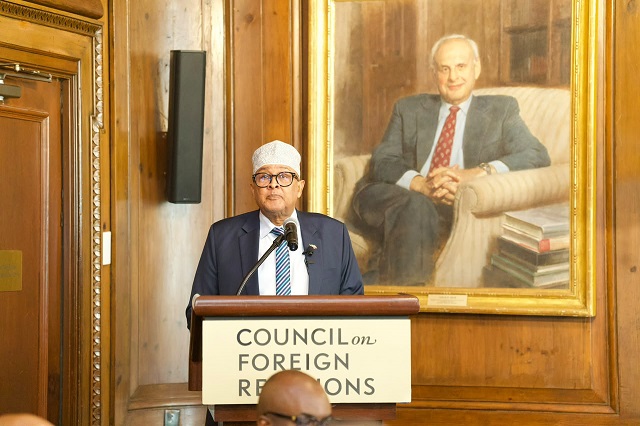
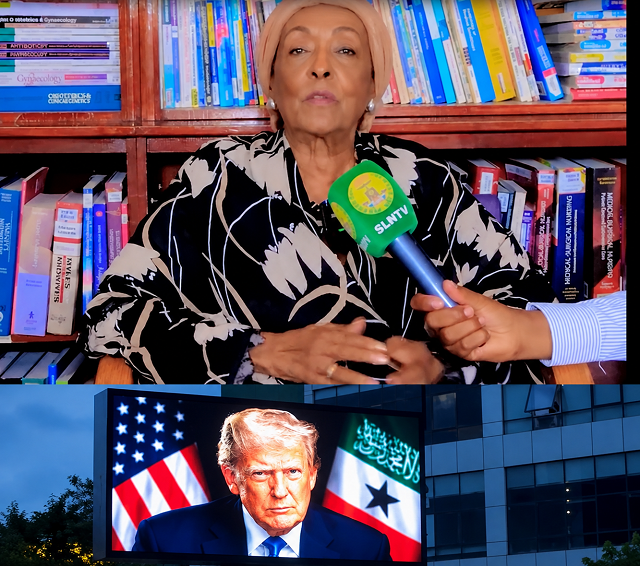
HARGEISA, Somaliland, (HornPost) Dr. Edna Adan Ismail, Somaliland’s former foreign minister and a prominent advocate for its international recognition, has congratulated U.S. President Donald Trump for describing Somaliland as distinct from Somalia, using the remarks to highlight the territory’s colonial-era boundaries, independence in 1960 and longstanding pursuit of sovereignty.
Speaking in English to local media in Hargeisa, Adan said she was pleased to hear Trump distinguish Somaliland from Somalia during a political rally in Ohio on Oct. 12. She argued that Somaliland’s historical experience, political institutions and territorial boundaries set it apart from its eastern neighbour.
“I was very happy to listen to a clip that was in one of the media in which I heard the President of the United States of America, President Donald Trump, mention the fact that Somalia and Somaliland are two different countries,” Adan said.
“I thank the President for that because this is the first time that the head of state has had the time to study and to get to know who Somalilanders are and how different Somalia and Somaliland.”
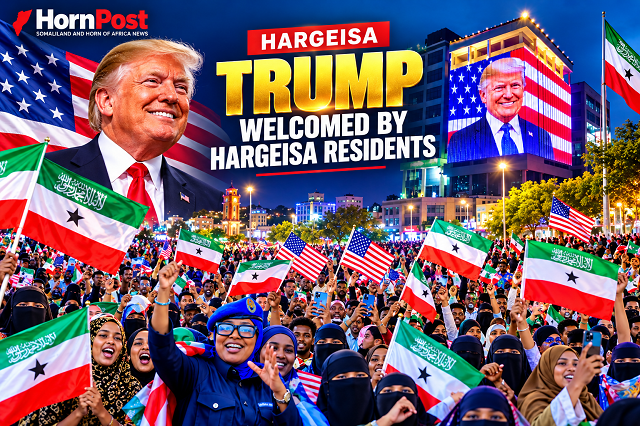
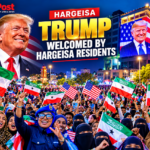
Trump described Somaliland as “a totally different country” from Somalia during the Ohio rally and suggested that it should change its name. His remarks prompted celebrations in Hargeisa and renewed calls from Somaliland officials and residents for Washington to formally recognize the territory’s independence. The comments were not, in themselves, a formal announcement of U.S. diplomatic recognition.
Adan’s message, delivered in English and shared on HornPost’s social media platforms, focused on the historical and legal arguments Somaliland has advanced in support of its claim to statehood.
Edna Adan Cites Colonial-Era Treaties in Somaliland Border Argument
Adan said Somaliland’s territorial boundaries were established through treaties involving Britain, France, Italy and Ethiopia during the colonial period.
She cited Anglo-Italian, Anglo-French and Anglo-Ethiopian agreements as part of the historical framework defining the boundaries of the former British Somaliland Protectorate.
“For those who have doubts, I would like to clarify that Somaliland was formerly British Somaliland Protectorate and its boundaries were defined according to international treaties,” she said.
Adan also compared Somaliland’s historical boundaries with those of neighbouring territories, including the former French Somaliland, now Djibouti, and the former Italian-administered territory of Somalia.
She argued that the boundaries established during the colonial period remained central to Somaliland’s claim to sovereignty and should not be altered through political disputes.
The former foreign minister said Somaliland’s borders were legally established and that its government had consistently maintained that its territorial claim rests on the boundaries it inherited at independence.
Somaliland’s government has similarly argued that its borders correspond to those of the former British protectorate and that its declaration of restored sovereignty in 1991 was based on its separate colonial and constitutional history.
Somaliland’s Independence on June 26, 1960
A central part of Adan’s argument concerned the events of 1960, when the former British Somaliland Protectorate gained independence on June 26, before uniting with the former Italian-administered territory of Somalia in July.
She said the difference in their independence timelines was important to understanding Somaliland’s claim that it had previously existed as a separate sovereign state.
“When Somaliland became independent on the 26th of June 1960, former Italian Somalia was still an Italian colony under Italian trusteeship,” Adan said.
She argued that Somaliland entered the union with Somalia after gaining independence and that its earlier status should be considered in discussions about its current political position.
Historical records support the distinction between the two territories’ independence dates. The former British Somaliland became independent on June 26, 1960, while the United Nations records the independence of the Trust Territory of Somaliland under Italian administration in July 1960. The two territories subsequently united to form the Somali Republic.
Adan also referred to historical documents associated with Somaliland’s independence, arguing that they support its claim to have been a separate state before the union.
“Somaliland has [a date of independence] because we have the plebiscite from Her Majesty Queen Elizabeth II that defines the date and the day when Somaliland became independent,” she said.
She maintained that the historical record should be considered in international discussions about Somaliland’s status.
African Union Borders Principle
Adan linked Somaliland’s position to the principle that African countries should respect the borders they inherited at independence.
She said Somaliland’s claim was consistent with the principle of preserving colonial-era boundaries, which she argued should protect the territory’s inherited borders from unilateral changes.
The principle of respecting borders existing at independence has featured prominently in Somaliland’s diplomatic campaign. Somaliland officials contend that their claim concerns the restoration of the former British Somaliland’s boundaries rather than the creation of an entirely new territorial entity.
However, the application of that principle to Somaliland’s present status remains politically contested. Somalia’s federal government maintains that Somaliland remains part of Somalia, while Somaliland’s authorities insist that the 1991 declaration restored a previously independent state.
Adan rejected Somalia’s claim over Somaliland’s territory, arguing that the former Italian-administered territory’s historical boundaries should not be used to challenge Somaliland’s own territorial claims.
Her remarks reflected the position long advanced by Somaliland’s leadership, although the legal and diplomatic implications remain disputed internationally.
Adan Says Somaliland Wants to Be Distinguished From Somalia
Beyond the question of borders, Adan welcomed Trump’s suggestion that Somaliland reconsider its name, saying the association between the names Somaliland and Somalia had complicated the territory’s international image.
She argued that Somaliland’s political identity should be distinguished from Somalia’s security and governance challenges.
Adan referred to piracy and militant violence associated with Somalia, including the activities of al-Shabab, saying she believed the shared Somali identity could lead outsiders to conflate Somaliland with problems elsewhere in the region.
“Because wherever Somalia pirates cause a mischief on the high seas, take hostages or engage in acts of terrorism, of Shababism, it’s the Somali people who have done that,” she said.
She argued that Somaliland should be assessed on its own political and security record rather than being grouped with Somalia.
Adan described Somaliland as democratic and stable, presenting those characteristics as further reasons for international partners to distinguish between the two territories.
Her comments on the Somali name reflected her personal and political position. Somaliland’s population is predominantly ethnic Somali, and the debate over naming, identity and sovereignty remains closely connected to the territory’s broader recognition campaign.
Adan said the issue of the name had previously been discussed during her time as foreign minister.
“In fact, this issue has been debated quite a lot in the Cabinet when I was foreign minister,” she said, adding that she believed an alternative name without the word “Somali” could help distinguish Somaliland internationally.
Trump Remarks Renew Recognition Debate
Trump’s comments have renewed attention to Somaliland’s decades-long campaign for international recognition.
Somaliland restored its claim to independence in 1991 and has since maintained its own government, security institutions and electoral system. Its administration argues that its history and institutions justify recognition as an independent state.
The Somaliland government welcomed Trump’s remarks in a statement issued on Oct. 13, describing them as an acknowledgment of the territory’s distinct status.
For Adan, the remarks offered an opportunity to restate Somaliland’s historical case to an international audience and urge greater understanding of its borders, independence and political identity.
She concluded her message by thanking Trump for what she described as his recognition of the differences between Somaliland and Somalia.
The next question is whether the president’s remarks will lead to any change in U.S. policy. For now, the distinction he made in a political speech has generated renewed public debate and expectations in Somaliland, but it has not by itself established formal U.S. recognition.
HornPost | Somaliland and Horn of Africa News
Prepared by:
HornPost staff
info@hornpost.com
www.hornpost.com