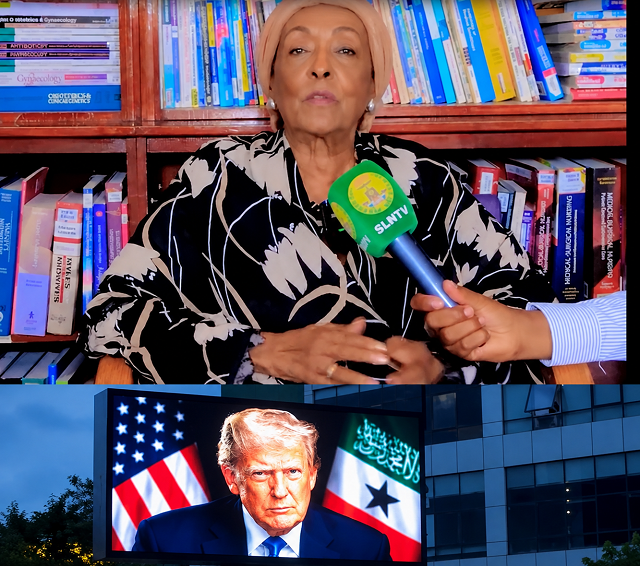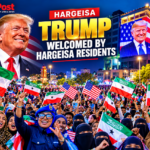

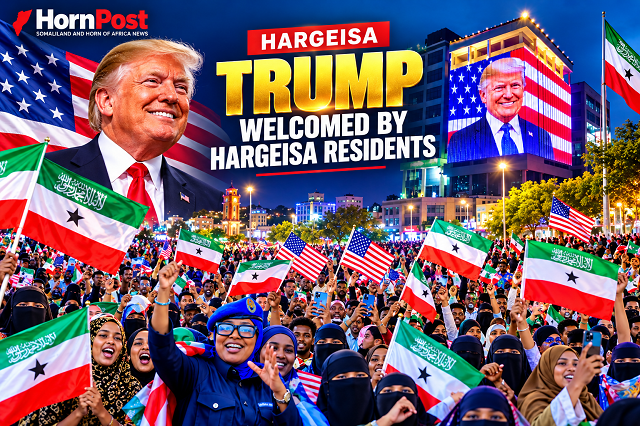
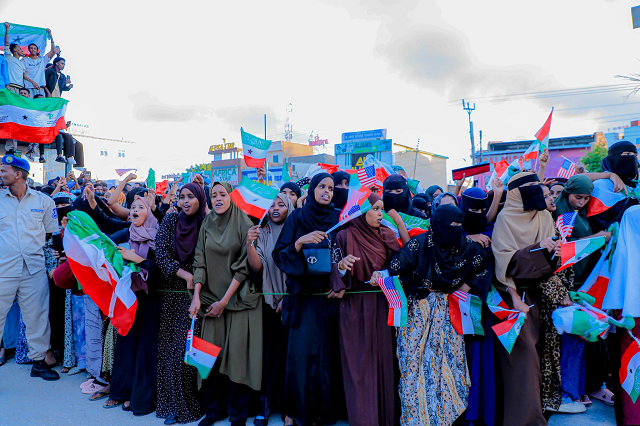
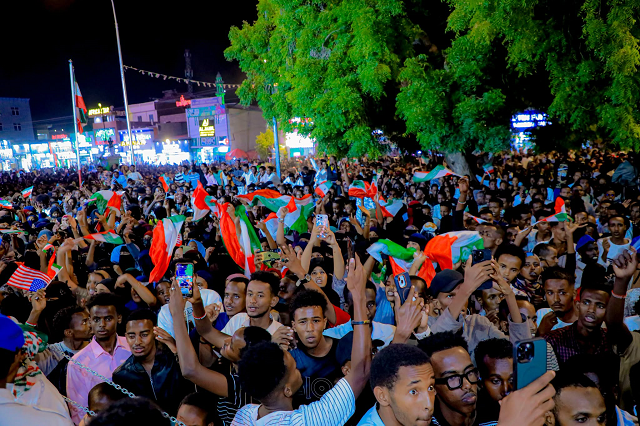
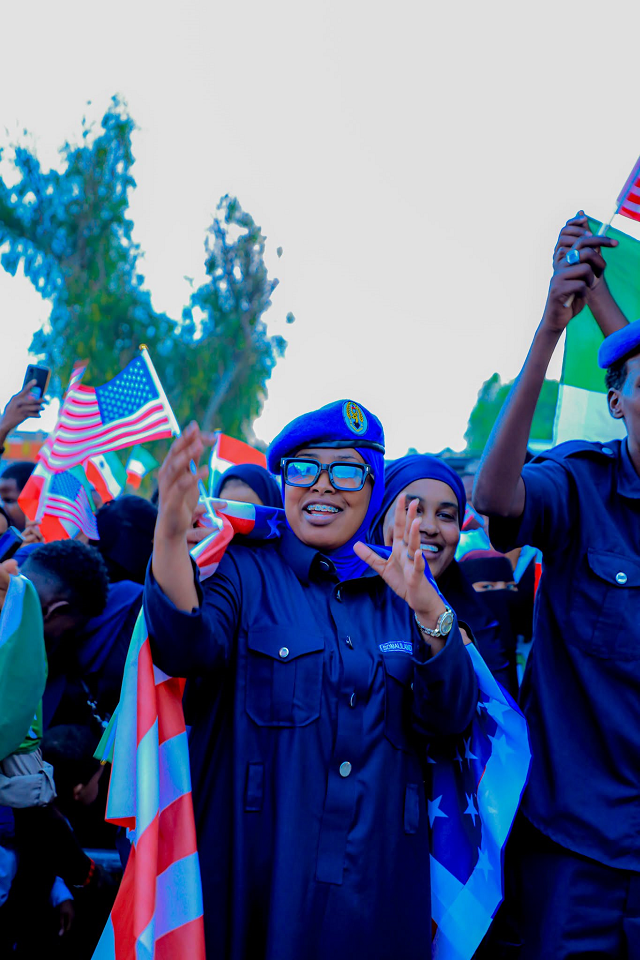
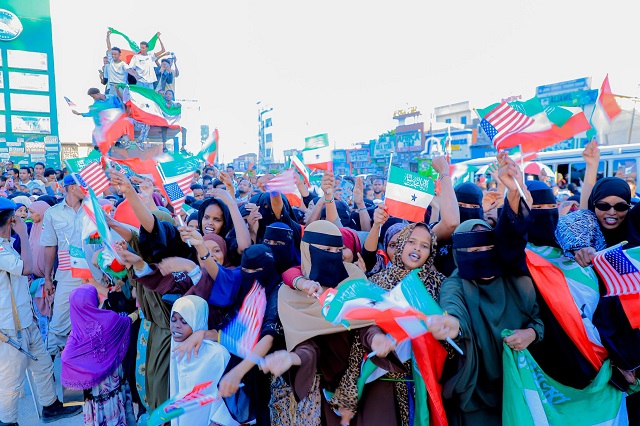
HARGEISA, Somaliland (HornPost) Residents of Hargeisa gathered in large numbers at public squares across the Somaliland capital, waving Somaliland and American flags and displaying images of U.S. President Donald Trump after his recent remarks describing Somaliland as a country distinct from Somalia.
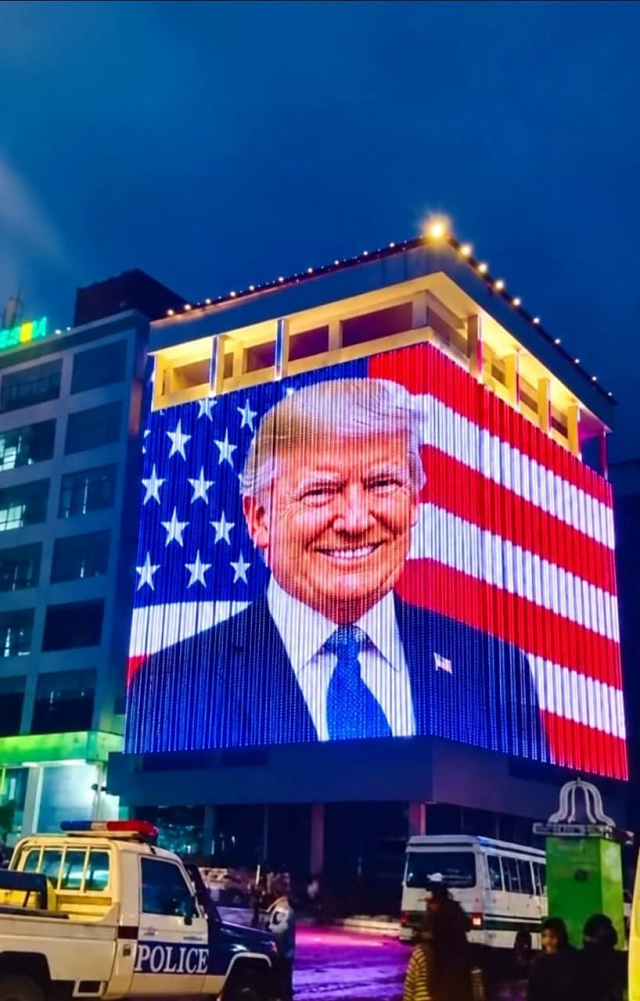
The rally brought together men, women, young people and members of the security forces, with crowds gathering around illuminated public displays featuring Trump’s portrait and the American flag. Participants expressed gratitude to the U.S. president and called on his administration to take the further step of formally recognizing Somaliland’s independence.
Trump made the remarks during a political rally in Youngstown, Ohio, on Oct. 12, while discussing U.S. domestic politics and immigration. He described Somaliland as “a totally different country” from Somalia and suggested that it should change its name. The comments were made in the context of a broader political speech, rather than as an announcement of a change in U.S. diplomatic policy.
The remarks nevertheless generated considerable enthusiasm in Somaliland, where the pursuit of international recognition has remained a central political and diplomatic objective for more than three decades.
Residents Call on Trump to Recognize Somaliland
Demonstrators at the Hargeisa gathering welcomed Trump’s comments, saying they viewed his distinction between Somaliland and Somalia as an important acknowledgment of Somaliland’s separate political identity.
Many carried Somaliland’s green, white and red flag, featuring the black star, alongside the Stars and Stripes. Trump’s image was also displayed on a large electronic screen overlooking the gathering.
Participants appealed directly to the American president to translate his remarks into formal diplomatic recognition.
“We are asking the American president to announce his recognition of Somaliland,” one woman said during the gathering, thanking Trump for what she regarded as his acknowledgment of the territory’s separate status.
Another woman reiterated the appeal, expressing enthusiasm about the possibility of recognition.
“We are asking President Trump to recognize Somaliland. We will even change the name, and we will slaughter many camels,” she said.
Her remarks reflected the celebratory mood among some demonstrators and their willingness to consider the name-change suggestion attributed to Trump. The proposal, however, has broader political implications, as Somaliland’s name is closely associated with its historical claim to restored sovereignty.
The comments also illustrated the high expectations among some residents that Washington could play a decisive role in Somaliland’s efforts to gain wider international acceptance.
Somaliland’s Recognition Campaign
Somaliland declared the restoration of its independence from Somalia in 1991, following the collapse of the Somali central government and years of conflict. It has since maintained its own governing institutions, security forces and electoral processes.
The territory traces its sovereignty claim to June 26, 1960, when the former British Somaliland protectorate became independent before entering a union with the former Italian-administered territory of Somalia later that year.
Somaliland’s government argues that its political history and the restoration of its former sovereignty distinguish it from a conventional secessionist movement.
International recognition has remained limited, however, and Somaliland’s status continues to be contested by Somalia’s federal government, which regards the territory as part of its sovereign territory.
For Somaliland officials and many residents, formal recognition would represent a significant diplomatic breakthrough, potentially opening the way to broader bilateral relations, increased foreign investment and deeper engagement with international institutions.
Trump’s remarks have therefore attracted attention beyond the immediate political debate, particularly because of the United States’ influence in international affairs and its strategic interests in the Horn of Africa and the Red Sea region.
However, the president’s comments do not, by themselves, establish a change in Washington’s recognition policy. No formal U.S. recognition announcement was included in the remarks cited in reports of the speech.
Somaliland Government Welcomes Trump’s Remarks
Somaliland’s Ministry of Foreign Affairs and International Cooperation welcomed Trump’s comments in a statement dated Oct. 13, describing them as an acknowledgment of Somaliland’s distinct status.
The ministry reiterated that Somaliland has its own constitution, elected government, defined borders and foreign relations, and has governed itself for more than three decades.
The government’s response underscored the importance it attaches to international engagement and its continuing efforts to persuade foreign governments to recognize its independence.
The public celebrations in Hargeisa reflected a similar sense of optimism among participants, although the long-term diplomatic implications of Trump’s remarks remain uncertain.
Residents Also Express Support for Somaliland President
During the gathering, some participants also expressed support for Somaliland President Abdirahman Mohamed Abdullahi, widely known as irro.
One attendee used the occasion to send congratulations to the president, linking the public celebration to Somaliland’s broader political aspirations.
“I send countless congratulations to the president of the Republic of Somaliland, Mr. Abdirahman irro,” the participant said.
The remarks highlighted the domestic political significance of the issue, with residents expressing hopes that diplomatic engagement with the United States could advance Somaliland’s longstanding campaign for international recognition.
What Trump’s Remarks Mean for U.S.-Somaliland Relations
Trump’s comments have renewed discussion about the future of relations between Washington and Hargeisa. Somaliland occupies a strategically important position near the Gulf of Aden and the Red Sea, close to major international shipping routes.
Supporters of recognition argue that Somaliland’s relative stability, functioning institutions and geographic position make it a potential partner in regional security, maritime trade and counterterrorism cooperation.
Nevertheless, formal recognition would represent a separate diplomatic decision from acknowledging Somaliland’s distinct political identity in a public speech.
The distinction is central to understanding the significance of the Hargeisa rally. While demonstrators welcomed Trump’s words as a positive development, the United States has not, on the basis of those remarks alone, formally recognized Somaliland’s independence.
For the residents who gathered in the capital, the immediate message was clear: they want the American president to go further and make recognition an official U.S. policy.
Whether the latest comments will lead to concrete diplomatic action remains to be seen.
HornPost | Somaliland and Horn of Africa News
HornPost | Somaliland and Horn of Africa News
Prepared by:
HornPost staff