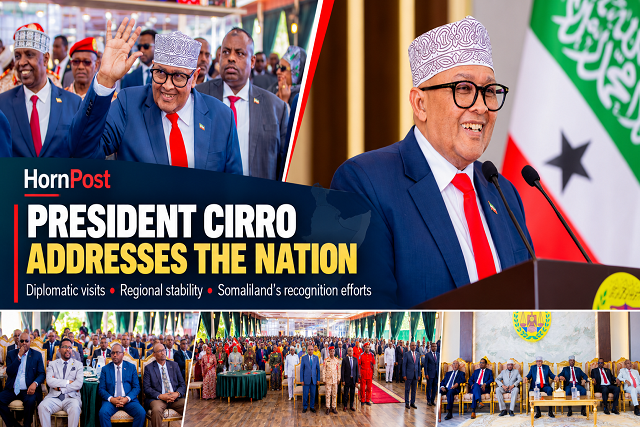
HARGEISA, Somaliland (HornPost) President of the Republic of Somaliland Abdirahman Mohamed Abdullahi “Irro” has welcomed four politicians from eastern Sanag who recently returned to Somaliland, describing their return as an opportunity to strengthen national unity, peace and stability in the eastern regions.
The politicians, who are originally from Sanag and had been associated with the administration based in Las Anod, recently returned to Somaliland and reaffirmed their political position in support of Somaliland, according to the presidency.
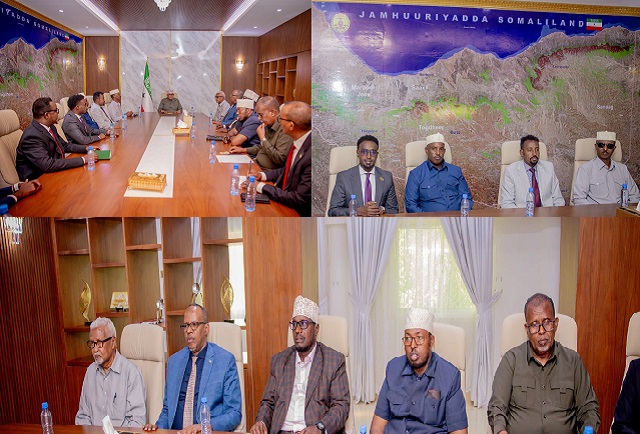
President Irro held a meeting with the politicians and other government officials, welcoming them back and thanking them for choosing to return to what he described as their homeland and people.
The president said their participation could contribute to peacebuilding, reconciliation and development in the communities from which they originate.
The meeting carried a broader political message focused on strengthening Somaliland’s national unity, maintaining security and stability, and promoting political understanding based on peace, cooperation and the national interest.
President Irro: “Somaliland Has No Internal Borders”
During the meeting, President Irro directly addressed the returning politicians, emphasizing that their origins in Sanaag and their recent political activities in Sool should not create divisions within Somaliland.
“I salute the ministers, the chairman and the secretary of the Peace Committee, all of them, and the politicians from Sanaag who have now come to us from eastern Sool. Welcome,” President Irro said.
President Irro stressed that Somaliland should be viewed as one political and national entity, regardless of regional or political differences.
“Somaliland has no internal borders. People may differ politically and have different views, but these people are relatives who have lived together since God created them,” he said.
The president added that the returning politicians should not consider themselves guests in Somaliland.
“Today, you are not guests whom I am welcoming. Historically, as people and as a country, you are in your own country, among your own people, and with your own government,” he said.
Appeal for Unity and Reconciliation
President Irro further emphasized the importance of reconciliation and social cohesion, saying the people of Somaliland had historically lived together and remained interdependent.
“Welcome with open arms and open hearts. I believe that this feeling is genuine, and what confirmed it for you was when you arrived inside Somaliland — the love you received and the desire people had to see you return,” he said.
“That demonstrates that we are people who need one another and cannot do without one another, God willing. So, welcome,” the president added.
The meeting was attended by members of Somaliland’s Cabinet, the chairman and secretary of the National Peace Committee, and other officials.
The politicians who attended the meeting thanked President Irro for the welcome and for giving them an opportunity to directly present their views. They also expressed their commitment to contributing to peacebuilding, social unity, development in their communities and the strengthening of Somaliland’s national institutions.
Analysis: A Broader Peace Effort in Eastern Sanaag
The meeting comes as President Irro’s administration seeks to advance peace and reconciliation efforts in eastern Sanaag, an area that has experienced armed confrontations and political tensions in recent years.
Eastern Sanag has strategic importance for Somaliland because the region extends toward the Gulf of Aden and includes the coastal town of Las Qoray, giving the area significance beyond its local political disputes.
Previous peace efforts have also been conducted in parts of eastern Sanag, reflecting the government’s broader attempt to reduce tensions and encourage dialogue among local communities and political actors.
The return of politicians originating from eastern Sanag who had been politically aligned with the administration in Las Anod therefore carries significance beyond the individuals involved.
Their return could be viewed as part of a wider effort to rebuild political relationships, strengthen reconciliation and reconnect communities affected by the prolonged political and security disputes in eastern Somaliland.
President Irro’s statement that “Somaliland has no internal borders” also represents a clear political message: regional differences and competing political positions should not, in his view, become permanent divisions among communities that Somaliland considers part of the same national political framework.
The challenge now is whether the political outreach can translate into sustained peace on the ground.
Eastern Sanaag remains strategically important because of its location along the Gulf of Aden, while the wider eastern regions remain connected to the unresolved political contest involving Somaliland, Somalia and emerging regional administrations.
For Somaliland, successful reconciliation in eastern Sanag could strengthen internal stability and reduce the possibility that local political disputes become linked to wider regional competition.
The meeting in Hargeisa therefore represents not only a political welcome, but also a potential component of Somaliland’s broader effort to pursue peace, reconciliation and political integration in eastern Sanag.
Prepared by:
Hornpost staff
info@hornpost.com
www.hornpost.com
HARGEISA, Somaliland