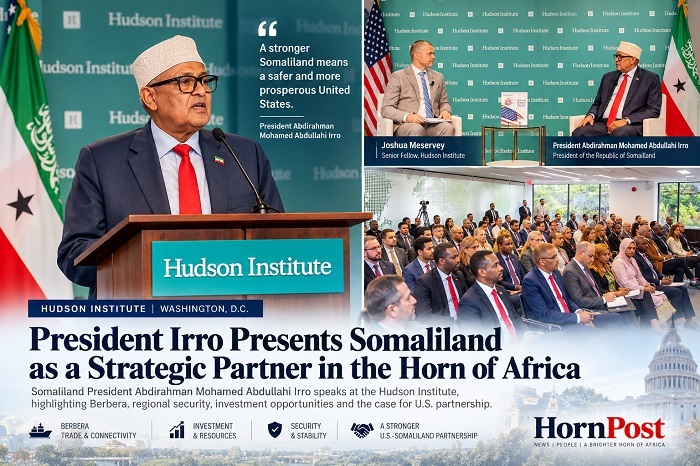
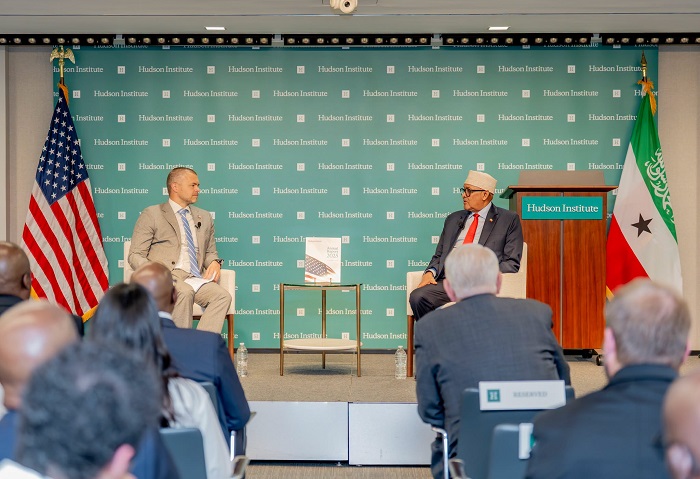
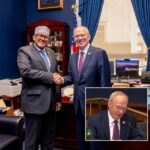
WASHINGTON (HornPost)— President of the Republic of Somaliland Abdirahman Mohamed Abdullahi “Irro” used a high-profile address at the Hudson Institute in Washington to present Somaliland as a strategic partner for the United States, highlighting the importance of Berbera port, access to Ethiopian and wider East African markets, maritime resources, minerals and potential security cooperation.
Speaking Monday, Sept. 14, at an event titled “Somaliland as a Strategic Partner in the Horn of Africa,” Irro argued that Somaliland’s geographic position and existing commercial infrastructure give American companies an opportunity to establish an early presence in a strategically important part of the Horn of Africa.
The event was hosted by the Washington-based Hudson Institute and featured a keynote address by Irro followed by a fireside discussion with Joshua Meservey, a senior fellow specializing in African geopolitics, great-power competition and counterterrorism. Hudson described the appearance as Irro’s first visit to the United States since winning Somaliland’s presidential election in November 2024.
Berbera as gateway to Ethiopia and East Africa
A central theme of Irro’s argument was the strategic and commercial importance of the Berbera corridor, which connects Somaliland’s port on the Gulf of Aden with Ethiopia and its large domestic market.
Irro said the corridor provides access to an Ethiopian market of more than 120 million people and offers a potential gateway to markets across East and Central Africa.
“That corridor provides commercial access to an Ethiopian market exceeding 120 million people and beyond, a gateway toward the wider market of East and Central Africa,” Irro said.
He contrasted the growing presence of Chinese financing, infrastructure and commercial interests across African markets with what he described as an opportunity for U.S. businesses to enter the Somaliland market at an early stage.
“In many of those markets, Chinese financing, infrastructure and commercial interests have become firmly established over the past two decades,” he said.
But, he argued, Somaliland remains relatively open to new American investment.
“I raise it to observe that at Berbera, the position remains open and that American enterprises would be entering early rather than late,” Irro said.
Somaliland offers U.S. companies a “first-mover” opportunity
Irro expanded his economic argument beyond Berbera, pointing to Somaliland’s maritime and mineral resources.
“Along Somaliland’s coast lie marine resources that remain very largely undeveloped. Our mineral potential remains significantly unexplored to American companies,” he said.
The president said his government is prepared to facilitate early access for U.S. companies interested in investment.
“I say this without qualification: We are prepared to extend an early and privileged opportunity to access and to invest in those resources,” Irro said.
He described the proposition as a “genuine first-mover position” in a jurisdiction that, he argued, has demonstrated reliability in its dealings with foreign partners.
“A genuine first-mover position in a jurisdiction that has honored every major foreign agreement it has concluded,” Irro said.
The comments place economic cooperation alongside Somaliland’s broader effort to deepen relations with Washington, presenting investment, trade and strategic access as mutually reinforcing elements of a potential partnership.
“Somaliland is not defined in its disposition toward the West”
Irro also sought to emphasize Somaliland’s political orientation and public support for closer engagement with Western countries.
“Somaliland is not defined in its disposition toward the West,” he said, adding that the territory has maintained a stable political environment and has developed its own institutions over decades.
“There is no faction requiring persuasion and no constituency requiring management,” Irro said.
“There is a population that has sustained this pattern for 35 years and has never been asked to enter into it,” he added, referring to Somaliland’s long-standing pursuit of international recognition and self-governance.
His argument was that Somaliland’s relationship with the United States would not need to be built from scratch, but could instead develop from existing political, security and commercial interests.
Recognition as a gateway to deeper economic ties
One of the strongest elements of Irro’s speech was his argument that international recognition would have practical economic and security consequences rather than being merely symbolic.
“Somaliland recognition is not principally a matter of flags and ceremonies,” Irro said.
“It is a matter of access.”
He argued that recognition could open channels for development finance, trade mechanisms and private-sector investment that American companies typically rely on when operating internationally.
“The recognition will open that channel together with development finance and trade mechanisms upon which American companies rely when they invest abroad,” he said.
The president also linked recognition to security cooperation.
He said greater diplomatic engagement would allow existing informal cooperation in security and counterterrorism to become more structured.
“It would permit security and counterterrorism cooperation, which is presently informal, to become formal, accountable and durable,” Irro said.
That argument comes as the Red Sea and Gulf of Aden have become increasingly important to international security discussions because of attacks on shipping, Houthi activity in Yemen and broader competition among regional and global powers.
Hudson Institute itself framed the event within the changing strategic environment around Somaliland, citing the Iran war, Houthi activity in Yemen, China’s expanding influence in Africa and growing Russian and Iranian engagement in East Africa.
“Nothing I have described this afternoon is aspirational”
Irro concluded his address by stressing that the opportunities he presented to Washington were already available rather than hypothetical.
“Nothing I have described this afternoon is aspirational,” he said.
“It is constructed. It is operating and it is available.”
The president argued that deeper cooperation between Somaliland and the United States would benefit both sides, linking Somaliland’s development and regional stability with U.S. strategic interests.
“A deeper partnership between our two countries will fund Somaliland’s development and the stability of our region,” Irro said.
But he added that the benefits would also extend to the United States.
“I would ask you to observe that it brings equally in the other direction,” he said. “It is a multiplier for a stronger, safer and more prosperous United States.”
Irro ended his address with a direct reference to Somaliland’s geography.
“Look at the map and the geography is the witness,” he said.
A strategic pitch to Washington
The Hudson Institute appearance represents a significant effort by the Somaliland government to frame its relationship with the United States around strategic interests rather than recognition alone.
For decades, Somaliland has sought international recognition after declaring the restoration of its independence from Somalia in 1991. The government in Hargeisa argues that its political stability, democratic institutions, geographic location and security cooperation make it a potential partner for Western countries.
The Hudson event offered Irro an influential Washington platform to make that case directly to U.S. policy experts and foreign-policy observers.
The timing is also significant. Somaliland sits along the Gulf of Aden, near one of the world’s most important maritime corridors and opposite Yemen, while Berbera has emerged as an increasingly important commercial and logistics hub.
The president’s message at Hudson was therefore built around a simple strategic proposition: Somaliland wants Washington to view its geographic position, port infrastructure, natural resources and security capabilities as assets that can serve U.S. economic and national-security interests.
Whether that strategy will translate into deeper formal U.S.-Somaliland relations remains a question for Washington and Hargeisa. But Irro’s speech made clear that his administration intends to present Somaliland not simply as a territory seeking recognition, but as a potential strategic, economic and security partner for the United States in the Horn of Africa.
Key quotes from President Irro
- On Berbera: “That corridor provides commercial access to an Ethiopian market exceeding 120 million people.”
- On U.S. investment: “American enterprises would be entering early rather than late.”
- On resources: “Our mineral potential remains significantly unexplored to American companies.”
- On investment opportunities: “We are prepared to extend an early and privileged opportunity to access and to invest in those resources.”
- On recognition: “Somaliland recognition is not principally a matter of flags and ceremonies. It is a matter of access.”
- On security: “It would permit security and counterterrorism cooperation, which is presently informal, to become formal, accountable and durable.”
- On the proposed partnership: “Nothing I have described this afternoon is aspirational. It is constructed. It is operating and it is available.”
- On U.S. interests: “It is a multiplier for a stronger, safer and more prosperous United States.”
- Closing message: “Look at the map and the geography is the witness.”
Prepared by:
Horn post staff
info@hornpost.com
www.hornpost.com
HARGEISA, Somaliland