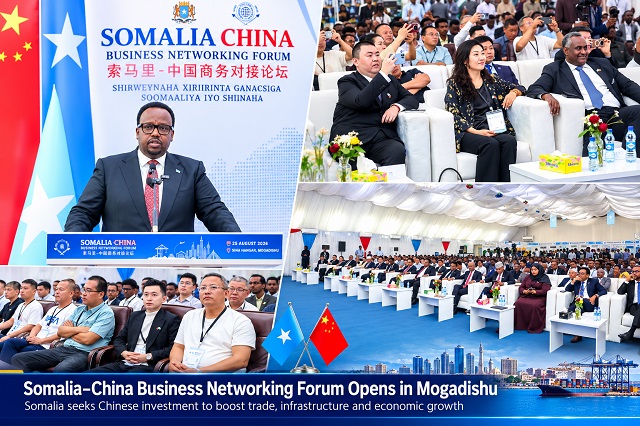
MOGADISHU, Somalia — (HornPost)— Somalia and China are seeking to deepen trade and investment ties as the Somali government hosted a Somalia-China Business Networking Forum in Mogadishu, bringing together government officials, business leaders and investors from both countries.
Somalian Deputy Prime Minister Salah Ahmed Jama officially opened the forum, which was organized by Somalia’s Ministry of Commerce and Industry.
Participants included Somali government ministers, the Somali ambassador to China, representatives of the Somali Chamber of Commerce and Industry and the China-Africa Chamber of Commerce, as well as businesspeople and investors from Somalia and China.
The forum comes as Mogadishu seeks to attract foreign investment and expand commercial links with international markets, while China has increased its diplomatic, educational and economic engagement with Somalia.
Somalia Courts Chinese Investment
Addressing the forum, Jama encouraged Chinese companies and investors to explore opportunities in Somalia, particularly in infrastructure, manufacturing, fisheries, agriculture, energy, transport and logistics.
He emphasized the importance of ensuring that increased trade and investment contribute to job creation and stronger domestic production.
The forum is part of the Somali government’s broader efforts to expand trade and investment relations with international partners and establish direct links between Somali businesses and global markets.
It also places emphasis on increasing Somali exports and connecting locally produced goods with overseas consumers.
Why China-Somalia Relations Are Gaining Attention
The renewed focus on economic relations comes amid a significant shift in Somalia’s international security and financing environment.
In July, the United States informed the African Union that it would not support funding for the United Nations Support Office in Somalia, or UNSOS, beyond Dec. 31, 2026. UNSOS provides critical logistical support to the African Union Support and Stabilization Mission in Somalia, known as AUSSOM. Washington said it would not oppose renewal of AUSSOM itself but would oppose continued UN logistical and operational support under the current arrangement.
The development has raised questions about how Somalia and its international partners will finance the country’s security architecture after 2026.
However, the economic relationship between Somalia and China should not be viewed solely through the lens of U.S. funding changes.
China has maintained a broader engagement with Somalia that includes education, development assistance, diplomatic relations, infrastructure and security-related cooperation.
China’s own statements also show its interest in continued engagement. At a 2025 high-level meeting on AUSSOM financing, China said it was the second-largest contributor to the U.N. peacekeeping budget and that it was contributing nearly one-quarter of the assessed funding for UNSOS for the 2025-26 fiscal year.
At the same time, there is no evidence that China intends to simply replace the full scale of U.S. and broader Western financing for Somalia’s security system. Beijing has instead emphasized continued international burden-sharing and support for AUSSOM.
China Expands Educational Engagement
The economic forum follows a series of recent Chinese initiatives involving Somalia.
On Aug. 16, the Chinese Embassy in Mogadishu hosted a “Study in China Gala & Scholarship Recipients Reception.” Chinese Ambassador Wang Yu attended alongside Somali government officials, scholarship recipients and alumni.
The embassy said the event attracted nearly 170 local guests and that Ambassador Wang encouraged Somali students to take advantage of educational opportunities and contribute to China-Africa relations and China-Somalia cooperation.
The educational initiative is part of a broader pattern of people-to-people engagement between China and Somalia, with education serving as an important component of bilateral relations.
Chinese Embassy Promotes Somalia-China People-to-People Links
The Chinese Embassy has also highlighted visits by Somali social media influencers to China.
In a recent post, the embassy highlighted visits to locations including the National Stadium, known as the Bird’s Nest, the Forbidden City, the Great Wall, an artificial intelligence company and the Museum of the Communist Party of China.
The embassy described the experience as giving Somali influencers a perspective on both ancient and modern China.
Such exchanges provide another channel for China to strengthen its public diplomacy and people-to-people relations with Somalia.
Trade, Investment and the Next Phase of Relations
The Mogadishu business forum points to a potentially broader phase of China-Somalia economic engagement.
For Somalia, the priority is to attract investment that can strengthen infrastructure, create jobs, expand domestic production and develop sectors such as agriculture, fisheries, energy and logistics.
For Chinese businesses, Somalia presents potential opportunities in a market with significant infrastructure and development needs, as well as access to the wider Horn of Africa and East African markets.
The challenge for Mogadishu will be to convert political and diplomatic engagement into sustainable commercial investment.
That will depend on factors including security, infrastructure, regulatory predictability, access to finance, market connectivity and investor confidence.
Key Takeaway
The Somalia-China Business Networking Forum represents another step in Mogadishu’s effort to diversify its economic partnerships and attract foreign investment.
China’s growing engagement with Somalia spans trade, investment, education, infrastructure and diplomatic cooperation. While the recent U.S. decision on AUSSOM financing has added a new strategic dimension to Somalia’s international partnerships, China’s role should be understood as part of a broader relationship rather than as a direct replacement for U.S. or Western financial support.
For Somalia, the central question is whether growing international interest can be translated into productive investment, stronger domestic industries, more exports and sustainable employment.
Prepared by
HornPost staff
info@hornpost.com
www.hornpost.com