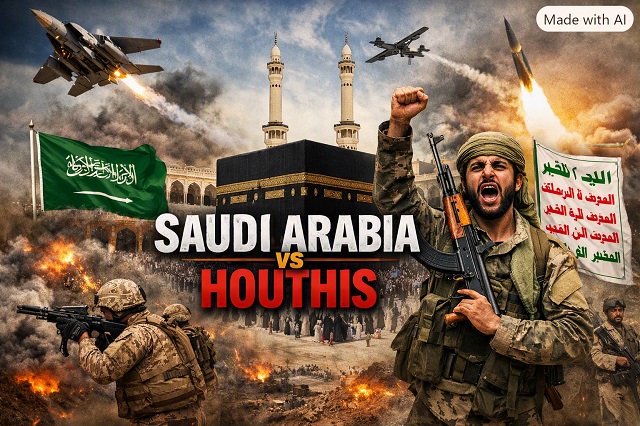
RIYADH (HornPost) — Saudi Arabia said Tuesday its air defenses intercepted a drone launched by Yemen’s Houthi rebels toward the holy city of Mecca, a claim the Houthis swiftly rejected as “fabricated.” The incident underscores the escalating conflict between the kingdom and the Iran‑aligned group, raising fears of wider instability across the Gulf and Red Sea.
Saudi Arabia’s Statement
The Saudi‑led coalition fighting in Yemen announced that its forces destroyed a drone approaching Mecca’s airspace. Coalition spokesman Turki al‑Malki described the attempt as a “deliberate attack on the holiest site in Islam,” adding that it represented a continuation of what he called the Houthis’ “terrorist tactics.”
Saudi officials emphasized that the alleged strike was not the first time the Houthis had targeted Mecca. In 2017, the coalition reported intercepting a ballistic missile aimed at the city. Riyadh framed the latest incident as proof that the Houthis pose a direct threat not only to Saudi territory but also to millions of Muslim pilgrims who travel annually for Hajj and Umrah.
Houthis Deny Responsibility
The Houthis, who control much of northern Yemen including the capital Sanaa, denied launching any drone toward Mecca. A spokesman for the group said the accusation was “a lie intended to rally regional and religious support for Saudi Arabia’s war.” The rebels insisted their operations target military and economic sites inside Saudi Arabia, not religious landmarks.
The denial reflects a broader narrative the Houthis have promoted: that their attacks are retaliatory responses to Saudi airstrikes in Yemen, which have killed thousands of civilians and devastated infrastructure.
Escalating Conflict
The dispute comes amid a surge in cross‑border violence. In recent weeks, the Houthis have intensified drone and missile strikes on southern Saudi provinces such as Jazan, Najran, and Abha. Several attacks have injured civilians and damaged airports and energy facilities.
Saudi Arabia has responded with heavy air raids on Houthi‑held areas, including Saada, Hodeidah, and Marib. Humanitarian groups warn that renewed escalation risks worsening Yemen’s already dire crisis, where millions face hunger and displacement.
Regional and Global Implications
Mecca’s symbolic importance magnifies the gravity of the accusation. Any attack on the city could inflame Muslim sentiment worldwide and destabilize Saudi Arabia’s role as custodian of Islam’s holiest sites. Analysts say Riyadh’s framing of the incident as a religious assault may be aimed at consolidating support among allies and justifying continued military operations.
The conflict also threatens global trade routes. The Houthis have previously targeted ships in the Red Sea, raising concerns about the security of Bab al‑Mandab, a strategic chokepoint for oil and commercial shipping between Europe and Asia.
Humanitarian Concerns
The United Nations has repeatedly called for restraint, warning that Yemen remains the world’s worst humanitarian crisis. More than 20 million people require assistance, and the war has displaced millions. Aid agencies fear that further escalation could disrupt relief operations and push the country closer to famine.
Strategic Calculations
Saudi Arabia views the Houthis as an extension of Iranian influence on its southern border. The kingdom has sought intelligence and military coordination with allies, including the United States, to counter drone and missile threats. Washington has condemned Houthi attacks on Saudi territory but has also urged both sides to pursue negotiations.
For the Houthis, denying responsibility for an alleged strike on Mecca may be an attempt to avoid alienating Muslim opinion. By insisting they target only military and economic sites, the group seeks to maintain legitimacy among supporters while deflecting accusations of sacrilege.
Outlook
Whether the drone incident occurred as Saudi Arabia claims or not, the episode highlights the fragility of regional security. The war in Yemen, now in its twelfth year, shows little sign of resolution. With both sides escalating attacks, prospects for peace remain dim.
Analysts warn that if the Houthis were ever to strike Mecca, the repercussions would be severe, potentially galvanizing broader regional intervention. For now, the accusation and denial illustrate the deep mistrust and propaganda battles that define the conflict.
Prepared by:
HornPost staff
info@hornpost.com