




A dispute over the sale of decommissioned port equipment raises fundamental questions about asset ownership, transparency, and the limits of DP World’s authority under the 2017 agreement with Somaliland.
Since DP World took over the management and modernization of the Berbera Port in 2017, the facility has undergone major infrastructural changes. These changes have included the removal of old, non-functional equipment to make room for new berths and container storage areas. As a result, DP World auctioned off the scrap metal that had been lying idle at the port—but whether that process complied with the law is now under question.
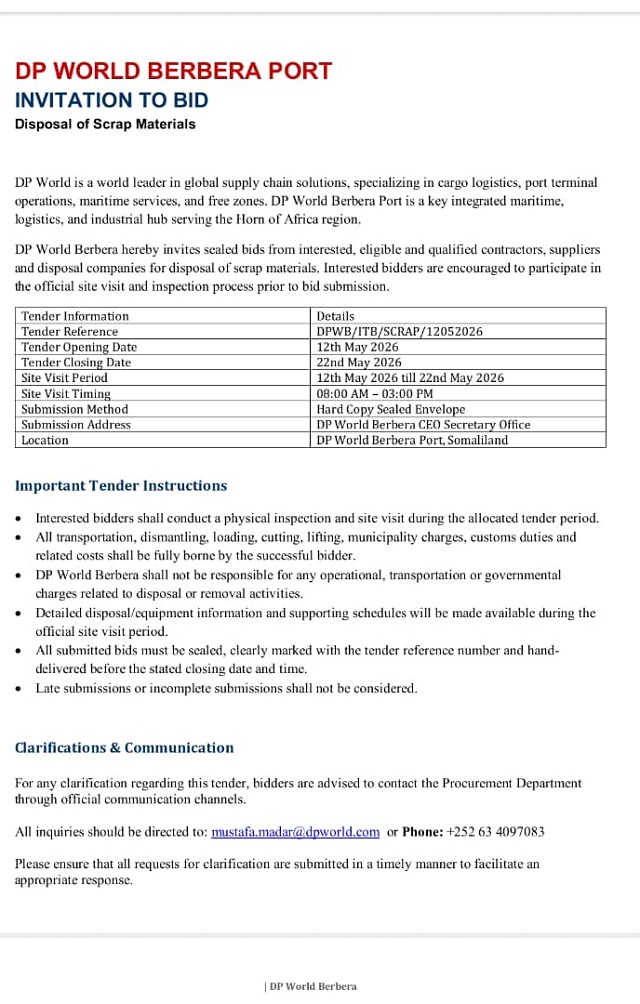
According to a tender document issued on May 12, 2026, DP World explicitly announced the auction of this scrap metal to private buyers.
The Legal Allegations: Who Owned the Old Equipment?
Concerns that DP World may have illegally auctioned the scrap rest on several key legal points:
· Ownership of Former State Assets: Under the agreement between the Somaliland government and DP World, the company owns all new equipment and modernization investments. However, the port’s pre-existing assets, including old cranes, metal structures, and decommissioned machinery—remained state property. As such, any disposal or sale of those assets would have required explicit, prior approval from relevant government bodies, including the Ministry of Finance, the Procurement Committee, or the Auditor General’s office.
· Lack of a Public Auction Process: The core legal question is whether DP World had the right to sell this scrap directly to private metal trading companies without going through the official public auction process that the government normally manages for the disposal of state property.
· Failure of Oversight Institutions: It remains unclear why Somaliland’s financial oversight and auditing bodies have not intervened in these matters to ensure that state assets are not being exploited improperly or without proper accountability.
DP World’s Position
DP World has consistently argued that its goal is to clear and expand the port to meet international standards. The company maintains that any equipment removed from the port should be handled through a process agreed upon with the Joint Venture Committee that oversees the implementation of the 2017 agreement. From the company’s perspective, the scrap auction was a routine part of port modernization, not a legal violation.
Key Legal and Governance Questions
The dispute over the Berbera Port scrap is not merely about discarded metal. It raises a much larger issue: the unclear boundary between DP World’s operational authority and the Somaliland government’s ownership of pre-existing permanent assets. Specifically:
· To what extent can DP World dispose of legacy port equipment without direct government oversight?
· Is the Joint Venture Committee functioning effectively to resolve such disputes?
· Why have financial watchdogs failed to investigate or publicly report on the transaction?
Conclusion: Calls for a Full Investigation
Although the modernization of Berbera Port has been widely hailed as an economic success, the controversy surrounding the scrap metal auction points to a significant gap in transparency and contractual oversight.
To resolve the matter and restore public trust, legal experts and civil society actors argue that the Auditor General and the Ministry of Finance must issue a clear, detailed report that includes:
1. The exact quantity and type of equipment sold.
2. The total revenue generated from the auction.
3. Where those funds were deposited and how they have been used.
Without such disclosure, suspicions will persist that state property was auctioned outside the bounds of the law, undermining both governance and the credibility of the port agreement itself.
Mohamed Said Abdilahi
Berberanews staff writer
mohamedsaidabdilahi1@gmail.com
Disclaimer:
The views and opinions expressed in this statement are those of the author and readers and do not necessarily reflect the official policy, editorial position, or views of Horn Post. Horn Post is not responsible for the accuracy of opinions, comments, or claims made by contributors or readers.