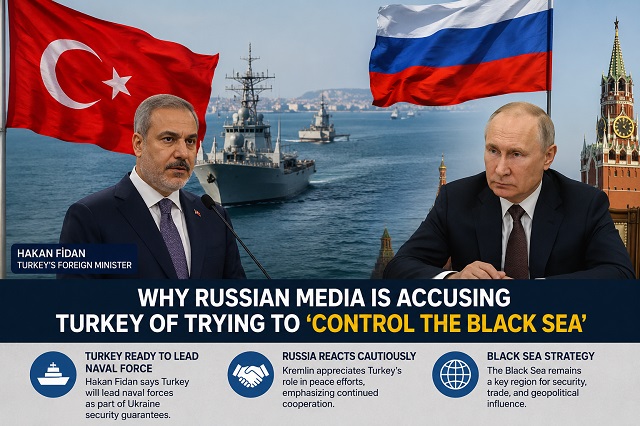
ANKARA/KYIV — (Horn Post) Turkey has come under criticism from Russian media and commentators after Foreign Minister Hakan Fidan said Ankara is prepared to lead a multinational naval mission as part of potential security guarantees for Ukraine under a future peace agreement with Russia.
The remarks, made during Fidan’s visit to Kyiv on July 16, have fueled debate in Russia, with some analysts claiming Turkey is seeking to expand its influence over the strategically vital Black Sea. Turkish officials, however, have framed the proposal as part of broader international efforts to support a lasting peace settlement between Moscow and Kyiv.
Speaking alongside Ukrainian Foreign Minister Andrii Sybiha, Fidan said one of the key pillars of any future peace agreement would be credible security guarantees for Ukraine.
He explained that those guarantees would need to cover land, sea, and air domains**, emphasizing that maritime security would play a critical role in preserving regional stability after the war.
“Turkey has agreed to lead the naval component, and we are coordinating this effort with our allies. Planning is already being carried out among the allied naval forces,” Fidan said.
Although the Turkish foreign minister did not disclose operational details, his comments suggested Ankara is willing to assume a leading role in any future international maritime security framework designed to protect Ukraine and ensure freedom of navigation in the Black Sea.
Russian Reaction
Russian officials responded cautiously rather than confrontationally to Fidan’s remarks, avoiding direct criticism of Turkey’s proposal.
Kremlin spokesperson Dmitry Peskov said on July 16 that Moscow appreciated Turkey’s willingness to assist diplomatic efforts aimed at achieving a peaceful resolution to the conflict in Ukraine.
“Turkey has consistently demonstrated its readiness to facilitate dialogue, and we value those efforts,” Peskov said.
Russia has repeatedly recognized Turkey as one of the few NATO members capable of maintaining communication channels with both Moscow and Kyiv throughout the conflict.
Meanwhile, according to the Russian state news agency TASS, Russian Ambassador to Ankara Sergey Vershinin said on July 17 that Moscow remains committed to strengthening constructive cooperation with Turkey and other regional partners.
Vershinin noted that Russia and Turkey continue to work together on regional issues beyond Ukraine, including conflicts in Syria and Libya, highlighting the importance of maintaining pragmatic diplomatic relations despite disagreements over the war.
Strategic Importance of the Black Sea
The Black Sea has become one of the most strategically contested regions since Russia launched its full-scale invasion of Ukraine in 2022.
The waterway serves as a critical route for military operations, global grain exports, energy transportation, and international trade. Control over maritime security in the region has become a central issue in discussions about any future peace agreement.
Turkey occupies a unique geopolitical position because it controls access to the Black Sea through the Bosporus and Dardanelles straits under the Montreux Convention, giving Ankara significant influence over naval movements between the Mediterranean and the Black Sea.
Since the outbreak of the war, Turkey has sought to balance its relations with both Russia and Ukraine. Ankara has supplied military support to Kyiv, including Bayraktar drones, while simultaneously maintaining diplomatic and economic ties with Moscow and facilitating several rounds of peace negotiations.
Why Russian Media Is Raising Concerns
Some Russian media outlets and commentators have interpreted Fidan’s proposal as an indication that Turkey could seek a more prominent military and political role in the Black Sea under the framework of a future peace agreement.
Analysts argue that if Turkey were to lead an international naval mission, it could significantly increase Ankara’s influence over maritime security in the region. However, Turkish officials have not suggested that such a mission would replace existing international arrangements or grant Turkey unilateral authority over the Black Sea.
Instead, Ankara has presented its role as part of a broader allied effort aimed at guaranteeing Ukraine’s long-term security while supporting regional stability.
As diplomatic efforts continue, Turkey remains one of the few countries maintaining active communication with both Russia and Ukraine, positioning itself as a key mediator in any future negotiations to end the conflict.
Prepared By:
Horn Post Staff
info@hornpost.com
www.hornpost.com