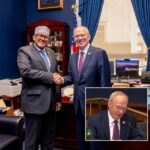
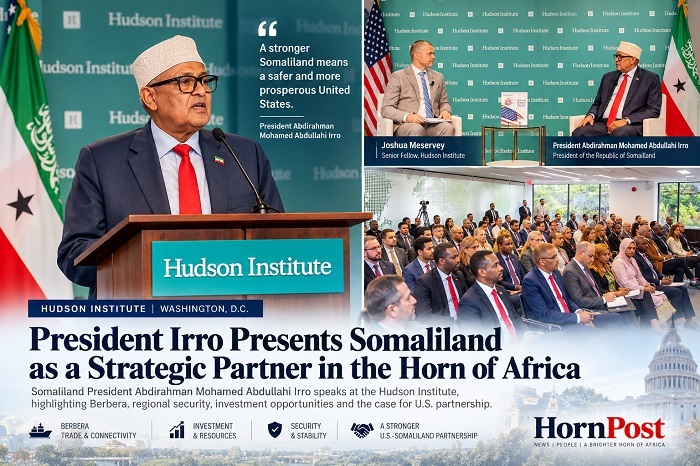


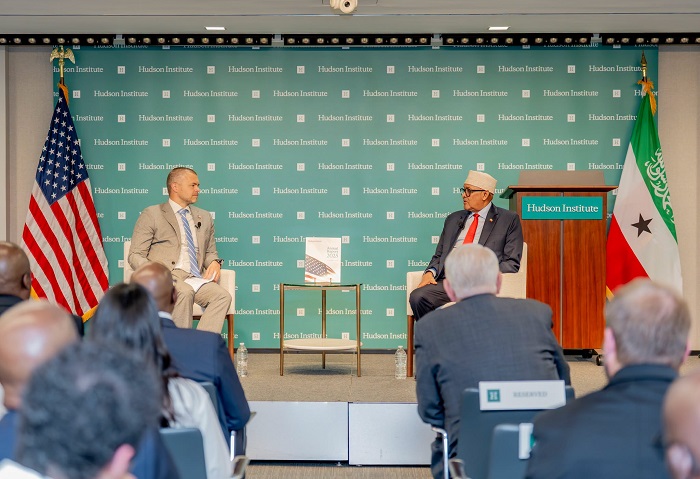
WASHINGTON — (HornPost) President of the Republic of Somaliland Abdirahman Mohamed Abdullahi “Irro” addressed a wide range of questions about Somaliland’s international recognition, relations with Somalia, regional security, Berbera port, Ethiopia, Taiwan, Israel, the Houthis and potential U.S. partnership during an extensive question-and-answer session at the Hudson Institute in Washington.
The discussion, moderated by Joshua Meservey, a senior fellow at Hudson Institute specializing in African geopolitics, great-power competition and counterterrorism, followed Irro’s keynote address on “Somaliland as a Strategic Partner in the Horn of Africa” on Sept. 14, 2026.
Below are the major questions and answers from the discussion, edited for clarity while preserving the substance of the president’s remarks.
Q1: Joshua Meservey: Somaliland has operated as a de facto state for more than 35 years, with its own military, passport, currency and institutions. Why, in your view, have African countries been unwilling to recognize that reality?
President Irro: The African Union has previously sent a fact-finding mission to Somaliland, and the report described Somaliland’s case as unique.
Irro said the AU mission’s findings were fair and indicated that Somaliland’s case could be considered separately because of its historical circumstances.
He argued that the main obstacle is the African Union’s emphasis on the territorial integrity of Somalia.
“Somaliland and Somalia have been two separate entities,” Irro said, pointing to their different colonial histories. Somaliland gained independence from Britain in June 1960, while Somalia’s other territory gained independence from Italy.
He argued that Somaliland’s historical experience therefore differs from many other secessionist cases on the continent.
Q2: Joshua Meservey: Some African governments argue that recognizing Somaliland could set a precedent and encourage other independence movements across the continent. How do you respond?
President Irro: Irro rejected the comparison, arguing that Somaliland has already demonstrated an unusually long period of separate governance.
“Practically, Somaliland is not part of Somalia,” he said, while acknowledging that internationally Somaliland continues to be treated as part of Somalia.
Irro pointed to Somaliland’s separate administration of its security forces, police, education, health system, budget and other institutions.
“For 35 years, no leader from Somalia ever came to our country,” he said, arguing that the practical reality is different from the internationally recognized legal position.
He added that Somaliland’s experience should not automatically be equated with other independence movements in Africa.
Q3: Joshua Meservey: Somaliland has maintained peace and democratic institutions for decades. What makes its case different?
President Irro: Irro said Somaliland built peace through its own traditional and community-based mechanisms rather than having peace imposed from outside.
“Since 1991, the elders, the communities, the intellectuals, the women and the children made their own peace,” he said.
He contrasted this with Somalia, arguing that repeated international peace efforts have failed to produce the same level of stability.
“We are peaceful. We have no problem with our neighbors. We don’t have any problem in security,” Irro said.
He argued that Somaliland’s relative security has become one of the clearest distinctions between Hargeisa and parts of Somalia.
Q4: Joshua Meservey: Some Arab states and organizations, including the Arab League and the Organization of Islamic Cooperation, have opposed Somaliland’s recognition. Why?
President Irro: Irro said the opposition is primarily political.
“I think it is purely political justifications,” he said.
His explanation was that Somalia is a member of the Arab League and that Arab states therefore tend to support Somalia’s territorial position.
“So that’s why all Arab states were against it,” Irro said, while acknowledging that some Arab countries maintain friendly relations with Somaliland.
Q5: Joshua Meservey: Somaliland and Somalia have held negotiations for more than a decade. Why have they failed to produce a settlement?
President Irro: Irro said the fundamental problem was that the two sides entered negotiations with fundamentally different objectives.
“The agenda for Somaliland was separation of the two entities, and the agenda for Somalia was the union,” he said.
He argued that because the central issue was never resolved, the talks could not produce a meaningful agreement.
“Over 10 years, the negotiations or the dialogue was ongoing. It didn’t produce any result,” Irro said.
He maintained that Somaliland’s position is not about separating from an existing Somali state, but about restoring what it considers its sovereignty.
Q6: Joshua Meservey: Is there a realistic scenario in which Mogadishu could acknowledge Somaliland’s independence and negotiate a settlement?
President Irro: Irro suggested that international recognition of Somaliland’s democratic and functional statehood could eventually change the political equation.
He argued that Somalia’s position is strengthened by the international community’s continued emphasis on Somalia’s territorial integrity.
“As long as the international community is considering and saying we respect the territorial integrity of Somalia, it will be very difficult for them to give up that sovereignty,” he said.
Irro described Somaliland as being constrained by Somalia’s internationally recognized sovereignty.
Q7: Joshua Meservey: How much does Somali irredentism and the idea of “Greater Somalia” contribute to opposition to Somaliland’s independence?
President Irro: Irro said the concept of Greater Somalia is no longer practical and warned that attempts to reunite all Somali-populated territories could create new conflicts.
He noted that Somali-populated areas are located in Ethiopia, Kenya and Djibouti and recalled historical conflicts involving Somalia and its neighbors.
“If the world is pushing all Somalis to unite, that may cause itself another war in the region,” Irro warned.
Q8: Joshua Meservey: Somaliland has historically had tense relations with Puntland. Why have relations recently improved?
President Irro: Irro said peace with neighboring communities was one of his administration’s first priorities.
“When I came to office, my first priority was to make peace in Somaliland and with the neighbors,” he said.
He said Somaliland had opened contacts with Puntland and agreed to cooperate on peace, counterterrorism and combating piracy.
The two sides established a ministerial committee that has met in Nairobi and elsewhere, according to Irro.
He also said the sides had agreed to facilitate the movement of people and goods.
Q9: Joshua Meservey: Piracy in the region declined dramatically but has recently shown signs of returning. What is driving the resurgence?
President Irro: Irro said there were theories about possible links between the Houthis and piracy, particularly amid wider instability around the Red Sea and Bab el-Mandeb.
“Some say that the Houthis and the pirates have some sort of connection,” he said.
However, he emphasized that Somaliland could not prove such a connection.
Q10: Joshua Meservey: Given Somaliland’s proximity to areas affected by piracy, how has Somaliland kept its waters relatively secure?
President Irro: He attributed Somaliland’s maritime security partly to its coastal guard.
“For this good number of years, we have a small coast guard,” Irro said.
He acknowledged that Somaliland’s coast guard does not have large ships or extensive equipment but said it has nevertheless helped protect Somaliland’s waters.
Q11: Joshua Meservey: There have been reports of possible exchanges involving al-Shabaab and Houthi-controlled areas of Yemen. What has Somaliland observed?
President Irro: Irro said Somaliland has received reports from partners suggesting cooperation between al-Shabaab and the Houthis.
“As far as some of the reports we get from our partners say, there is cooperation of al-Shabaab and Houthis,” he said.
He stressed that Somaliland is not at war with Yemen or the Houthis but remains alert to potential threats from across the Gulf of Aden.
“We feel the threat,” Irro said.
Q12: Joshua Meservey: Somaliland has largely avoided major terrorist attacks despite being surrounded by areas where al-Shabaab operates. What is the secret?
President Irro: Irro attributed Somaliland’s security largely to cooperation between citizens and security authorities.
“Our citizens act, all of them, as police,” he said.
He explained that residents alert authorities when they encounter suspicious activity.
“The main secret is that they don’t find sanctuary in your home in Somaliland,” Irro said.
He argued that terrorist organizations cannot operate effectively without some level of local support or sanctuary.
Q13: Joshua Meservey: What is happening in eastern Somaliland, and what is Hargeisa’s strategy for dealing with the unrest?
President Irro: Irro said his administration’s priority has been peaceful engagement.
He said the government had mobilized approximately 60,000 armed personnel from the eastern conflict into Somaliland’s army, describing the process as having taken less than 120 days.
He said the government subsequently provided salaries and training to those incorporated into the security forces.
But Irro emphasized that his preferred strategy remains reconciliation.
“My priority number one is peace,” he said.
“We don’t want to invade anybody. We want to take [nothing] by force. We will dialogue and [seek] peaceful means of solution,” he said.
He cited peace conferences in eastern areas, including Erigavo and other communities, as examples of the government’s approach.
Q14: Joshua Meservey: Somalia has been deeply affected by clan divisions. How does Somaliland reassure minority communities that they have a place in government?
President Irro: Irro said his administration was committed to equal rights and broad political representation.
“In my government, all constituencies or tribes are almost now in my government,” he said.
He said representatives from different communities hold ministerial positions and participate in government.
Q15: Joshua Meservey: Somalia remains divided by clan, regional and political disputes, while the fight against al-Shabaab continues. What do you see as the country’s future?
President Irro: Irro said Somaliland considers people in Somalia to be brothers and wishes them peace and prosperity.
But he criticized the political direction of the federal government in Mogadishu.
“It looks like the central government in Mogadishu is dividing more than uniting the people,” he said.
Irro also questioned Somalia’s electoral system, arguing that the country’s previous elections have not been direct national elections.
“It’s not an election in Somalia. Election never happened in Somalia,” he said, describing the system as one in which a limited number of electors select the leadership.
Q16: Joshua Meservey: Israel’s recognition of Somaliland was a major diplomatic development. Why do you think Israel decided to recognize Somaliland, and why at that particular time?
President Irro: Irro linked Israel’s decision to the historical relationship between the two sides.
“Israel was the first country that recognized Somaliland on 26 June 1960,” he said.
He suggested that the historical precedent was significant in Israel becoming the first country to recognize Somaliland again.
Irro also disclosed that he had personally appealed to world leaders before Israel’s recognition.
“I wrote a petition to all world leaders on 17 May 2025,” he said.
He said the appeal was sent to leaders including U.S. President Donald Trump and China’s president, as well as leaders of UN member states.
According to Irro, Israel and Denmark were among the countries that responded to the appeal, although Denmark did not recognize Somaliland.
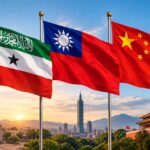
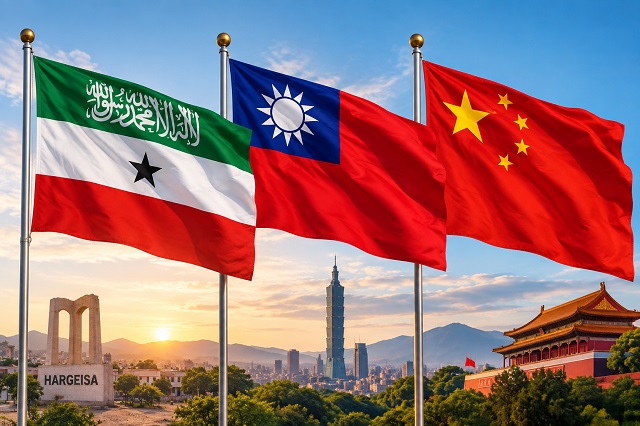
Q17: Joshua Meservey: Somaliland established relations with Taiwan in 2020. What benefits has the relationship produced?
President Irro: Irro praised Taiwan’s technological development and said Somaliland had benefited from cooperation in several areas.
“Taiwan, unfortunately, is not a member of the United Nations, but it’s a highly developed country, technologically advanced,” he said.
He highlighted cooperation in education, training, health, agriculture and technology.
Irro said Taiwan was building a clinic in Hargeisa and supporting the development of a data center, among other projects.
He said Somaliland intended to maintain the relationship despite objections from Beijing.
Q18: Joshua Meservey: What pressure or incentives has Beijing offered since Somaliland established relations with Taiwan?
President Irro: Irro said China had communicated its position through diplomatic channels.
“They prefer Taiwan to leave,” he said.
But Irro indicated that Somaliland would continue its relationship with Taiwan.
He compared the situation to the coexistence of China and Taiwan’s diplomatic and political presence in Washington.
Q19: Joshua Meservey: Berbera is a modern port but remains below its potential capacity. What is needed for it to become a serious competitor to Djibouti?
President Irro: Irro said Berbera’s port infrastructure is efficient but that supporting infrastructure remains insufficient.
“We need more infrastructure, better roads, better corridor and maybe railway,” he said.
He identified the lack of a railway connection to Ethiopia as one of the major limitations.
Irro also said Somaliland was working toward a trade and transit agreement with Ethiopia, which he expects would increase trade volumes between Ethiopia and Somaliland.
He said Ethiopia has expressed strong interest in using Berbera, but infrastructure improvements are needed for the port to compete more effectively with Djibouti.
Q20: Joshua Meservey: What sectors are attracting interest from U.S. companies?
President Irro: Irro said American companies had expressed interest in both the port and mining.
“We have some companies who are interested in mining. Some companies [are] interested in the port itself,” he said.
He also encouraged international companies and countries to participate in geological surveys of Somaliland.
“We need a bit more general geological survey,” Irro said.
“We will be happy to discuss that with any international company or country that is interested to make that general survey.”
Q21: Joshua Meservey: What minerals do Somaliland potentially possess?
President Irro: Irro acknowledged that he is not a geologist but said Somaliland has significant mineral potential.
When asked about the country’s known resources, he also said Somaliland has oil and gas potential.
“We have offshore, onshore. We have oil. We have gas,” Irro said.
He said several companies, including British and Arab firms, were showing interest in oil and gas opportunities.
Q22: Joshua Meservey: With the Bab el-Mandeb facing growing security risks, what advice would you give the international community on dealing with the Houthi threat?
President Irro: Irro argued that maritime security around the Bab el-Mandeb should be a global priority.
He said Somaliland has worked for decades with limited resources to protect its waters.
“A small country with a small coast guard has been trying their level best to protect the waters in Somaliland, and now the whole world is feeling the burden,” he said.
Irro warned that global energy and trade routes are vulnerable in both the Strait of Hormuz and Bab el-Mandeb.
He argued that the maritime passage must be protected and welcome security cooperation with international partners.
“We are really [open to] any partnership with the United States and our friends as well,” he said.
Q23: Joshua Meservey: Have you made the case to Red Sea countries that a stronger Somaliland could become a security provider for regional shipping?
President Irro: Irro said the changing security environment has made regional actors more receptive to Somaliland.
“Because of the current situation and the demand for a safer passage of international trade and marine security as well, I think our friends now in the region, maybe the United States, United Arab Emirates, we feel now they are more receptive than before,” he said.
He criticized countries that continue to exclude Somaliland from regional maritime-security discussions.
“It is unacceptable that Somaliland [is] ignored in any conferences or whatever for marine security,” Irro said.
He added that some regional countries are now paying greater attention to Somaliland’s potential role.
Q24: Joshua Meservey: The region faces wars and political instability in Sudan, Somalia, South Sudan and tensions involving Ethiopia and Eritrea. What should U.S. policymakers do?
President Irro: Irro said greater strategic cooperation among Somaliland, the United States, Israel and the United Arab Emirates could contribute to regional stability.
“The way forward is that Somaliland, as I said, [is] offering a partnership to the United States, to Israel, to United Arab Emirates,” he said.
He argued that cooperation among these partners could help reduce regional threats.
“I think it can save the problem and can minimize the threat,” Irro said.
Q25: Joshua Meservey: You served as a diplomat in the Soviet Union during its collapse. What did you learn from that experience?
President Irro: Irro said his years in the Soviet Union taught him that political structures that appear permanent can change rapidly.
He served there from 1988 to 1996 and witnessed the fall of the Soviet Union and the emergence of independent republics.
“Structures can change and states can dissolve as well,” he said.
Irro said the collapse of the Soviet Union demonstrated that geopolitical arrangements should not be considered permanent.
He also drew parallels between the dissolution of the Soviet Union and the breakup of Yugoslavia, noting how rapidly previously unified political structures can fragment.
Q26: Joshua Meservey: Why should Washington recognize Somaliland rather than maintain the status quo, particularly given the diplomatic complications that recognition could create?
President Irro: Irro framed his final argument around U.S. national interests.
He referenced President Donald Trump’s stated goal of making America “great” and “prosperous.”
“I think Somaliland can provide both — that America be great and America can be prosperous,” Irro said.
He highlighted Somaliland’s natural resources, strategic geography and security potential.
“We have resources. America can be safe. We have the most strategic real estate in the world,” he said.
Irro stressed that Somaliland was seeking partnership rather than dependency.
“Our principle is that we are not seeking [aid]. We are seeking cooperation and partnership and investment,” he said.
He concluded:
“So, we can make America safer and greater and prosperous as well.”
The audience applauded following his response.
Meservey: Somaliland’s “Consistent Pro-American Stance”
Closing the discussion, Meservey thanked President Irro for appearing at Hudson Institute and praised Somaliland’s relationship with the United States.
He specifically highlighted Somaliland’s “consistent pro-American stance,” saying that he personally appreciated it despite pressures from countries in the region and beyond.
Meservey also congratulated Irro and the people of Somaliland for what he described as their achievements over the past three decades.
“It is an extraordinary accomplishment,” Meservey said.
He added that Somalilanders “have every right to be hugely proud of that.”
The Hudson Institute event provided President Irro with a prominent Washington platform to make the case that Somaliland’s strategic geography, security record, commercial potential and political stability make it a potential partner for the United States.
The institute described the Sept. 14 event as Irro’s first visit to the United States since winning Somaliland’s presidency in November 2024.

Abdikarim Saed Salah
Abdikarim Saed Salah is Editor-in-Chief and Founder of HornPost.com, an independent Hargeisa-based news platform covering Somaliland, the Horn of Africa, East Africa, the Red Sea and international affairs. A journalist, television presenter, producer and geopolitical analyst, he has more than 15 years of experience in broadcast journalism, digital media, reporting and diplomacy. He works with Horn Cable TV and focuses on politics, elections, security, foreign policy and conflict. He holds a BA in Journalism and an MA in International Relations.