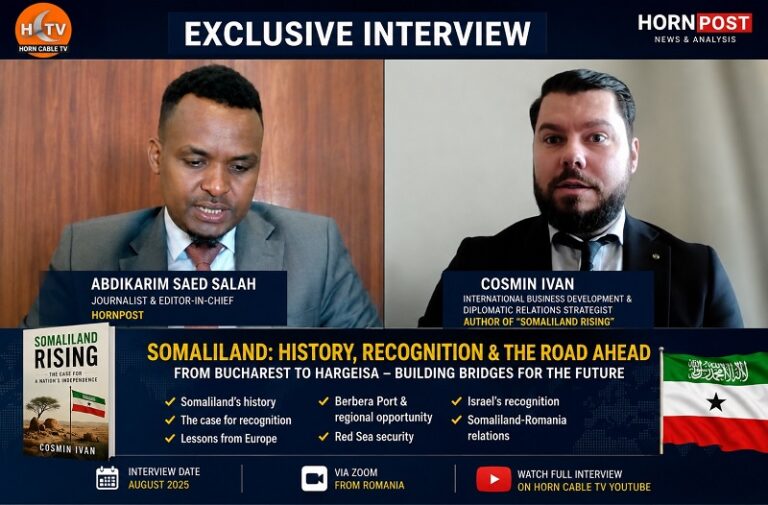
HARGEISA, Somaliland — (HornPost) Romanian business development and diplomatic relations strategist Cosmin Ivan, author of Somaliland Rising: The Case for a Nation’s Independence, says Somaliland’s history, democratic institutions and strategic location in the Horn of Africa could strengthen its case for international recognition.
Ivan made the remarks in an interview with journalist Abdikarim Saed Salah, Editor-in-Chief of HornPost, during a Horn Cable TV program conducted via Zoom while Ivan was in Romania.
The interview focused on Ivan’s book, Somaliland Rising, his first exposure to Somaliland, the territory’s history and statehood aspirations, international recognition, the role of the African Union, Red Sea security and the potential for stronger relations between Somaliland and European countries.
Why Cosmin Ivan Became Interested in Somaliland
Ivan said his interest in Somaliland developed through his international professional work, particularly during his time working in Norway.
He said he was struck by what he described as a contrast between Somaliland’s relative political stability and democratic experience and its lack of broad international recognition.
“What struck me immediately was the contrast between the fact of stability and democracy that Somaliland is exposing all over the world and the complete absence from the map as a recognized state.”
That contrast, he said, encouraged him to study the history of the Horn of Africa more closely.
Ivan, who has a background in psychology and works in international business development across Europe, the Balkans and Africa, said his research eventually led him to write Somaliland Rising.
‘Recognition Is Not a Favor’
Ivan described his book as an advocacy-oriented case for Somaliland’s international recognition, rather than a neutral historical account.
He argued that recognition should not be viewed as a political favor but as an issue that should be assessed against Somaliland’s existing political and institutional reality.
“Recognition first of all is not a favor. It’s an overdue justice for Somaliland,” Ivan said.
He argued that Somaliland has developed functioning state institutions and should therefore be treated as a political reality by the international community.
Lessons From Romania, the Baltics and Czechoslovakia
A central feature of Somaliland Rising is its comparison of Somaliland’s statehood aspirations with historical experiences in Europe.
Ivan discussed Romania’s independence from the Ottoman Empire, the independence of the Baltic states following the collapse of the Soviet Union, the peaceful separation of Czechoslovakia, and Kosovo’s experience in the Balkans.
He particularly highlighted the Romanian historical figure Nicolae Iorga, whom he said supported the interests of Albania during its struggle for international recognition.
Ivan argued that these historical examples demonstrate that the path toward independence and international recognition can take different forms depending on political circumstances.
He said Somaliland could study these experiences while developing its own diplomatic strategy.
African Union Remains a Major Challenge
Asked about the main obstacles to Somaliland’s international recognition, Ivan identified concerns within the African Union surrounding the precedent that recognizing Somaliland could create for colonial-era borders elsewhere on the continent.
He acknowledged those concerns but argued that political realities have changed and that Somaliland should increasingly be assessed on its current institutions, governance and strategic importance.
Ivan said Somaliland’s diplomatic engagement with Ethiopia and neighboring countries demonstrates that practical relations can help open political doors.
He argued that Somaliland could potentially present itself to the African Union as an asset rather than a threat to regional stability.
Berbera and Somaliland’s Strategic Importance
Ivan placed particular emphasis on Berbera Port and Somaliland’s location along the Gulf of Aden.
He said Somaliland could become an important gateway to East Africa through its port infrastructure and geographic position.
Looking ahead, Ivan predicted that Somaliland could become one of the most strategically important locations in East Africa over the next 10 to 15 years.
His argument comes amid growing international attention to the Red Sea, Gulf of Aden and Bab el-Mandeb, which connect major global trade routes with the Indian Ocean.
Red Sea Security as a Diplomatic Opportunity
Ivan recommended that Somaliland place greater emphasis on its potential contribution to Red Sea and Gulf of Aden security.
He said the recent tensions surrounding the Strait of Hormuz and other maritime chokepoints demonstrate the importance of secure shipping routes.
According to Ivan, Somaliland’s geographic position gives it an opportunity to present itself as a source of stability in a strategically important maritime region.
He said international actors could view Somaliland more favorably if it demonstrates a constructive role in maintaining security around the Gulf of Aden.
Democracy and Education as Somaliland’s Assets
Ivan also identified Somaliland’s democratic system as one of its strongest arguments for international engagement.
He pointed to elections, political institutions, an active media environment and what he described as efforts to invest in education.
He argued that Somaliland should continue strengthening these institutions as part of its broader international diplomacy.
For Ivan, the combination of democracy, geographic importance and international partnerships could strengthen Somaliland’s case for recognition.
Building International Partnerships
Ivan said Somaliland should continue building relationships with countries around the world.
He referred to Romania’s own historical experience, arguing that countries seeking independence and international recognition often benefited from building alliances and maintaining strong relationships with neighboring and distant partners.
His recommendation to Somaliland was therefore based on what he described as three broad areas: security, strong institutions and international friendships.
He said Romania could potentially become one of the European countries with which Somaliland develops deeper educational, political, economic and cultural relations.
Israel’s Recognition and Somaliland’s Diplomatic Campaign
The interview also addressed Israel’s recognition of Somaliland, which Ivan described as a significant milestone in Somaliland’s international recognition campaign.
He argued that Israel’s international influence and strategic position made the development particularly important.
Ivan said the development could also create opportunities for Somaliland to strengthen relations with other countries that maintain close ties with Israel.
However, his remarks on future recognition by other states were presented as his own expectations rather than announcements by those governments.
Could Romania Be Next?
Asked which country could potentially recognize Somaliland next, Ivan pointed specifically to Romania.
He said he hopes his efforts to promote greater awareness of Somaliland in Romania could contribute to stronger bilateral relations.
Ivan described Romania as an important European country and a NATO member and said he believes there is an opportunity for new diplomatic discussions as Romania develops its government and foreign-policy priorities.
He did not claim that the Romanian government has decided to recognize Somaliland.
A New Somaliland App
During the interview, Ivan also announced plans for a “Somaliland Quest” application that he said would be made available through Google Play and Apple’s App Store.
According to Ivan, the application is intended to provide people around the world with an opportunity to learn more about Somaliland, including its history and identity.
He described the project as another small contribution to Somaliland’s international recognition campaign.
‘Somaliland Can Be a Gateway to East Africa’
Ivan’s broader argument is that Somaliland’s geographic position could become one of its greatest strategic assets.
With Berbera and its location along the Gulf of Aden, he believes Somaliland has the potential to become an important gateway for trade and investment in East Africa.
He also argued that international recognition should be pursued alongside continued investment in democracy, education, diplomacy and regional security.
HornPost Analysis
Cosmin Ivan’s Somaliland Rising presents a clear advocacy argument: that Somaliland’s case for recognition should be evaluated through the combined lenses of history, functioning institutions, democracy, strategic geography and international diplomacy.
His comparison with European independence movements gives the book a historical framework, while his discussion of Berbera and the Gulf of Aden places Somaliland within the current geopolitical competition surrounding the Red Sea and East Africa.
The most significant question raised by the interview is whether Somaliland can transform its strategic importance into diplomatic influence.
For Hargeisa, that would require more than geographic advantages. It would also require sustained diplomatic engagement, institutional credibility, economic development and stronger international partnerships.
Prepared by:
HornPost Staff
info@hornpost.com
www.hornpost.com