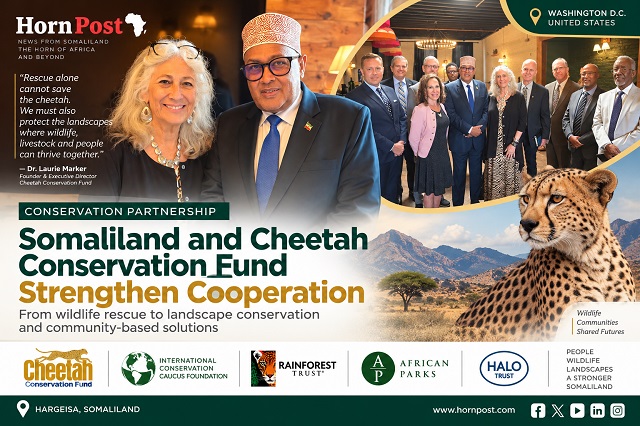
WASHINGTON, D.C. (HornPost) —The Cheetah Conservation Fund is expanding its long-running work in Somaliland beyond rescuing cheetahs from illegal wildlife trafficking, with a growing focus on protecting natural habitats and developing community-based conservation areas, the organization’s founder and executive director, Dr. Laurie Marker, said.
Marker said Thursday that CCF’s partnership with Somaliland now includes landscape conservation and programs designed to allow wildlife, livestock and pastoral communities to coexist while supporting local development.
Her comments followed a lunch hosted by the International Conservation Caucus Foundation, or ICCF, that brought together Somaliland President Abdirahman Mohamed Abdillahi and representatives from conservation organizations including CCF, Rainforest Trust, African Parks and HALO Trust.
“Rescue alone cannot save the cheetah,” Marker wrote in a Facebook post, stressing the need to protect the landscapes on which wildlife and communities depend.
CCF and Somaliland authorities have worked together for more than a decade to combat the illegal wildlife trade, particularly the trafficking of cheetah cubs taken from the wild in the Horn of Africa and destined for the exotic pet trade.
CCF says it has been assisting Somaliland authorities with confiscated cheetahs since 2011. Somaliland strengthened wildlife protection measures in 2016, criminalizing the capture and export of cheetahs, according to the organization.
From cheetah rescue to habitat conservation
The partnership has increasingly shifted toward preventing cheetahs from being removed from the wild in the first place.
Marker said CCF and local communities have helped develop conservation initiatives at Geed-Deeble and Libaaxley, combining biodiversity protection with the needs of pastoral communities.
CCF previously said its community-centered conservation initiative involved government officials, regional and district authorities and village development committees, with more than 50 villages involved in consultations over conservation areas in Maroodi Jeex and Awdal regions.
The strategy includes establishing a protected area at Geed-Deeble and a community conservancy around Libaaxley Mountain.
This approach is intended not only to protect wildlife but also to improve livelihoods and give communities a direct role in managing natural resources.
Geed-Deeble has already become central to Somaliland’s cheetah conservation efforts.
The Cheetah Rescue and Conservation Centre, located on about 800 hectares at Geed-Deeble outside Hargeisa, was developed to provide long-term care for animals confiscated from wildlife traffickers and cases of human-wildlife conflict.
In 2023, CCF transferred dozens of rescued cheetahs from temporary safe houses in Hargeisa to the center. A March 2026 CCF report said 89 cheetahs, a caracal and a leopard were moved during the major relocation.
Communities at center of conservation effort
CCF is also conducting ecological research aimed at improving knowledge about the remaining wild cheetah population across the Horn of Africa.
In 2025, researchers deployed 72 camera traps in Somaliland’s Awdal region as part of research examining cheetah distribution and habitat across Somaliland, Ethiopia’s Somali Region and Puntland. Local pastoralists have been involved in research, providing knowledge about wildlife and the surrounding landscape.
The organization argues that conservation efforts will be more sustainable if pastoral communities benefit from protecting wildlife and have alternatives that reduce human-wildlife conflict.
Rainforest Trust has also supported work at Geed-Deeble. CCF’s 2024 year-end report said a Rainforest Trust grant supported efforts to develop Geed-Deeble as a formally protected national park and conduct wildlife surveys in the proposed conservation area.
Marker described the broader conservation partnership as an effort to create a model in which environmental protection and economic needs are addressed together.
The latest discussions with international conservation organizations could provide another platform for Somaliland and CCF to broaden cooperation on wildlife protection, protected landscapes and community conservation.
For CCF, the long-term objective is increasingly focused on preventing the loss of cheetahs before they reach traffickers — protecting not only individual animals, but also the ecosystems and communities needed for wild populations to survive.
Prepared by:
Horn post staff
info@hornpost.com
www.hornpost.com
HARGEISA, Somaliland