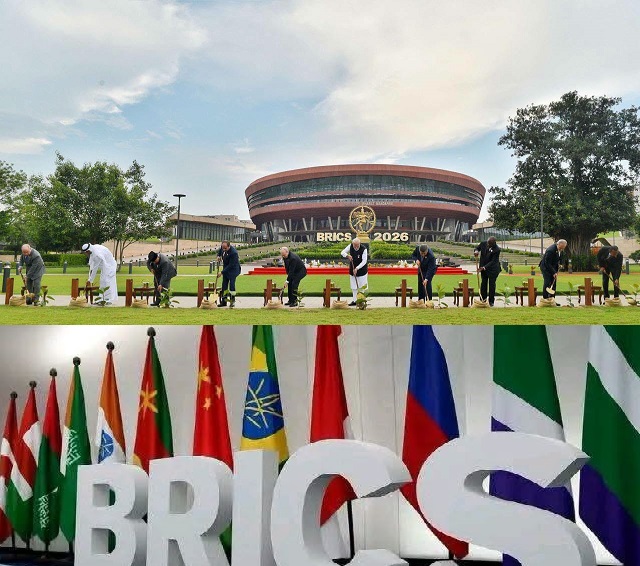
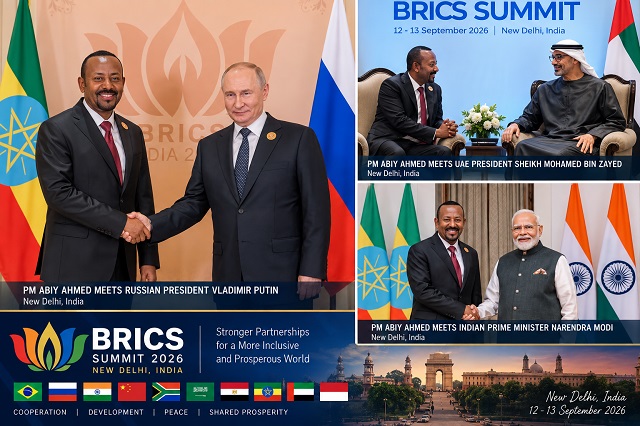
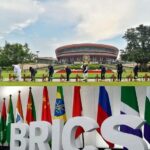
NEW DELHI (HornPost) — The 18th BRICS Summit in New Delhi opened with India pushing for local currency trade and food security mechanisms. But internal divisions — from Iran vs. UAE disputes to India–China tensions — tested the bloc’s unity as leaders adopted the New Delhi Declaration.
The 18th BRICS Leaders’ Summit opened in New Delhi on Saturday with India calling for resilience and cooperation among the expanded 11‑nation bloc. But the first day of talks revealed the challenges of unity, as regional rivalries and border disputes tested the group’s cohesion even as leaders pushed forward on trade in local currencies and food security initiatives.
A Bloc With Global Weight
BRICS — now comprising Brazil, Russia, India, China, South Africa, Egypt, Ethiopia, Iran, the United Arab Emirates, Saudi Arabia and Indonesia — represents nearly half the world’s population and 40 percent of global GDP. The expanded membership underscores its ambition to serve as a counterweight to Western‑led institutions, but also magnifies internal differences.
India’s Chairship Theme
Prime Minister Narendra Modi opened the summit under the theme “Building for Resilience, Innovation, Cooperation and Sustainability.” India positioned itself as a mediator, seeking to balance competing visions within the bloc while advancing its own priorities of economic independence and food security.
Fault Lines on Display
Diplomatic sources said disputes between Iran and the UAE over West Asia conflicts complicated consensus‑building during the first day. Both countries joined BRICS in 2024, bringing their rivalry into the bloc’s deliberations.
Meanwhile, Modi and Chinese President Xi Jinping met to stress “mutual respect and sensitivity,” but border tensions remain unresolved. Analysts note that India’s cautious engagement with China reflects both the potential for cooperation and the risk of confrontation.
Push for Local Currency Trade
India used its chairship to press for greater financial autonomy. Modi called for linking payment systems and expanding trade in local currencies to reduce reliance on the U.S. dollar. Leaders backed the initiative, signaling momentum toward a more multipolar financial order.
The move reflects frustration among BRICS members with dollar dominance in global trade and finance. Economists say success will depend on harmonizing payment infrastructure and building trust among members with divergent monetary policies.
Food Security Mechanisms
The summit also advanced plans for a BRICS Grain Exchange by 2027, designed to stabilize agricultural trade and strengthen food security. With members spanning major producers and importers, the initiative aims to reduce volatility and ensure reliable supply chains.
India highlighted its role as a leading agricultural exporter, positioning the exchange as a tool to support both domestic farmers and global markets.
New Delhi Declaration
The first day concluded with adoption of the New Delhi Declaration, reaffirming support for reforming multilateral institutions. Leaders pledged to expand representation of developing countries at the United Nations Security Council and to build a “fairer, more inclusive global order.”
The declaration also emphasized cooperation in technology, energy, and sustainable development, while acknowledging the need to manage internal differences.
India’s Diplomatic Balancing Act
Hosting the summit, India sought to project itself as a bridge between rival members. Modi’s bilateral meetings with Russian President Vladimir Putin, Iranian President Masoud Pezeshkian, and Xi underscored India’s effort to maintain dialogue across divides.
Analysts say India’s success in balancing these relationships will determine whether BRICS can evolve into a cohesive force in global governance or remain a fragmented coalition.
Challenges Ahead
Despite progress on economic initiatives, internal divisions remain a major obstacle. Iran and the UAE’s rivalry threatens to spill into BRICS deliberations, while India and China’s border disputes continue to cast a shadow over cooperation.
Observers caution that without mechanisms to manage conflict, BRICS risks being undermined by the very diversity that gives it global weight.
Outlook
The summit’s opening day highlighted both the promise and the peril of BRICS expansion. The bloc’s push for local currency trade and food security mechanisms reflects a desire to reshape global economic structures. But internal divisions underscore the difficulty of forging unity among nations with competing interests.
As the summit continues, India’s role as mediator will be critical in steering BRICS toward consensus. Whether the bloc can overcome its fault lines will shape its credibility as a voice for the Global South in the years ahead.
Prepared by:
Horn post staff
info@hornpost.com
www.hornpost.com