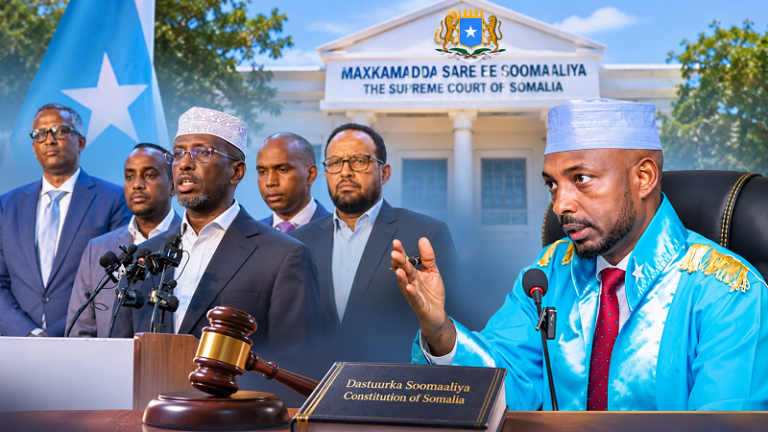
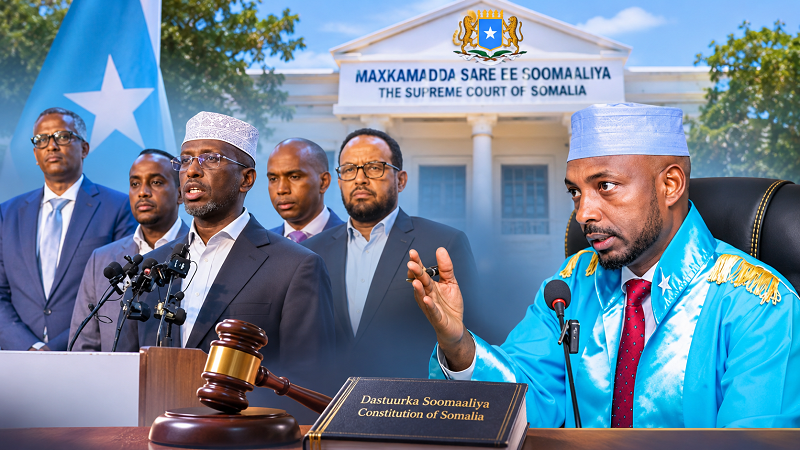
MOGADISHU (HornPost) – Somalia’s Supreme Court has ruled that the constitutional terms of the Federal Parliament, the President and the Federal Government expired in 2026, rejecting the application of a five-year term extension to the country’s current political leadership.
In a landmark decision issued on Thursday, the court said the constitutional amendments adopted in 2026 did not automatically extend the mandates of officials already in office. It ruled that the previous four-year term remains applicable to the current institutions because the amendments did not explicitly state that the new five-year term would apply retrospectively.
The ruling followed a constitutional petition filed by former Somali President Sheikh Sharif Sheikh Ahmed, who challenged the constitutional amendments and their implications for the terms of the country’s federal institutions.
The court, however, distinguished between the constitutional amendment process and the legal consequences of applying the revised term limits to incumbent leaders. It rejected part of the petition while accepting the argument concerning the constitutional terms of the current institutions.
Court Sets Dates for Expired Mandates
According to the ruling, the term of the Federal Parliament ended on April 14, 2026. The mandate of the Federal Government also expired on the same date, while President Hassan Sheikh Mohamud’s presidential term ended on May 15, 2026.
The court stated that official actions taken after the expiration of these constitutional mandates could not be considered legally valid under the applicable constitutional provisions.
It further clarified that the Federal Government should operate only in a caretaker capacity. This means its responsibilities should be limited to routine administrative matters and the continuation of essential government services.
The court also directed political stakeholders and relevant parties to reach an agreement on an electoral framework within 30 days.
It ordered that elections be held within 90 days, setting a short deadline for political leaders to resolve the country’s ongoing electoral dispute.
Court Rejects President’s Dismissal of Chief Justice
In a separate but related decision, the Supreme Court declared the dismissal of Chief Justice Baashe Yusuf Ahmed by President Hassan Sheikh Mohamud null and void.
The court ruled that the President could not unilaterally remove the Chief Justice without following the constitutional and legal procedures governing the judiciary.
It also questioned the legal basis of a statement published on the Presidency’s official Facebook page announcing the Chief Justice’s dismissal. The court said the announcement had no legal effect.
The ruling further raised concerns that the dismissal was intended to interfere with the constitutional proceedings before the court, although the Presidency had previously announced the decision.
The dispute emerged after President Hassan Sheikh Mohamud dismissed Baashe Yusuf Ahmed on November 4 and announced the reinstatement of former Chief Justice Ibrahim Idle Suleiman.
The Presidency said the decision followed concerns about the administration of the judiciary. However, it did not publicly provide detailed allegations or explain the legal procedures used to remove the Chief Justice.
The Supreme Court based its decision on constitutional provisions and existing laws governing the independence and organisation of the judiciary.
Former Leaders Welcome the Ruling
Former President Sheikh Sharif Sheikh Ahmed welcomed the Supreme Court’s decision, describing it as an important step in defending the Constitution and the rule of law.
Sharif had filed the petition that brought the constitutional dispute before the court. He also praised the judges for issuing the ruling amid growing political tensions.
Former Prime Minister Hassan Ali Khaire also welcomed the decision. He described it as a decisive ruling that had protected the interests of the Somali people.
Several opposition figures also expressed support for the court’s position, particularly its decision concerning the dismissal of Chief Justice Baashe Yusuf Ahmed.
They have argued that the independence of the judiciary must be protected and that no government official should act outside the limits set by the Constitution.
Political Uncertainty Ahead
The Supreme Court’s decision comes amid growing disagreements between the Federal Government, opposition groups and other political stakeholders over Somalia’s electoral process and constitutional arrangements.
The dispute has centred on the interpretation of the 2026 constitutional amendments, the duration of political mandates and the framework for holding the next elections.
The court’s ruling now places pressure on political leaders to reach an agreement within the deadlines it has established.
The 30-day period for agreeing on an electoral framework and the 90-day deadline for holding elections could have significant implications for Somalia’s political future.
However, implementing the decision will depend on cooperation among the Federal Government, opposition groups, parliament and other political stakeholders.
At the time of publication, the Federal Government had not issued an official response to the Supreme Court’s decisions. HornPost contacted government officials for comment but had not received a response.
The coming weeks are expected to be critical as Somalia faces the challenge of resolving its electoral dispute, respecting constitutional limits and preventing further political instability.
HornPost Staff Reporter
Email: info@hornpost.com
Website: https://www.hornpost.com