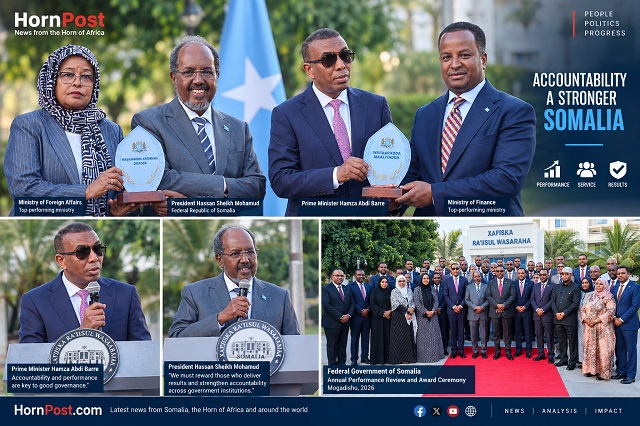
MOGADISHU, Somalia —(HornPost) President Hassan Sheikh Mohamud and Prime Minister Hamza Abdi Barre have recognized Somalia’s top-performing federal ministries following an annual government performance review aimed at measuring progress, accountability and the implementation of national plans.
The review, held in Mogadishu, assessed the performance of federal ministries and government institutions against commitments, targets and work plans for 2026. Prime Minister Hamza led the accountability process, while President Hassan Sheikh attended the closing ceremony and praised what he described as progress made by the government.
The Ministry of Finance and Ministry of Foreign Affairs were awarded medals after ranking among the highest-performing ministries in this year’s assessment. The Office of the Prime Minister was also recognized for introducing a digital system to monitor and evaluate the performance of government ministries.
According to the government, the exercise was designed to strengthen institutional accountability and ensure that ministries are evaluated against measurable targets rather than general political commitments.
Prime Minister Hamza stresses government accountability
Prime Minister Hamza Abdi Barre said accountability and performance evaluation are essential to improving the effectiveness of Somalia’s public institutions.
He urged ministers, directors-general and government officials to intensify their efforts and deliver higher-quality public services.
The annual review compared the work completed by ministries with commitments made at the beginning of the assessment period. Government officials said the process also identified areas where ministries had fallen behind and where additional efforts were required.
The government has increasingly promoted performance-based management as part of efforts to strengthen state institutions and improve public service delivery.
The latest assessment also marked the use of a digital government performance management system to display ministry results and rankings.
The system is intended to allow government officials to monitor progress more regularly and identify areas requiring corrective action.
President praises high-performing ministries
President Hassan Sheikh Mohamud praised the government for what he described as progress achieved during its four-year period in office.
He emphasized the importance of regularly evaluating government institutions and rewarding officials and ministries that meet their targets.
“The government must reward those who demonstrate effort and performance, rather than treating those who worked hard and those who fell short in the same way,” Hassan Sheikh said, according to the government account of the event.
The president also welcomed the use of digital systems to measure government performance, saying modern management tools could help transform government plans into measurable results for the Somali public.
He urged ministries to use the latest assessment as a basis for improving their performance and addressing areas where progress has been slow.
Digital performance system introduced
A major focus of the ceremony was the government’s Unified Government Integrated Performance Management System, known as GIPMS.
The system was introduced by the Office of the Prime Minister to strengthen monitoring, evaluation and accountability across federal government institutions.
Government officials say the system allows ministries to track progress against agreed targets and provides a more systematic way of comparing institutional performance.
The Ministry of Finance and Ministry of Foreign Affairs were among the highest-ranked institutions in the latest assessment.
The government says such rankings are intended not only to recognize strong performance but also to identify ministries that need additional support or improvements.
The approach represents an effort to move government performance management away from broad assessments toward measurable indicators and regular reporting.
Accountability claims face wider scrutiny
The government’s emphasis on accountability comes as Somalia continues to face significant challenges in governance and public service delivery.
Transparency International’s 2025 Corruption Perceptions Index, released in February 2026, gave Somalia a score of 9 out of 100, placing it at 181st among 182 countries and territories. Somalia was tied with South Sudan at the bottom of the ranking. The index measures perceived public-sector corruption using assessments from experts and businesspeople. Transparency.org
The ranking does not by itself establish that specific government ministries are corrupt, but it highlights the broader governance and institutional challenges facing Somalia.
Government critics and political analysts have consequently questioned whether internal performance assessments can translate into meaningful improvements in transparency, oversight and public services.
Security remains another major challenge. Somalia continues to face threats from al-Shabab and other armed groups, while federal and regional authorities remain engaged in efforts to expand state control and strengthen security institutions.
The delivery of basic services also remains a major issue for millions of Somalis.
Public services remain a key test
Despite challenges, development programs have produced measurable improvements in some sectors.
The World Bank reported in September that nearly 7 million people, including about 3.5 million women, are benefiting from improved electricity access and services across Somalia. The programs have also supported energy services at 205 health facilities and 380 schools. World Bank
At the same time, the World Bank says major challenges remain. Its 2026 Somalia Economic Update noted that only about 21% of households receive more than eight hours of electricity supply per day, while affordability remains a significant concern. World Bank
Water access, education, health care, electricity and infrastructure therefore remain central measures of whether government plans translate into tangible improvements in people’s lives.
The federal government says its performance management system is intended to strengthen precisely this link between planning, government spending and service delivery.
What comes next
President Hassan Sheikh called on ministers and government institutions to treat the latest results as a starting point for further improvements.
The government faces pressure to demonstrate that performance rankings can lead to concrete changes rather than becoming an annual administrative exercise.
For Somalia, the broader test will be whether stronger monitoring and accountability can improve the delivery of services, strengthen public institutions and increase public confidence in government.
The recognition of the Ministry of Finance and Ministry of Foreign Affairs gives the government an opportunity to showcase successful performance. But the administration will also face continued scrutiny over security, corruption, transparency and the delivery of basic services.
As Somalia continues its state-building efforts, the effectiveness of systems such as GIPMS will ultimately depend on whether government performance data leads to better decisions, stronger accountability and measurable improvements for citizens.
Prepared by:
Horn post staff
info@hornpost.com
www.hornpost.com
MOGADISHU, Somalia