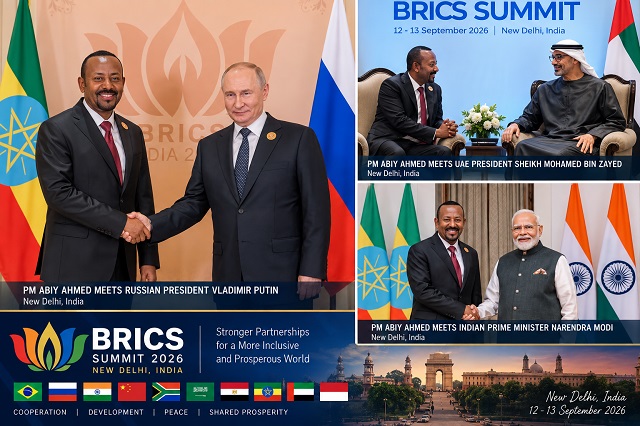
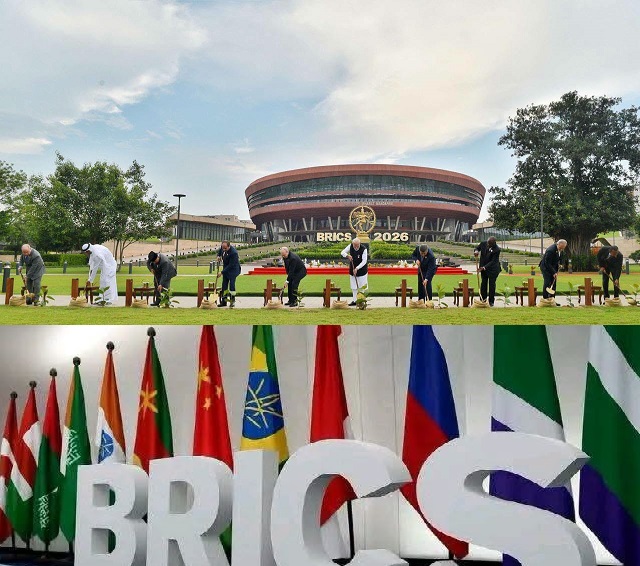
NEW DELHI, India—(HornPost) Ethiopian Prime Minister Abiy Ahmed used the 18th BRICS Leaders’ Summit in New Delhi to highlight Ethiopia’s development priorities, call for stronger cooperation between BRICS and Africa, and promote deeper ties with India.
The summit, hosted by India on Sept. 12-13 under the theme “Building for Resilience, Innovation, Cooperation and Sustainability,” brings together the 11 BRICS member states. The bloc represents about 49.5% of the world’s population, 40% of global GDP and 26% of global trade, according to the Indian government.
Ethiopia joined BRICS as a full member in January 2024, giving Addis Ababa a larger platform to engage with major emerging economies and promote its economic and diplomatic priorities.
Abiy Calls for More Inclusive Global Governance
During the first-day discussions, Abiy emphasized the need for a more inclusive and balanced international system, according to Ethiopia’s Prime Minister’s Office.
He argued that international institutions should provide developing countries with a greater voice in global decision-making and called for stronger multilateral cooperation.
The issue is central to the wider BRICS agenda. Leaders at the New Delhi summit have been discussing reforms to global governance and international institutions as the expanded bloc seeks a larger role in shaping the global economic and political order.
For Ethiopia, BRICS provides an additional diplomatic platform beyond its longstanding engagement with Western institutions and African organizations.
Ethiopia Highlights Food Security Gains
Abiy also highlighted Ethiopia’s progress in agricultural production and food security.
According to the Ethiopian government account of his remarks, the prime minister pointed to the country’s efforts to reduce dependence on imported wheat and increase domestic agricultural production.
The issue has broader relevance for BRICS, which has been examining ways to strengthen agricultural trade and food security among its members.
BRICS agriculture ministers have backed continued work toward a BRICS Grain Exchange, a proposed trading platform designed to facilitate agricultural transactions among member countries.
The grain initiative remains under development rather than being an operational global exchange. In 2026, BRICS countries continued discussing the proposal, including a potential platform for direct trade between producers and buyers.
Ethiopia’s growing agricultural output could give Addis Ababa an opportunity to position itself as both a major African food producer and a participant in emerging BRICS agricultural supply chains.
Africa Seeks a Bigger Role in BRICS
Ethiopia’s participation also carries wider significance for Africa.
As the headquarters of the African Union, Addis Ababa has long sought to position itself as an important center for African diplomacy. Through BRICS, Ethiopia can promote African priorities on trade, development finance, technology, climate change and reform of international institutions.
The expanded BRICS grouping includes two other African members alongside Ethiopia — Egypt and South Africa — giving the continent a stronger presence inside the forum.
The BRICS leadership has repeatedly emphasized the role of the Global South in international governance. South African President Cyril Ramaphosa told the New Delhi summit that African and developing-country voices should be fully reflected in shaping the future international order.
Technology and Artificial Intelligence
Abiy also highlighted Ethiopia’s efforts to expand digital transformation and artificial intelligence.
His government has promoted AI, digital public services and technology education as part of Ethiopia’s broader development strategy. Ethiopia’s Digital Ethiopia 2030 strategy identifies artificial intelligence, machine learning, blockchain and quantum computing as technologies that could strengthen economic sectors and public services.
At the BRICS summit, Ethiopia presented technological development as another area where developing countries can cooperate, build capacity and reduce the digital divide.
The emphasis comes as BRICS members increasingly discuss artificial intelligence, digital infrastructure and technological governance as part of the group’s broader development agenda.
Ethiopia and India Deepen Strategic Partnership
On the sidelines of the summit, Abiy held bilateral talks with Indian Prime Minister Narendra Modi.
The two leaders discussed strengthening the Ethiopia-India Strategic Partnership, including economic cooperation, defense and security, and capacity building, according to India’s Ministry of External Affairs.
Modi also welcomed Ethiopia’s participation in the BRICS summit and said Ethiopia’s presence strengthens the collective voice of the Global South. The meeting builds on Modi’s visit to Addis Ababa in December 2025.
The talks reflect India’s growing interest in strengthening relations with Ethiopia, one of East Africa’s largest economies and a major diplomatic center on the continent.
Mining, Energy and Infrastructure
Beyond politics, Ethiopia is seeking foreign investment and partnerships in sectors including mining, renewable energy, infrastructure, agriculture and manufacturing.
India has longstanding commercial and diplomatic links with Ethiopia, while Addis Ababa has increasingly sought to diversify its economic partnerships.
For Ethiopia, deeper engagement with India and other BRICS economies could provide additional sources of investment, technology and market access as the government pursues industrialization and infrastructure development.
Ethiopia Prepares to Host COP32
Climate diplomacy is another area where Ethiopia is seeking a larger international role.
Ethiopia is preparing to host COP32, the United Nations climate change conference, in Addis Ababa in 2027.
BRICS environment ministers endorsed Ethiopia’s COP32 presidency during a meeting in New Delhi in August, adding diplomatic support to Addis Ababa’s climate agenda.
Ethiopia has already established a national steering committee to coordinate preparations for the conference, which is expected to bring thousands of government officials, diplomats, climate experts and business representatives to Addis Ababa.
The COP32 presidency could give Ethiopia another major platform to promote African priorities on climate finance, adaptation, renewable energy and sustainable development.
What BRICS Means for Ethiopia
Ethiopia’s BRICS membership gives Abiy’s government access to a forum that includes some of the world’s largest emerging economies.
For Addis Ababa, the strategic value extends beyond trade. BRICS provides opportunities to pursue investment, technology transfers, development financing and diplomatic cooperation while strengthening Ethiopia’s role in debates over the future of global governance.
The challenge will be converting political commitments into concrete projects, particularly in agriculture, infrastructure, technology and industrial development.
Conclusion
Prime Minister Abiy Ahmed’s participation in the 18th BRICS Summit reflects Ethiopia’s effort to use its membership in the expanded bloc to advance national development priorities while promoting a stronger African voice in global affairs.
Food security, digital transformation, climate diplomacy and economic cooperation with India are central to that strategy.
With Ethiopia preparing to host COP32 in Addis Ababa in 2027 and deepening its strategic partnership with India, the BRICS platform gives Abiy another avenue to position Ethiopia as an important player in the emerging Global South economic and diplomatic order.
Prepared by:
Horn post staff
info@hornpost.com
www.hornpost.com
NEW DELHI, India