

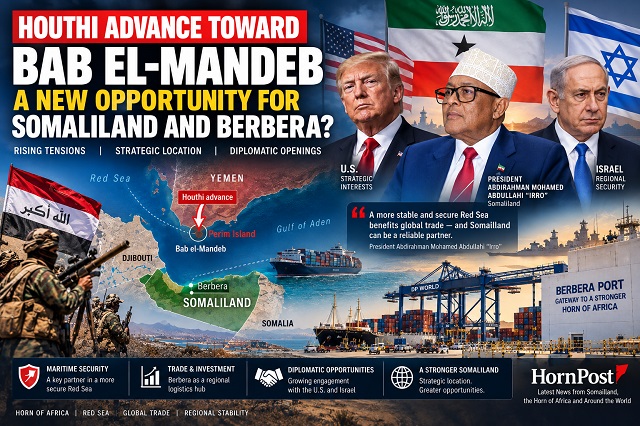
HARGEISA, Somaliland (HornPost) The rapid advance of Iran-aligned Houthi forces toward the Bab el-Mandeb Strait is creating a new strategic equation across the Red Sea and Gulf of Aden — one that could increase the geopolitical importance of Somaliland and its Berbera Port at precisely the moment President Abdirahman Mohamed Abdullahi “Irro” is seeking deeper security and diplomatic ties with the United States and Israel.
Reuters reported Saturday that the Houthis had moved into a position to potentially control the crucial waterway after reaching Perim (Mayun) Island, a strategically located island in the Bab el-Mandeb. Yemeni government sources told Reuters that government forces had withdrawn from the island and that Houthi forces had also taken the mainland coastal town of Dhubab, which faces Perim.
The development does not mean the Houthis have established uncontested control over the entire Bab el-Mandeb. But their presence on Perim significantly changes the strategic picture because the island sits inside one of the world’s most important maritime chokepoints.
For Somaliland, the timing is particularly significant.
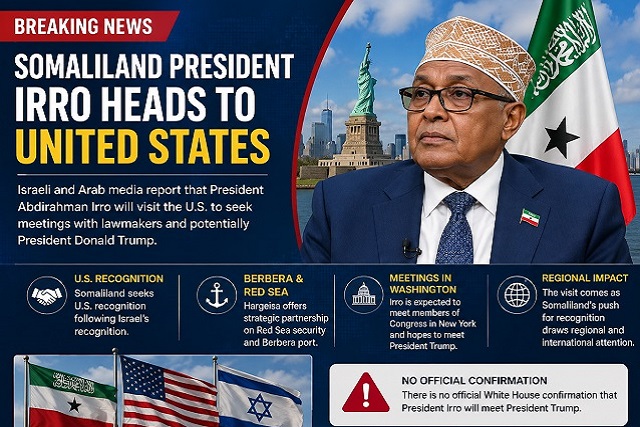
Irro is currently in Washington pressing Somaliland’s case for international recognition while presenting the territory as a potential security and economic partner for the United States. At the same time, Israel — the first U.N. member state to recognize Somaliland, according to current reporting — has already established diplomatic relations with Hargeisa.
The question emerging from the latest developments is therefore not simply whether Somaliland can attract more investment.
It is whether Berbera can become strategically important enough to influence the calculations of Washington and Jerusalem.
Bab el-Mandeb has suddenly become even more important
The Bab el-Mandeb connects the Red Sea with the Gulf of Aden and the Indian Ocean. It is the maritime gateway through which ships traveling between the Suez Canal and the Indian Ocean must pass.
The Houthi advance comes amid a wider regional conflict involving Iran, the United States and their respective allies.
Reuters reported that if the Houthis were able to consolidate control over the waterway, Iran would gain a powerful position from which to threaten another major global shipping corridor, after the Strait of Hormuz. The combination could place enormous pressure on international energy and commercial shipping.
The strategic importance is therefore much larger than Yemen.
A disruption in Bab el-Mandeb affects Europe, Asia, the Gulf and East Africa simultaneously.
And on the African side of that maritime corridor sits Somaliland.
Berbera’s geography suddenly matters more
Berbera is located on the Gulf of Aden, directly across the maritime space from Yemen.
That geography has long been an argument used by Somaliland to promote the port as a regional logistics hub. DP World describes Berbera as a gateway to East Africa and has invested in expanding its container and cargo-handling capabilities. The company’s current plans envision substantial increases in container capacity and a broader port-centered logistics ecosystem.
But the strategic value of Berbera is no longer simply about moving containers.
A worsening security environment around Bab el-Mandeb makes maritime awareness, coastal security, logistics, surveillance, search and rescue, naval access and secure shipping infrastructure increasingly valuable.
This creates a potential convergence between Somaliland’s economic ambitions and Western security interests.
Somaliland can argue that Berbera offers something different from a traditional military base: a commercial port located next to one of the world’s most strategically sensitive maritime corridors.
That distinction could become important in Washington.
Irro has already made the security argument in Washington
The latest Houthi developments come only days after Irro made an unusually direct strategic pitch in Washington.
In an interview with The Jerusalem Post on the sidelines of the MEAD conference, Irro said Somaliland had discussed both recognition and security cooperation with U.S. officials.
He said he could not point to an American commitment to recognize Somaliland but added:
“We are optimistic.”
Irro is also expected to meet members of Congress, including Sen. Ted Cruz, one of Somaliland’s most vocal supporters in Washington.
This is important because Somaliland’s recognition campaign has traditionally emphasized history, democratic institutions and the right to self-determination.
Those arguments remain central.
But the emerging Red Sea crisis gives Hargeisa another argument:
strategic utility.
The pitch to Washington increasingly becomes:
Somaliland is not asking the United States to recognize it simply because it wants recognition. Somaliland argues that recognition could create a more capable and reliable partner on the African side of the Red Sea.
That is a fundamentally different geopolitical argument.
Israel’s recognition gives Somaliland another strategic opening
Israel’s recognition of Somaliland in December 2025 dramatically changed Hargeisa’s diplomatic position.
Before that decision, Somaliland had spent decades seeking international recognition without a U.N. member state formally recognizing its independence.
Israel broke that pattern.
Irro has since argued that recognition dramatically increased Somaliland’s international profile.
In his latest Washington interview, he said Somaliland was now receiving far more international attention.
The Houthi advance gives that relationship an additional strategic dimension.
Israel has direct security interests in the Red Sea because attacks and threats from Yemen have repeatedly affected Israeli-linked shipping and the wider maritime environment.
Somaliland sits on the opposite side of the Gulf of Aden.
That does not mean Israel and Somaliland are preparing joint military operations against the Houthis.
In fact, Irro explicitly denied that his government had discussed allowing Israel to use Somaliland’s territory or airspace for operations against the Houthis. He also said Somaliland currently has no conflict with the Houthi movement.
That denial is significant.
It suggests that Hargeisa understands the danger of allowing its emerging relationship with Israel to be interpreted as a platform for direct military confrontation with Yemen’s Houthis.
The real opportunity may be maritime security, not a military base
The strongest strategic argument for Somaliland may therefore be maritime security rather than basing.
A future partnership could potentially involve:
- maritime surveillance;
- coast guard development;
- port security;
- anti-piracy operations;
- protection of commercial shipping;
- search and rescue;
- intelligence sharing;
- logistics;
- telecommunications and satellite monitoring;
- protection of critical infrastructure.
Such cooperation would be easier for Washington and its allies to defend politically than an immediate decision to establish a major foreign military base.
It would also fit Somaliland’s economic interests.
Berbera is already being developed as a commercial port and logistics hub. DP World says its Berbera operation connects the port to regional and international markets and provides onward connections toward Ethiopia.
The same infrastructure that supports commercial shipping can potentially support wider maritime-security objectives.
That is where the economic and geopolitical arguments converge.
Recognition could become a strategic calculation for Washington
The White House has made clear that U.S. policy toward Somaliland has not changed.
A report published Saturday said the White House told Politico that there had been “no change” in U.S. policy toward Somaliland. Irro himself has acknowledged that Washington has not promised recognition.
That means the Houthi advance should not be interpreted as evidence that U.S. recognition is imminent.
But it does change the strategic context in which the recognition debate takes place.
Washington now has to think about the possibility of a more dangerous Red Sea environment at the same time that Somaliland is offering itself as a potential partner.
That creates a policy question:
Would recognizing Somaliland give the United States a more useful strategic relationship on the African side of Bab el-Mandeb, or would it create unacceptable diplomatic and regional costs?
That is the real calculation.
Recognition would almost certainly provoke strong opposition from Mogadishu and could generate further tensions with Turkey and other countries that support Somalia’s territorial integrity.
But the strategic value of Somaliland cannot simply be separated from the geography.
Somalia and Turkey remain major complications
Any American move toward Somaliland would have consequences for Somalia’s federal government and its international partners.
Turkey is one of Mogadishu’s closest military partners and maintains a major military training presence in Somalia.
The latest tensions surrounding Turkey’s role in Somalia, including protests in Gedo and the burning of Turkish flags, demonstrate how sensitive the country’s external security relationships have become.
For Washington, therefore, Somaliland is not an isolated recognition question.
It is connected to a larger competition involving Somalia, Turkey, Israel, the Gulf states, Ethiopia, Yemen and the wider Red Sea security system.
A decision on Somaliland could alter the balance among these actors.
Berbera could complement rather than replace Djibouti
Another important consideration is Djibouti.
The United States already maintains a major military presence at Camp Lemonnier in Djibouti, while several other international powers operate military facilities there.
That means Washington does not necessarily need Berbera simply because it needs a military base near Bab el-Mandeb.
The more compelling argument is strategic diversification.
A second location on the African side of the Gulf of Aden could potentially provide additional logistical flexibility and resilience in the event that regional instability threatens existing facilities or maritime routes.
For Somaliland, this means the argument should not be:
“Replace Djibouti with Berbera.”
It could instead be:
“Add Berbera to a broader Red Sea security network.”
That is a more realistic strategic proposition.
But Somaliland also faces a serious risk
The same geography that creates opportunity creates danger.
If Berbera becomes publicly associated with American or Israeli military operations against the Houthis, Somaliland could become a direct target.
Irro’s denial that Somaliland has discussed Israeli operations against the Houthis therefore has strategic significance.
Hargeisa may want deeper cooperation with Israel and the United States while simultaneously avoiding becoming a battlefield in the Yemen conflict.
This is a delicate balance.
Somaliland needs to demonstrate that it can contribute to regional security without turning its territory into a platform for offensive operations.
That could become one of the most important elements of Irro’s diplomatic strategy.
The recognition argument is changing
For three decades, Somaliland’s recognition campaign has centered largely on its historical case, political institutions and democratic record.
Those arguments remain important.
But the strategic environment around Somaliland has changed dramatically.
The Gulf of Aden is no longer simply a commercial corridor.
It is increasingly a frontline in competition involving Iran, Israel, the United States, Yemen, Saudi Arabia and international shipping companies.
And Somaliland occupies a uniquely sensitive position within that geography.
The Houthi presence on Perim Island does not automatically translate into American recognition of Somaliland.
But it does make the question of who controls, monitors and secures the African side of the Bab el-Mandeb more consequential.
That gives Irro a new argument to take to Washington.
A new diplomatic formula for Hargeisa
The strongest Somaliland strategy may be to combine three propositions:
Recognition + Security + Economic Connectivity.
Recognition would provide the diplomatic framework.
Berbera would provide the economic and logistical infrastructure.
Maritime-security cooperation would provide the strategic rationale.
That combination is potentially more persuasive to Washington than a recognition campaign based exclusively on Somaliland’s historical claims.
It also aligns with Israel’s interests in Red Sea security while giving the United States a potential partner in a region where shipping routes are becoming increasingly vulnerable.
But Somaliland must avoid overplaying the argument.
The United States may conclude that the strategic benefits of closer ties with Hargeisa can be achieved without formal recognition.
The bigger question for Berbera
The most important question is therefore not whether the Houthi advance will immediately produce Somaliland’s recognition.
It will not.
The more important question is whether the crisis will change the cost-benefit calculation in Washington and Jerusalem.
If Bab el-Mandeb becomes persistently threatened, the value of secure ports, alternative logistics routes, maritime surveillance and reliable regional partners will rise.
Berbera already has the beginnings of the infrastructure needed to play such a role.
The port is being expanded. Its logistics connections are growing. DP World is positioning it as a gateway into East Africa. And Somaliland is actively seeking stronger relations with the United States and Israel.
The missing piece is political recognition.
That is why the current moment could be important for Irro.
The Houthi advance has not created Somaliland’s strategic importance. Geography did that long ago. What it may have done is make that strategic importance harder for major powers to ignore.
And if the Bab el-Mandeb crisis continues, Berbera could increasingly become part of the conversation about how the United States, Israel and their partners secure the Red Sea’s African flank.
For Somaliland’s recognition campaign, that could prove to be one of the most consequential geopolitical developments in years.
Prepared by:
Horn post staff
HARGEISA, Somaliland
Horn post staff
Horn Post Staff is a team of professional journalists and editors responsible for researching, writing, and publishing accurate, timely, and independent news coverage on HornPost.com. The team includes reporters based in Hargeisa, Mogadishu, Addis Ababa, and Nairobi, World, Africa, and middle east providing on-the-ground reporting and regional insights. Horn Post covers developments across Somaliland, Somalia, Ethiopia, Djibouti, and the wider Horn of Africa, as well as major global news. All reporting is fact-based and produced in line with the organization’s editorial standards for accuracy, fairness, and independence. Articles published under the byline “Horn Post Staff” represent collaborative newsroom work or reports filed by correspondents whose individual bylines may not be used on the website. Abdikarim Saed Salah is the Editor and Founder of Horn Post, overseeing editorial direction, standards, and content across the platform.