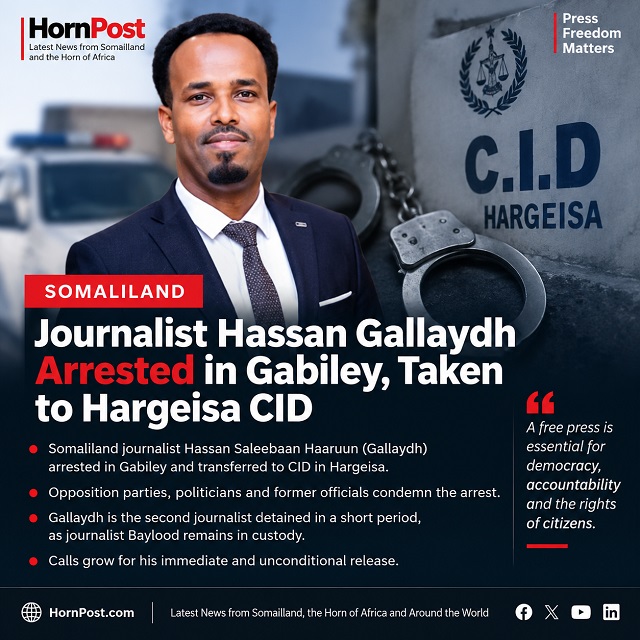
HARGEISA, Somaliland (HornPost) Somaliland journalist Hassan Gallaydh has been arrested in Gabiley and transferred to Hargeisa CID, prompting opposition calls for his release and renewed concerns over press freedom.
Somaliland journalist Hassan Saleebaan Haaruun, widely known as Hassan Gallaydh, was arrested in the city of Gabiley on Wednesday and transferred to the Criminal Investigation Department (CID) headquarters in Hargeisa, according to opposition parties and political figures who condemned the detention.
The arrest has triggered renewed concerns over press freedom, freedom of expression and the treatment of journalists in Somaliland, with opposition politicians accusing the government of President Abdirahman Mohamed Abdullahi “Irro” of using state authority to restrict critical voices.
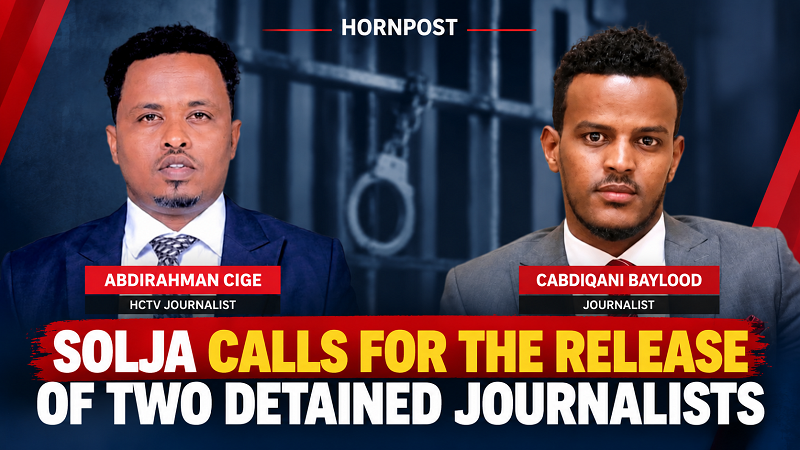
Gallaydh is the second journalist reported by opposition figures to have been detained within a short period. His arrest also comes as journalist Baylood remains in detention, according to the statements issued by political parties and officials.
The Kulmiye Party, Somaliland’s main opposition party, said Gallaydh was arrested in Gabiley and subsequently taken to the CID headquarters in Hargeisa. The party described the arrest as a serious concern for freedom of the press and citizens’ constitutional rights.
“The KULMIYE Party strongly condemns the government’s arrest of Journalist Hassan Galaydh,” the party said in a statement issued Sept. 9.
Kulmiye said Gallaydh, who manages Galaydh Media, had previously spoken publicly in support of journalist Baylood, who the party said had been detained for more than two weeks.
According to the party, the presence of two journalists in detention raises broader concerns about the state of press freedom in Somaliland.
Opposition Parties Condemn Arrest
Kulmiye called on the government to release Gallaydh immediately and unconditionally if there is no valid court order or criminal case providing a legal basis for his detention.
The party also urged authorities to release Baylod and ensure that journalists receive their legal rights.
Kulmiye argued that freedom of the press is an essential pillar of democracy, government accountability and the protection of citizens’ rights.
“If there is a complaint or dispute arising from a report, article or statement published by a journalist, the government should follow legal procedures,” the party said, stressing the need to distinguish between criminal and civil cases while respecting legally protected rights.
The opposition party further warned against using state power to intimidate, pressure or silence journalists.
KAAH Calls Arrest “Unlawful”
The KAAH Party also issued a statement strongly condemning Gallaydh’s arrest, describing it as part of what it called a growing pattern of pressure against journalists and critical voices.
The party said the detention was unacceptable if it was connected to the journalist’s professional work or statements.
“KAAH” argued that the media serves as a mirror of society and remains one of the key institutions responsible for government accountability and democratic oversight.
The party called on the government to respect freedom of expression and the rights of journalists, while urging the authorities to release detained journalists, including Gallaydh.
KAAH also warned that continued reliance on arrests and restrictions could further weaken public confidence in the government.
Politicians Question Government’s Record
Several Somaliland politicians and former officials have also criticized the arrest.
PM Xirsi Cabdillahi Hirsi, secretary of the Kulmiye Central Council and a member of the Somaliland House of Representatives, accused the Waddani-led government of undermining press freedom.
He said the government had moved away from its previous promises regarding freedom of expression and the media.
MP Mohamed Abib also called for Gallaydh and other detained journalists to be released, describing the detention as unacceptable.
“The government should return the freedom of journalist Hassan Gallaydh and other journalists,” Abib said, according to remarks circulated following the arrest.
Former government minister Dr. Abdiwali Sufi also criticized the administration’s record on press freedom.
Suufi questioned whether the Waddani Party’s earlier promises to protect freedom of expression and journalists’ rights had been genuine or whether the party’s approach changed after taking power.
He alleged that Gallaydh had become the 47th journalist detained by the Waddani government during its time in office. That figure was also cited in the Kulmiye statement.
However, the figure is an allegation made by opposition figures and was not independently verified in the material reviewed for this report.
Gallaydh Had Spoken About Detained Journalist
Gallaydh’s detention is particularly significant because of his reported public support for journalist Baylood.
Kulmiye said Gallaydh was among journalists who had openly discussed and advocated for Baylood’s situation.
Baylood, according to the opposition party, has been held for more than two weeks in connection with his journalistic work.
The circumstances surrounding the arrests, including the specific allegations or legal grounds against Gallaydh, were not provided in the statements cited above.
That absence of information has intensified calls from opposition politicians for authorities to clarify the legal basis for the detention.
Press Freedom Debate
The latest arrest has reopened a wider debate over press freedom in Somaliland and the relationship between journalists and the government.
Somaliland has a relatively active private media sector, with television stations, newspapers, websites and social media platforms playing a major role in public debate. Journalists regularly report on politics, government policy, security and social issues.
At the same time, arrests of journalists and disputes between media organizations and authorities have repeatedly generated concerns among local political groups and press-freedom advocates.
The central issue in the latest case is therefore not only the detention of one journalist but also whether disagreements involving published material should be handled through transparent legal procedures rather than detention.
For the government, any investigation involving a journalist should be conducted according to the law and should clearly establish the alleged offense, the legal basis for detention and the journalist’s access to due process.
For media organizations, the case highlights the importance of protecting journalists’ ability to investigate, question officials and report matters of public interest without intimidation.
Calls for Due Process
The opposition parties have not argued that journalists should be immune from the law. Instead, their statements emphasize that any allegations against journalists should be addressed through established legal procedures.
That distinction is important in assessing the wider Somaliland press freedom debate.
A journalist can be held accountable when there is a legitimate legal basis for doing so. But the government also has a responsibility to ensure that journalists receive due process and that any restrictions on their liberty are supported by law.
The government has not, in the statements provided for this report, publicly detailed the specific reason for Gallaydh’s arrest or confirmed the allegations made by opposition parties concerning the treatment of journalists.
The lack of an official explanation leaves important questions unanswered.
A Test for Somaliland’s Media Environment
Gallaydh’s arrest is likely to become another test of Somaliland’s commitment to freedom of expression, press freedom and democratic accountability.
The government has the authority to enforce the law, while journalists have a responsibility to report accurately and operate within the legal framework. But those responsibilities need to coexist with transparent institutions and protections for legitimate journalism.
The immediate question is therefore what legal grounds led to Gallaydh’s arrest and whether he will be released, charged or brought before a court.
The broader question is whether Somaliland’s political institutions can manage disagreements with journalists through law and due process rather than measures that could be perceived as attempts to silence criticism.
As opposition parties continue to demand the release of Gallaydh and Baylood, attention is now likely to focus on the government’s response and whether authorities provide a clear explanation for the arrests.
For Somaliland, the case carries significance beyond one journalist. It touches on the country’s broader democratic institutions, freedom of the press, freedom of expression, rule of law and government accountability.
Prepared by
Hornpost staff
info@hornpost.com
HARGEISA, Somaliland