HARGEISA, Somaliland (HornPost) Ethiopia’s present crisis is often described as a collection of ethnic conflicts, insurgencies and constitutional disputes. But beneath these immediate problems lies a much larger question:
Who will shape the Ethiopian state of the future?
The real contest is increasingly concentrated among three major political forces: Tigray, Amhara and Oromia. Other national communities remain important, and in some regions can be decisive, but the struggle over Ethiopia’s political centre is largely being shaped by these three constituencies.
The question is no longer simply who governs Ethiopia today. It is which political constituency will have the greatest influence over the state when the present political order eventually changes.
Abiy Is Not the Whole Story
Prime Minister Abiy Ahmed’s rise should not be confused with the rise of the Oromo political movement.
Abiy emerged from the crisis of the EPRDF system and came to power through a political coalition that included significant Amhara forces. His relationship with Oromo nationalist movements has never been straightforward. There have been periods of serious confrontation between his government and Oromo political organizations.
But something larger has happened during his years in power.
The political center of gravity of Ethiopia has been shifting.
Abiy may remain in power for years, or he may eventually leave. Either way, the deeper question is what political structure will remain after him.
This is where the Oromo question becomes much more consequential.
The emerging Oromo political project may seek not merely participation in Ethiopian power, but a durable political position that prevents Ethiopia from returning to an Amhara- or Tigrayan-dominated order.
That is a political possibility—not a claim about every Oromo politician or every Oromo citizen. But it is increasingly difficult to analyse Ethiopia’s future without taking that possibility seriously.
Finfinnee Is the Epicentre
Nowhere is this struggle more visible than in Finfinnee, or Addis Ababa.
The Ethiopian Constitution establishes Addis Ababa as the federal capital and provides for self-government by its residents. At the same time, Article 49 recognizes the “special interest” of Oromia in Addis Ababa.
That constitutional arrangement has never completely settled the political question.
Who does Finfinnee ultimately belong to politically?
Is it simply the capital of Ethiopia?
Is it also the capital of Oromia?
How should its administration relate to Oromia?
Who controls its resources, land, institutions and political direction?
These are not merely administrative questions. They go directly to the distribution of political power inside Ethiopia.
Whoever controls Finfinnee possesses enormous influence over the political centre of the country.
That is why the debate over Addis Ababa is so sensitive. It is not really about a city alone.
It is about the architecture of the Ethiopian state.
The Tigrayan Question
For decades, Tigray stood at the centre of Ethiopian political power through the TPLF-led EPRDF system.
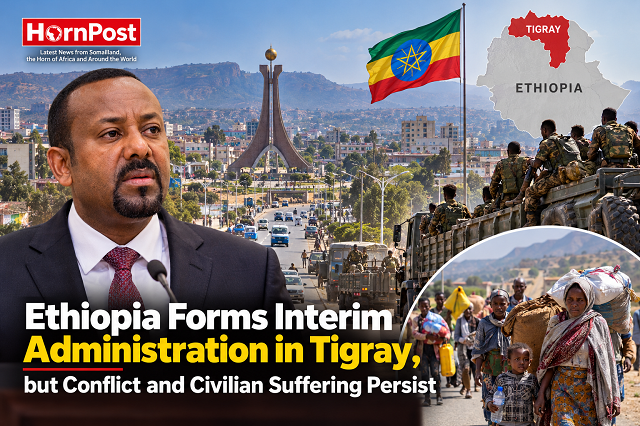
That era ended dramatically after 2018 and the subsequent Tigray war.
Today, Tigray is politically weaker at the national level than it was during the EPRDF period. But its political tradition, military experience, historical memory and organized leadership have not disappeared.
The fundamental question is whether Tigray will accept a permanently reduced role in Ethiopia’s political order—or seek, directly or indirectly, to recover national influence.
The tensions that have continued to emerge in northern Ethiopia demonstrate that the Tigrayan question has not been fully resolved.
It has merely changed form.
The Amhara Question
The Amhara political question is equally fundamental.
For much of modern Ethiopian history, Amhara political elites were central to the construction and administration of the Ethiopian state. Their relationship with the state is therefore not simply a matter of regional interest. It is tied to competing interpretations of Ethiopian identity itself.
Today, however, the Amhara region is experiencing a profound political and military crisis.
The Fano insurgency has transformed the political environment. Disputes over territory, federal authority, security and the future structure of Ethiopia have become deeply intertwined.
The Amhara question is therefore not simply whether Amhara forces can defeat the federal government.
The deeper question is:
What place will the Amhara political constituency occupy in a future Ethiopia in which the balance of power is moving away from the old northern political order?
The Oromo Question
Then comes Oromia.
Oromia possesses something that no other regional constituency can ignore: demographic weight, enormous territory and its geographic relationship with the federal capital.
The constitutional recognition of Oromia’s “special interest” in Addis Ababa gives the issue an institutional dimension.
This is why the debate over Finfinnee matters so much.
The Oromo political question is no longer simply about greater representation in an Ethiopian state dominated by others.
It is increasingly about the nature of the state itself—and about the position Oromia will occupy within it.
If the political centre of gravity continues moving toward Oromia, Ethiopia could be entering a new political era.
But that raises another uncomfortable question.
Can Ethiopia Change Dominance Without Repeating Domination?
Ethiopia has already experienced different political centers of gravity.
The danger is that the country could move from one form of political dominance to another without resolving the underlying problem.
If the old system concentrated power around one political constituency, replacing that constituency with another would not necessarily create a more stable Ethiopia.
It could simply reproduce the same structure under a different political owner.
The real test, therefore, is not whether Oromia becomes stronger.
It is whether Oromo political strength can be translated into a political settlement in which Amhara and Tigray—and the country’s other national communities—have a secure stake in the Ethiopian state, without any one constituency being able to monopolize it.
That is the harder task.
The Somali Fault Line
The Somali question must also be watched carefully—not because Somalis are likely to become one of the three principal contenders for control of Ethiopia’s political centre, but because the Somali Region sits on a different strategic fault line.
For Ethiopian Somalis, questions of federalism, regional autonomy, resources and political representation are inseparable from Ethiopia’s relationships with Somalia, Somaliland and Djibouti.
The Somali Region therefore connects Ethiopia’s internal constitutional struggle to the wider geopolitics of the Horn of Africa and the Red Sea.
A change in Ethiopia’s internal balance of power will inevitably affect that relationship.
Ethiopia’s Next Political Settlement
The 2026 election has strengthened Abiy Ahmed’s formal political position, but it has not eliminated Ethiopia’s deeper fault lines.
Tigray remains unsettled.
Amhara remains in conflict with the federal centre.
Oromia remains at the heart of the country’s future political equation.
And at the centre of all three questions stands Finfinnee.
The battle over Addis Ababa is therefore much larger than a dispute over municipal administration.
It is a contest over political geography.
It is a contest over constitutional power.
And ultimately, it is a contest over who will define Ethiopia after the present political order passes.
The central question facing Ethiopia is no longer simply:
Who is ruling Ethiopia today?
It is:
Who Will Own Ethiopia’s Political Future?
Author: Abdillahi Jama Ali – Qurus
abdillahijamac9@gmail.com
Hargeisa, Somaliland