Hargeisa, Somaliland (HornPost) If Ethiopia wants access to Somaliland’s maritime economy, where is the reciprocal access to its market?
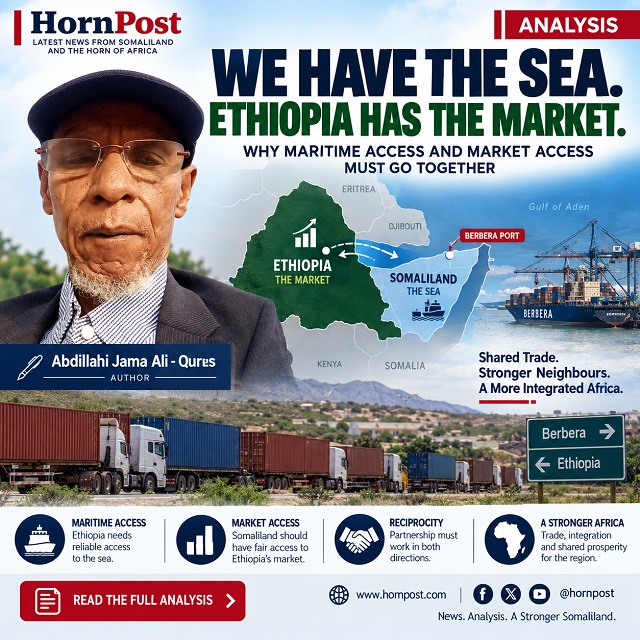
We have the sea. Ethiopia has the market.
That should be the starting point for any serious discussion about Ethiopia’s growing demand for reliable maritime access.
Ethiopia is landlocked. Its search for dependable access to international trade is understandable. No one can reasonably deny a country the right to seek efficient and affordable access to the sea.
But there is a fundamental principle that cannot be ignored:
Maritime access should not become a one-way entitlement.
If Ethiopia wants access to the ports, corridors and maritime economy of its neighbors, Somaliland has an equally legitimate question:
What economic access is Ethiopia prepared to offer in return?
This is not an argument against Ethiopia.
It is an argument for reciprocity.
The Country at the Center of African Integration
The question becomes even more important because Ethiopia occupies a unique position in Africa.
Addis Ababa hosts the headquarters of the African Union, while the continent is simultaneously attempting to create a common economic space through the African Continental Free Trade Area (AfCFTA).
The promise of AfCFTA is an Africa in which borders become less of an obstacle to legitimate trade, investment and economic cooperation.
But continental integration cannot be built simply by signing agreements in conference halls.
It has to be experienced at the border.
And that is where the contradiction becomes visible.
The Berbera Corridor
The Berbera Corridor is not a theoretical project.
It is an established commercial route connecting Ethiopia’s hinterland with the Gulf of Aden through Somaliland. Research has identified the corridor as an important link between landlocked Ethiopia and Berbera Port, with Tog Wajaale serving as a major crossing point for formal and informal trade.
Goods move through Berbera toward Ethiopia.
Ethiopian goods move in the opposite direction.
Livestock crosses the border. Traders, transporters and communities on both sides depend on this circulation.
The economic geography is already telling us something important:
Ethiopia needs the corridor. Somaliland needs the trade.
That should create partnership.
But genuine partnership requires two-way opportunity.
The Asymmetry
Research on the Ethiopia-Somaliland trade corridor has documented an important imbalance.
Somaliland exports to Ethiopia have historically involved a relatively limited range of goods, while Somaliland imports a much broader range of Ethiopian products, including qat, vehicles, clothing and electronics.
Research has also documented restrictions that have made it difficult for Somaliland residents to conduct business in Ethiopia’s Somali Region, with formal trade increasingly channeled through Ethiopian nationals and prescribed procedures.
This is the heart of the problem.
The corridor can be open for Ethiopia’s access to the sea without being equally open for Somaliland’s access to Ethiopia’s market.
That is not economic integration.
It is asymmetric integration.
A Border Is More Than a Line on a Map
For governments, a border may be a customs post.
For traders, it is something much more fundamental:
Can I enter?
Can I sell?
Can I bring my goods across?
Can I return with merchandise?
Are the rules clear?
Are they applied consistently?
Can a legitimate shipment suddenly become a customs problem?
These practical questions determine whether regional integration works in reality.
The World Customs Organization has examined border management and traders’ experiences at Ethiopian border posts, including Tog Wajaale, highlighting the importance of procedures, controls and trade facilitation at strategically important crossings.
The existence of informal trade itself provides another important lesson.
When formal channels become difficult, expensive or unpredictable, commerce does not necessarily disappear.
It moves around the system.
That is why improving customs procedures, simplifying requirements and establishing predictable arrangements for small-scale traders should be central to Ethiopia-Somaliland economic relations.
Now Come to Berbera
Ethiopia wants a maritime economy.
It wants reliable access to ports.
It wants lower transport costs.
It wants efficient logistics.
It wants alternative trade corridors.
All of these objectives are legitimate.
But Somaliland’s question should be equally legitimate:
If Ethiopia wants access to Berbera, why should Somaliland not ask for meaningful access to Ethiopia’s market?
Not special treatment.
Not charity.
Not political favors.
Reciprocity.
If Ethiopian goods can travel through Somaliland toward the sea, legitimate Somaliland goods should have a fair opportunity to travel into Ethiopia.
If Ethiopian traders benefit from the corridor, Somaliland traders should not face a fundamentally different economic reality on the other side of the border.
If Ethiopia wants the benefits of a maritime corridor, the corridor should work in both directions.
We Are Not Subordinates
This is the point that must not be lost.
There is no reason for hostility between Ethiopia and Somaliland.
There is an obvious basis for cooperation.
Ethiopia has the market. Somaliland has the maritime position.
Both are valuable.
Neither makes the other subordinate.
Ethiopia’s population and market size do not give it ownership of Somaliland’s coastline.
Likewise, Somaliland’s maritime position does not give it ownership of Ethiopia’s market.
But both assets create mutual leverage.
That is precisely why the relationship should be negotiated between equals.
The Question of Power
This is where the discussion becomes political.
Is Ethiopia seeking maritime access through genuine negotiation and reciprocal economic partnership?
Or is it relying on its size, population and strategic importance to pressure smaller neighbors into providing access while keeping its own economic gate comparatively narrow?
The difference matters.
Negotiation says:
We need access to the sea. What can we build together?
Pressure says:
We need access to the sea. You must accommodate us.
The first creates partnership.
The second creates resentment.
AfCFTA Must Mean Something
If Africa is serious about the African Continental Free Trade Area, then the principle must apply particularly to countries that sit along the continent’s strategic trade gateways.
The objective cannot simply be to make it easier for a landlocked country to reach a port.
It should also be to make it easier for African economies to trade with one another.
That means addressing tariffs, but tariffs are only part of the problem.
It also means addressing:
- Customs procedures
- Non-tariff barriers
- Border administration
- Movement of goods
- Trade documentation
- Small-scale cross-border commerce
- Predictability and transparency
Otherwise, Africa risks creating a continental free-trade agreement on paper while maintaining national economic walls on the ground.
The Bargain Is Simple
There is no reason for hostility between Ethiopia and Somaliland.
There is a clear economic basis for cooperation.
Ethiopia has the market.
Somaliland has the maritime position.
Let Ethiopia bring its commerce toward the sea.
Let Somaliland bring its commerce into the Ethiopian market.
Let Berbera become a genuine two-way economic bridge.
Let the border facilitate legitimate commerce rather than frustrate it.
Let maritime access and market access develop together.
That is what reciprocity means.
That is what partnership means.
And ultimately, that is what African economic integration should mean.
We have the sea. Ethiopia has the market.
Neither should treat the other as subordinate.
Analysis | Somaliland–Ethiopia
Author: Abdillahi Jama Ali – Qurus
abdillahijamac9@gmail.com
Hargeisa, Somaliland