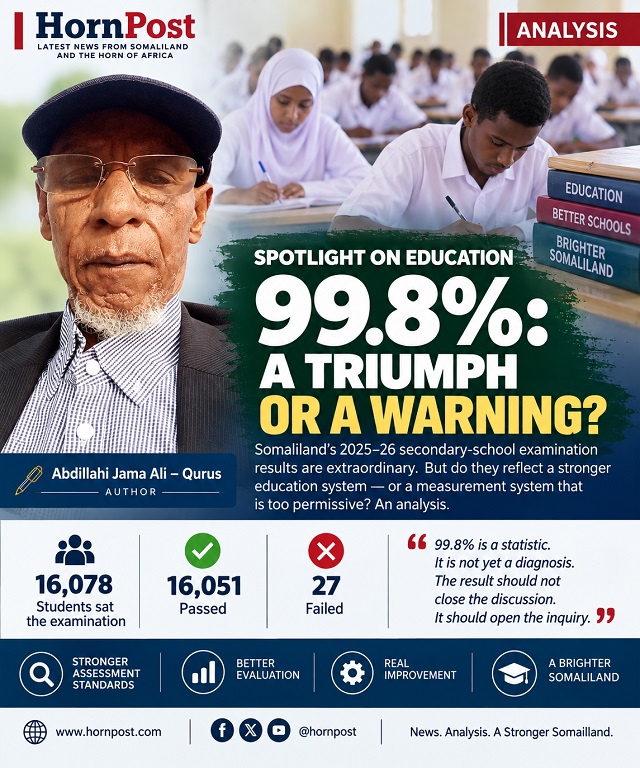
Hargeisa, Somaliland (HornPost) The reported 99.8% pass rate in Somaliland’s 2025–26 secondary-school examinations deserves serious public attention.
Not simply because 99.8% of candidates reportedly passed, but because such an extraordinary figure raises a fundamental question:
What does 99.8% actually tell us about the quality of education in Somaliland?
According to the reported results, 16,078 students sat the secondary-school examination, with 16,051 passing and only 27 failing. The previous year’s reported pass rate was already exceptionally high at 97.9%.
These figures may represent remarkable educational success. But they could also expose weaknesses in how educational performance is measured.
The statistic alone cannot tell us which one it is.
That is why an inquiry is necessary.
The Question Is Not Whether Students Passed
The real question is what the pass rate means.
If the examination is rigorous, the curriculum is properly tested, the pass threshold is appropriate, and marking and moderation are reliable, Somaliland has every reason to celebrate the achievement of its students.
But if the threshold is too permissive, the examination does not adequately distinguish different levels of achievement, or the assessment system fails to identify weaknesses, then a 99.8% pass rate could create a misleading picture of educational quality.
A number can be accurate and still fail to describe reality adequately.
Measure — Then Evaluate
Measurement tells us what happened. Evaluation tells us what it means.
An examination should do more than produce a pass percentage. It should identify weaknesses in subjects, schools, teaching methods, curriculum design and student learning.
Those weaknesses should lead to corrective action. Subsequent examinations should then show whether meaningful improvement has taken place.
If examination results are collected every year but do not lead to diagnosis, correction and improvement, then Somaliland may be measuring students without adequately evaluating its education system.
What Should an Inquiry Examine?
An independent parliamentary or external inquiry should not begin by accusing the Ministry of Education of wrongdoing.
Instead, it should ask a neutral and important question:
Is Somaliland’s assessment system robust enough to measure the true quality of education?
An inquiry should examine:
- Examination standards
- Curriculum alignment
- Question-setting
- Marking procedures
- Moderation
- Pass thresholds
- Statistical methods
- Evaluation of examination results
It should also ask a more important question:
What changed because of last year’s examination results?
If the system is sound, an inquiry will confirm it. If weaknesses exist, it will help identify and correct them.
Either way, Somaliland stands to benefit.
Somaliland Should Benchmark the Measurement System
Somaliland should not only benchmark its students. It should also benchmark the system that measures them.
A credible examination should distinguish exceptional, average and inadequate levels of achievement.
The purpose is not to make more students fail. The purpose is to ensure that passing an examination represents a meaningful level of learning and academic achievement.
An exceptionally low pass rate can be an alarm.
So can an exceptionally high one.
The objective should not be to produce a particular percentage. It should be to produce a percentage that accurately reflects reality.
Beware of Orwellism
George Orwell’s Nineteen Eighty-Four offers a powerful warning about the relationship between official language, statistics and reality.
Orwell imagined a Ministry of Plenty in a society experiencing scarcity. The name suggested abundance; the reality suggested the opposite.
That is Orwellism: when official language or statistics can make something appear to be what it is not.
This does not mean Somaliland’s reported 99.8% examination result is false.
It means society should be careful not to confuse an impressive statistic with definitive proof of educational quality.
99.8% is a statistic. It is not yet a diagnosis.
An Independent Inquiry Is an Opportunity
The Ministry of Education should have nothing to fear from an independent review.
If the assessment system is robust, an inquiry could strengthen public confidence and validate the achievement of Somaliland’s students.
If weaknesses are found, Somaliland would have an opportunity to correct them and strengthen its education system.
Finding a weakness is not failure. Failing to look for one is.
The achievements of Somaliland’s students deserve to be protected — not by questioning success, and not by blindly celebrating it, but by ensuring that the measurement behind that success is credible, rigorous and capable of reflecting genuine learning.
So the question remains:
Are we looking at an exceptionally successful education system — or an exceptionally permissive measurement system?
The reported 99.8% pass rate should not close the discussion. It should open an inquiry.
By Abdillahi Jama Ali – Qurus
abdillahijamac9@gmail.com
Hargeisa, Somaliland