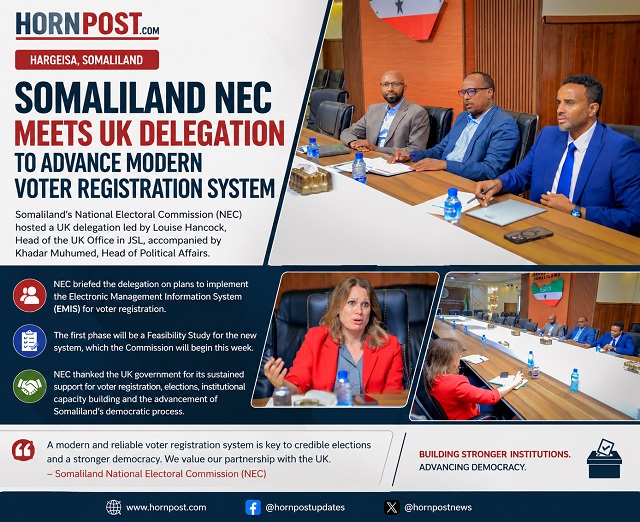
HARGEISA, Somaliland —(HornPost) The Somaliland National Electoral Commission (NEC) has held talks with a senior United Kingdom delegation in Hargeisa as the Commission moves forward with plans to modernize the country’s voter registration and electoral management systems.
The delegation was led by Louise Hancock, head of the UK Office in Somaliland, and included Khadar Muhumed, head of political affairs at the UK Office.
The meeting focused on information-sharing, strengthening cooperation and discussing ongoing efforts to improve Somaliland’s electoral institutions and voter registration processes.
According to the National Electoral Commission, the discussions included a detailed briefing on the planned implementation of the Electronic Management Information System (EMIS) for voter registration.
The Commission said the first stage of the initiative will involve preparing and conducting a feasibility study, which is scheduled to begin this week.
NEC Outlines Plans for Modern Voter Registration
During the meeting, Somaliland’s electoral commission presented the UK delegation with an overview of its plans to introduce a modern system for managing voter registration.
The proposed system is expected to form part of the Commission’s wider efforts to strengthen electoral administration, improve institutional capacity and modernize the management of voter information.
The feasibility study will provide an important first step toward determining the technical, institutional and operational requirements of the new system.
The NEC has separately advertised a consultancy for an Integrated Electoral Management System (IEMS) programme design and feasibility study, describing the initiative as part of a broader transition toward a new voter registration system and integrated electoral management architecture.
The Commission’s current digitalization efforts come after Somaliland’s electoral authorities conducted biometric voter registration and biometric verification during the 2024 elections. The NEC has said its institutional development has included reforms to internal policies and procedures as well as strengthening cooperation with civil society and international partners.
UK Support for Somaliland’s Electoral Process
The Somaliland National Electoral Commission thanked the United Kingdom for its continued support for voter registration, elections and institutional capacity-building.
The Commission said British assistance has contributed to efforts aimed at strengthening its institutional capabilities and accelerating Somaliland’s democratic processes.
The latest meeting also reflects continued engagement between Somaliland’s electoral institutions and international partners.
The UK has maintained engagement with Somaliland through its office in Hargeisa, while continuing to hold its longstanding position that Somaliland’s status should be addressed through dialogue between Hargeisa and Mogadishu.
Louise Hancock has previously engaged with Somaliland government officials on strengthening bilateral cooperation. A Somaliland government report published in 2025 recorded her appointment as the new head of the UK Office in Somaliland and described discussions focused on strengthening relations and cooperation between the two sides.
Technology at the Center of Electoral Reform
The planned voter registration system represents a significant technological component of Somaliland’s wider electoral reform agenda.
The NEC’s feasibility-study tender identifies several areas requiring assessment, including existing registration equipment, biometric verification systems, servers, networks, storage infrastructure, software and connectivity.
The tender also outlines plans to examine how voter registration could be integrated with verification, card production and other electoral processes.
Among the technical requirements identified by the Commission are real-time online deduplication and on-the-spot voter card printing and issuance.
Such capabilities could potentially improve the efficiency of voter registration while strengthening the accuracy and integrity of the electoral register.
Building Confidence in Future Elections
For Somaliland, modernization of voter registration is not simply a technology project. The voter register is one of the foundations of a credible electoral process.
A reliable registration system can help electoral authorities identify eligible voters, reduce duplication, maintain accurate records and improve the administration of polling operations.
The NEC has previously emphasized its responsibility for managing voter registration, voter education, elections and electoral dispute processes. Its mandate covers presidential, parliamentary and local council elections as well as national referendums.
The Commission’s 2024 electoral preparations also involved extensive training and deployment of polling personnel, while international observers highlighted the NEC’s efforts to maintain communication with political stakeholders and provide greater public access to electoral information.
A Broader Partnership With the UK
The latest discussions between the NEC and the UK delegation come amid broader UK-Somaliland engagement in areas including governance, security and institutional development.
In July 2026, Somaliland’s Interior and Security Ministry also held talks with a senior UK delegation on security cooperation, institutional reform, intelligence-sharing and capacity-building.
The electoral commission’s engagement with British officials therefore forms part of a wider pattern of cooperation focused on strengthening Somaliland’s institutions.
For the NEC, international partnerships remain important as it seeks to improve electoral technology, institutional capacity and the administration of future elections.
Feasibility Study Marks Next Step
The planned feasibility study is expected to provide the foundation for the next stage of the voter registration modernization program.
The NEC’s procurement documents indicate that the wider process is intended to produce an implementation blueprint, assess existing infrastructure, establish technical requirements, examine institutional reforms and develop a roadmap for implementation.
The Commission’s decision to begin with a feasibility assessment suggests that the modernization program will involve both technological investment and institutional changes.
As Somaliland continues to develop its electoral institutions, the success of the new voter registration system could become an important test of the Commission’s ability to combine technology, institutional reform and international cooperation.
For the United Kingdom, continued support for Somaliland’s electoral institutions provides an avenue for practical engagement in governance and democratic development, even as London maintains its established position on Somaliland’s political status.
The start of the EMIS feasibility study this week therefore marks an important step in Somaliland’s effort to build a more modern, integrated and reliable voter registration system ahead of future electoral processes.
Prepared by:
HornPost staff
info@hornpost.com
HARGEISA, Somaliland