
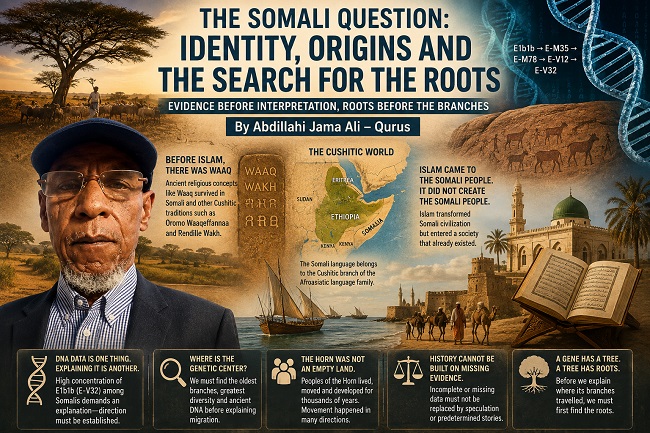
The Somali Question: Identity, Origins and the Search for the Roots
By Abdillahi Jama Ali – Qurus
A gene has a tree.
A tree has roots.
Before we explain where its branches travelled, we must first find the roots.
This Is Not an Attempt to Replace One Myth With Another
For generations, the origin and identity of the Somali people have been explained through competing narratives.
One influential narrative traces Somali ancestry to Arab Muslim ancestors who crossed the Gulf of Aden and spread Islam. Another places the Somali people within the ancient Cushitic world of the Horn of Africa.
The purpose of this article is not to replace one predetermined story with another.
It is to insist that evidence must come before interpretation.
The question of Somali origins is now increasingly discussed through DNA research. But genetic research introduces an important distinction that must never be forgotten:
DNA data is one thing. Explaining the data is another.
That distinction lies at the center of the Somali question.
Islam Came to the Somali People. It Did Not Create the Somali People.
Islam became one of the greatest forces in the formation of Somali civilization. It shaped Somali law, morality, education, literature, names, social institutions and international connections.
But Islam did not create the Somali people.
Islam did not create the Somali language.
Islam did not create the pastoral culture of the Somali people.
Islam entered a society that already existed.
The Somali people must therefore have had a history before Islam, just as every other people who later accepted Islam had a history before Islam.
The question is not whether Arabia influenced Somali society. It clearly did.
The question is whether the history of an entire people should begin with that influence.
It should not.
Somalis have a proverb:
“Intii qar jiray, quruurux waa jiray.”
As long as the cliff existed, the gravel existed.
The Somali people and their language cannot be separated. A language does not suddenly appear fully developed because a new religion arrives. Before Islam, there must already have been earlier forms of the language spoken by the people who later became known as Somalis.
The Somali language belongs to the Cushitic branch of the Afroasiatic language family. It connects Somali speakers to a wider world of Cushitic-speaking populations in the Horn of Africa.
Islam profoundly influenced Somali vocabulary and culture. Arabic contributed enormously to Somali civilization.
But influence is not origin.
A people may receive a religion without being created by that religion.
A people may adopt words from another language without ceasing to possess their own linguistic roots.
Before Islam, There Was Waaq
The survival of older religious vocabulary raises another important question.
Among the words that deserve serious attention is Waaq.
Somali expressions and words preserve traces of this ancient vocabulary. Related forms of Waaq or Waaqa also appear among other Cushitic-speaking peoples of the region.
Among the Oromo, Waaqeffannaa is an indigenous religious tradition centered on Waaqa as the supreme divine power.
The Rendille of northern Kenya also preserve traditional concepts associated with Wakh or Waaq.
This does not mean that we can reconstruct every detail of the ancient religion of the Somali people. Such a reconstruction would require more evidence.
But it demonstrates an important principle:
The Somali people did not begin to think about God when Islam arrived.
They already had religious concepts.
They already had names for the divine.
They already possessed spiritual traditions.
Islam transformed these societies and eventually became central to Somali identity. But Islam entered a human landscape that already existed.
DNA Data Is One Thing. Explaining It Is Another.
This is where the argument becomes most important.
Modern DNA research has shown that Somali male populations contain a high concentration of paternal Y-chromosome lineages belonging to the broader E1b1b family, formerly classified in some older studies as E3b1.
One major study of Somali men found approximately:
- 77.6% E3b1/E1b1b
- 75.1% in a particular E3b1 cluster
- 70.6% sharing a more specific Y-chromosome STR profile
This concentration is extraordinary. It demands an explanation.
But here lies the danger.
A genetic finding is not the same thing as a historical explanation.
Finding a related lineage in Egypt, Sudan, Arabia or elsewhere does not automatically prove that the Somali lineage came from there.
The direction of movement must be established.
And this brings us to the central question.
Before We Explain Migration, Where Is the Genetic Center?
A gene may be found in several regions.
But where did its particular lineage begin?
Where are its oldest branches?
Where is its greatest diversity?
Where are its deepest surviving branches?
Where are the oldest ancient-DNA samples?
How old is the lineage?
Until these questions are answered, a migration story remains an interpretation.
A scientist cannot simply find a genetic lineage in Egypt and Somalia and declare that it moved from Egypt to Somalia.
Why?
Why not from the Horn toward Egypt?
Why not from an older population center from which both populations later separated?
Why not movement in several directions at different times?
Similarity does not prove direction.
The Somali E1b1b Puzzle
The dominant Somali-associated paternal lineage belongs to a larger genetic tree:
E1b1b → E-M35 → E-M78 → E-V12 → E-V32
Every branch of this tree has its own history.
The birthplace of E-V32 may not be the birthplace of E-V12.
The birthplace of E-V12 may not be the birthplace of E-M78.
And the birthplace of E-M78 may not be the birthplace of the entire E1b1b family.
This is why broad statements about where “E1b1b came from” can be misleading.
The question is not simply:
Where did E1b1b originate?
The more precise question is:
Where did the specific branch that became so extraordinarily concentrated among Somali men originate?
That is the center of the investigation.
Seventy Percent Is Not an Accident
A concentration approaching 70% cannot simply be dismissed as a minor genetic pattern.
Something significant happened in the population history of the Somali people.
A particular paternal lineage expanded dramatically.
But why?
Was there an ancient population expansion in the Horn?
Was there a founder effect?
Was the expansion connected with pastoral societies?
Did the lineage become dominant among communities that later developed into Somali-speaking populations?
Or did it come from elsewhere and subsequently become dominant?
These questions must be investigated.
The conclusion must not come before the evidence.
DNA identifies the pattern. History must explain the pattern.
But history must explain it according to evidence — not according to a predetermined narrative.
The Horn Was Not an Empty Land
Any explanation of Somali genetic history must begin with one fundamental historical fact:
The Horn of Africa was not an empty land waiting to be populated by outsiders.
The Horn belongs to one of the world’s most ancient human landscapes.
Africa is the cradle of humanity, and the wider northeastern African region played an important role in ancient human history and the dispersal of human populations.
The peoples of the Horn did not suddenly appear when Arab ships crossed the Gulf of Aden.
Human populations had lived, moved, mixed and developed in this region for thousands of years before Islam.
This does not mean that no migration entered the Horn.
Of course there were migrations.
There was trade.
There was intermarriage.
There were movements across the Red Sea and the Gulf of Aden.
But movement occurred in different directions.
The Horn was not merely a passive recipient of population movements.
Its peoples were participants in the great human history of Africa.
The Problem With the One-Directional Story
For too long, African history has often been explained through a one-directional imagination.
Civilization came from outside.
Religion came from outside.
Trade came from outside.
Genetic ancestry came from outside.
Even identity came from outside.
But history is rarely so simple.
The Somali coast faced Arabia, but Arabia also faced the Somali coast.
Ships crossed in both directions.
People moved in both directions.
Ideas travelled in both directions.
Genes travelled in both directions.
Therefore, the mere existence of genetic similarity between populations on opposite sides of the Red Sea cannot establish the direction of migration.
The direction must be demonstrated.
And the first step is to identify the center.
Ancient Egypt and the Same Genetic Landscape
The question becomes even more interesting when ancient Egypt enters the discussion.
Ancient Egyptian DNA has demonstrated the presence of branches of the broader E1b1b family among some ancient Egyptian individuals.
But the dominant Somali-associated lineage is a much more specific branch.
Sharing the broad E1b1b family does not mean that ancient Egyptians and Somalis belonged to the same recent paternal branch.
Nor does it mean that one population necessarily descended from the other.
They may represent different branches of a much older northeastern African genetic tree.
This is exactly why the direction of movement cannot be assumed.
Before we explain the branches, we must understand the tree.
The Missing Royal DNA
Another limitation in reconstructing the genetic history of ancient Egypt is the limited public availability of high-resolution genetic data from many royal mummies.
Some famous rulers have been genetically tested.
Ramesses III was genetically investigated, and a paternal relationship was established with another mummy believed to be his son.
The royal family of the Eighteenth Dynasty — including Amenhotep III, the KV55 mummy widely identified as Akhenaten, and Tutankhamun — was also genetically investigated.
Yet the publicly available information does not provide a complete, independently verifiable, high-resolution genetic map for many of the most famous Egyptian kings and queens.
This matters.
A broad label such as E does not tell us enough.
Even a label such as E1b1b is not sufficient to establish a close relationship with the Somali-associated branch:
E1b1b → E-M35 → E-M78 → E-V12 → E-V32
Different branches may have separated thousands of years ago.
Therefore, no serious genetic bridge can be built between ancient Egyptian royalty and modern Somali populations without sufficiently detailed and independently examinable evidence.
This does not prove that anyone is deliberately hiding genetic information.
But it also cannot be ruled out.
What it does establish is a legitimate scientific limitation:
The genetic evidence remains incomplete, and high-resolution data are not sufficiently available to reconstruct every ancient branch or independently test every historical claim.
The absence of complete data must not be replaced by speculation.
History Cannot Be Built on Missing Evidence
We cannot claim that ancient Egyptian kings were Somalis.
We cannot claim that Somalis descended from Egyptian kings.
The evidence is not sufficient for either conclusion.
But the same principle must apply in the opposite direction.
No one should confidently construct a one-directional migration story from incomplete genetic evidence.
A branch found in one place does not automatically prove that it originated there.
A lineage found in two populations does not reveal the direction of movement by itself.
Before we explain migration, we must establish the center.
Before we follow the branches, we must find the roots.
The Real Question of Somali Origins
The debate over Somali origins has too often begun with conclusions.
One begins with Arabia.
Another begins with religion.
Another begins with genetics.
But perhaps the proper method should be simpler.
Ask first:
Where is the center of the lineage?
Then ask:
Where are its oldest branches?
Then:
Where is its greatest diversity?
Then:
What ancient DNA is available?
And only then:
What direction did it travel?
This is not only a Somali question.
It is a question about how history should be written.
The Roots Before the Branches
The Somali people are not a people without a past.
They had a language before Islam.
They had a society before Islam.
They had pastoral traditions before Islam.
They had concepts of the divine before Islam.
They belonged to the wider Cushitic world of the Horn of Africa.
Islam later became central to their civilization and identity. Arabic influence became profound. Contact across the Red Sea left its mark.
But influence is not origin.
Contact is not replacement.
Migration is not the creation of an empty land.
And genetic similarity does not automatically reveal the direction of human movement.
A gene has a tree.
A tree has roots.
Before we explain where its branches travelled, we must first find the roots.
That is where the investigation of Somali origins, Somali identity and the genetic history of the Horn of Africa must begin.
Author Abdillahi Jama Ali – Qurus
Hargeisa, Somaliland