




HARGEISA, Somaliland — (HornPost) The security map of the Horn of Africa is being redrawn by a convergence of maritime insecurity, renewed Somali piracy, Ethiopia’s search for dependable access to the sea and the growing strategic importance of Somaliland’s Berbera port.
Across the Gulf of Aden and the Red Sea, commercial shipping is confronting a security environment that has deteriorated sharply in recent months. At the same time, countries on both sides of the Bab el-Mandeb are competing for greater influence over ports, trade corridors and maritime security.
The developments are no longer isolated.
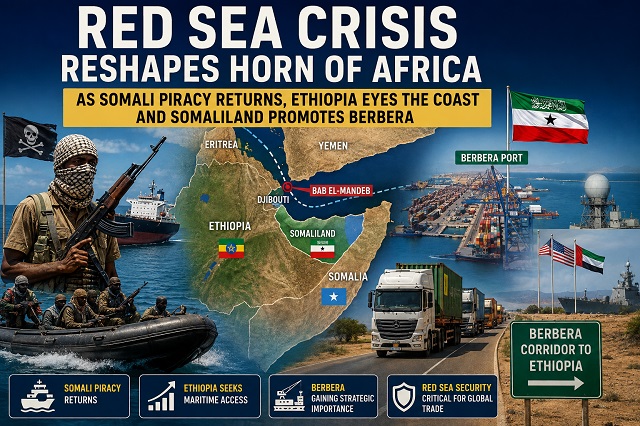
The return of Somali piracy is occurring alongside continuing instability around the Red Sea, while Ethiopia’s long-standing dependence on Djibouti is driving its interest in alternative maritime routes. Somaliland, meanwhile, is increasingly presenting Berbera not simply as a commercial port but as a strategic gateway connecting the Gulf of Aden, the Red Sea and the wider Horn of Africa.
For a region where geography has always been a source of strategic importance, the current crisis is turning geography into geopolitical leverage.
Somali Piracy Makes a Sharp Comeback
The most immediate warning sign is the renewed wave of Somali piracy.
On Aug. 20, Somali pirates hijacked the Eritrean-flagged oil products tanker M.T. Sibu 1 about 136 nautical miles east of al-Mukalla, Yemen, and took the vessel toward Somalia’s Puntland coast, according to The Associated Press.
The attack followed the seizure three days earlier of the Cameroon-flagged M/V Lutuf off Puntland.
AP reported that the Sibu 1 became the sixth commercial vessel hijacked by Somali pirates since April, following the seizures of the Honor 25, Sward, Eureka, Asana and Lutuf. The attacks have increasingly taken place farther from Somalia’s coastline, including in waters off Yemen.
The International Maritime Organization has issued a warning over the resurgence.
On Aug. 24, IMO Secretary-General Arsenio Dominguez said that more than 90 seafarers were being held captive by pirates and armed robbers and called for immediate action to address the worsening situation in the Gulf of Aden and surrounding waters.
The figures underline the scale of the reversal.
In July, the IMO said it had recorded 24 actual and attempted piracy or armed-robbery incidents in the Red Sea and Gulf of Aden over a three-month period, with 44 seafarers being held captive aboard three vessels at the time.
The U.S. Maritime Administration has separately warned that the overall piracy threat in the Gulf of Aden, Arabian Sea and western Indian Ocean increased during 2026, recording multiple hijackings and armed-robbery incidents since March.
The significance is clear: piracy, once largely contained after years of international naval patrols and improved security measures, is again becoming a serious factor in the maritime calculations of shipping companies and governments.
Why the Red Sea Crisis Is Different This Time
The resurgence of piracy is taking place in a maritime environment already destabilized by conflict in and around Yemen.
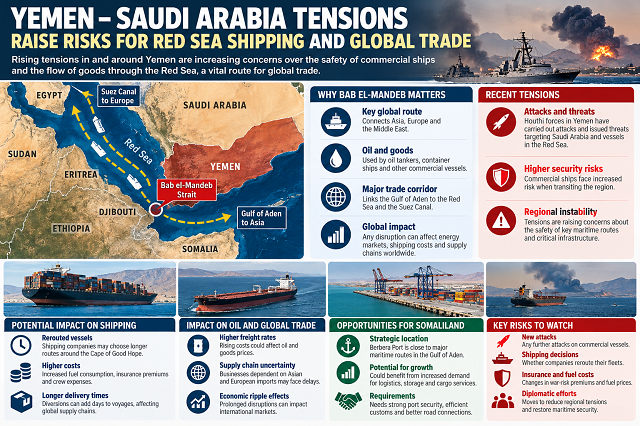
The Bab el-Mandeb Strait is the critical maritime chokepoint connecting the Gulf of Aden with the Red Sea and the Suez Canal.
Attacks on commercial vessels in the Red Sea have forced many shipping operators to reconsider the route, while continued threats have increased the cost and complexity of maritime transportation.
The IMO continues to monitor attacks against international shipping in the Red Sea and has condemned renewed assaults on commercial vessels.
Reuters has also reported that Yemen’s Houthi movement was considering imposing fees on commercial vessels using the southern Red Sea through Bab el-Mandeb, a development that would add another layer of risk to an already heavily contested waterway.
The result is a rare overlap of security threats.
A ship moving through the Gulf of Aden can potentially face the risk of piracy from the African side, missile and drone threats from Yemen, military activity, higher insurance costs and disruption to normal shipping routes.
That makes the security of the African side of the Red Sea increasingly important.
Berbera Moves Closer to the Center of the Red Sea Equation
This is where Somaliland enters the wider strategic picture.
Somaliland’s location on the Gulf of Aden places it directly opposite Yemen and close to the maritime approaches to Bab el-Mandeb.
Reuters has described Somaliland as strategically important because of its location at the junction of the Red Sea and Indian Ocean and because its main port, Berbera, provides access to major international shipping lanes.
The port has also undergone major investment.
The Financial Times reported in March that UAE-based DP World had invested about $450 million in Berbera port, while transport links connect the port to landlocked Ethiopia.
The investment is significant because Berbera is simply not competing for local cargo.
Its longer-term potential is connected to Ethiopia, one of Africa’s largest economies and the world’s most populous landlocked country.
A major highway linking Berbera with Ethiopia has further strengthened the port’s potential as an alternative trade corridor.
The Financial Times reported in August that the UAE had upgraded storage infrastructure and built a 250-kilometer highway connecting Berbera with Ethiopia.
That infrastructure gives Berbera a strategic proposition that extends far beyond Somaliland’s borders.
Ethiopia’s Search for a Route to the Sea
Ethiopia’s maritime dilemma is one of the central drivers of the changing regional landscape.
Since Eritrea’s independence left Ethiopia landlocked, Djibouti has served as Ethiopia’s principal maritime gateway.
That dependence has economic and strategic consequences.
For Addis Ababa, alternative access to the sea offers the possibility of reducing its reliance on one corridor and improving its negotiating position with neighboring states.
Somaliland’s location makes Berbera particularly attractive.
Reuters reported that Ethiopia signed a 2024 memorandum with Somaliland involving access to territory around Berbera, while the arrangement triggered a major dispute with Somalia.
The original agreement became one of the most consequential diplomatic developments in the Horn because it combined three highly sensitive issues:
Ethiopia’s maritime ambitions, Somaliland’s quest for international recognition and Somalia’s territorial claims.
The dispute also drew Egypt and Eritrea closer to Somalia, while Turkey became involved in diplomatic efforts to ease tensions between Mogadishu and Addis Ababa. Reuters has described the dispute as part of a wider regional rivalry involving Egypt, Eritrea, Ethiopia and Somalia.
Berbera Is Becoming a Strategic Asset for Somaliland
For Somaliland, the significance of Berbera extends beyond port revenues.
The territory has long argued that its geographic position and relatively stable security environment make it a natural partner for countries seeking secure access to the Gulf of Aden.
That argument has gained additional weight as the Red Sea crisis has intensified.
The Financial Times reported in April that Berbera’s location, combined with UAE investment in the port and transport links to Ethiopia, gives Somaliland a platform from which to pursue greater international engagement.
Reuters have similarly highlighted Berbera’s role in the wider competition over Red Sea security, trade and diplomatic influence.
Somaliland’s strategic calculation is therefore becoming increasingly clear:
If Berbera becomes indispensable to regional trade and maritime security, Somaliland’s geopolitical importance grows with it.
That does not automatically translate into diplomatic recognition, but it gives Hargeisa an asset that few other actors in the region can replicate.
Israel’s Recognition Adds a New Security Dimension
Israel’s recognition of Somaliland has further elevated the territory’s strategic profile.
Reuters reported that Israel’s recognition made it the first country to formally recognize Somaliland’s independence and noted the speculation surrounding possible military cooperation because of Somaliland’s proximity to the Red Sea and Houthi threats.
At the same time, Somaliland has denied that recognition means Israel has been granted permission to establish a military base or resettle Palestinians from Gaza.
The Associated Press similarly reported concerns that Israeli involvement around Berbera could increase regional tensions or contribute to proxy competition, particularly if Israel sought a presence there to counter threats emanating from the Red Sea.
The distinction between strategic cooperation, military cooperation and an actual foreign military base is therefore important.
They should not be treated as interchangeable.
What is clear is that Berbera has become part of a much wider conversation about Red Sea security.
The Somalia-Somaliland Dimension
The strategic importance of Berbera also creates a major political complication.
Somalia considers Somaliland part of its territory, while Somaliland maintains that it restored its independence in 1991.
Consequently, agreements involving foreign governments and Berbera are viewed very differently in Mogadishu and Hargeisa.
The Ethiopia-Somaliland agreement produced a strong reaction from Somalia, while the possibility of foreign military or security cooperation with Somaliland has the potential to generate further tensions.
AP previously reported that Somalia had objected strongly to Ethiopia’s proposed arrangement with Somaliland, which included plans for maritime access.
This means the port question cannot be separated from the sovereignty dispute.
Every major strategic investment in Berbera now has a diplomatic dimension.
Djibouti Faces a New Port Competition
The rise of Berbera does not mean Djibouti is losing its strategic importance.
Far from it.
Djibouti remains one of the world’s most important military and logistics hubs because of its position near Bab el-Mandeb and its established infrastructure.
But Berbera gives Ethiopia another potential maritime option.
That creates a competitive dynamic between two neighboring ports.
For Djibouti, Ethiopia’s trade has historically been central to its port economy. For Somaliland, attracting part of that trade could transform Berbera into one of the most important commercial gateways in the Horn.
The Financial Times has previously described Berbera’s development as part of a broader competition over Ethiopia’s trade and regional port infrastructure.
The competition is therefore not necessarily about replacing Djibouti.
It is increasingly about diversifying the Horn’s maritime network.
Ethiopia and Eritrea: The Dangerous Northern Dimension
The maritime question becomes even more sensitive when Ethiopia’s relationship with Eritrea is considered.
The two countries fought a devastating war between 1998 and 2000 before reaching a peace agreement in 2018.
They later cooperated during the Tigray conflict, but relations deteriorated after the 2020-22 war.
Reuters reported in February that Ethiopia accused Eritrea of military aggression and of supporting armed groups inside Ethiopian territory, allegations Eritrea has disputed.
The unresolved tensions matter because Eritrea controls a substantial stretch of Red Sea coastline, including the ports of Massawa and Assab.
That gives Eritrea strategic leverage over Ethiopia’s maritime ambitions.
If Ethiopia seeks alternative access to the sea, Eritrea will inevitably factor into the calculation.
This creates a potentially dangerous triangle involving:
Ethiopia’s maritime ambitions — Eritrea’s Red Sea coastline — Somaliland’s Berbera corridor.
Somalia’s Security and Humanitarian Crisis
While governments and international powers compete over maritime corridors, Somalia itself is confronting a severe humanitarian emergency.
Reuters reported this week that nearly 1.9 million children in Somalia are expected to suffer from malnutrition in 2026.
The number of children admitted to health facilities with severe acute malnutrition and related complications has risen by 32%, while 205 health and nutrition facilities have already closed following major reductions in humanitarian funding.
AP reported that around 6 million people in Somalia are facing acute food insecurity, while nearly 1.9 million children under 5 are at risk of acute malnutrition and about 500,000 require urgent treatment.
The humanitarian crisis matters to the security picture.
Somalia is being asked to strengthen maritime security, combat piracy and confront militant threats at a time when large sections of its population are facing drought, displacement and hunger.
That creates a difficult policy dilemma:
The international community wants greater security from Somalia’s coastline, but Somalia also requires resources to address the conditions that make insecurity harder to contain.
The International Powers Behind the Maritime Competition
The Horn of Africa has become a meeting point for the interests of major powers.
The United States seeks to protect shipping and counter militant and maritime threats.
China maintains a military base in Djibouti.
France has a longstanding military presence there.
Japan operates a facility supporting maritime security and anti-piracy operations.
Türkiye maintains significant military and security ties with Somalia.
The UAE has built a major commercial and strategic presence around Berbera and other regional ports.
Israel’s new relationship with Somaliland has added another layer to the competition.
At the same time, Iran’s relationship with the Houthis makes the western side of the Red Sea an extension of the broader Middle Eastern strategic contest.
The Horn is therefore no longer merely adjacent to the Red Sea crisis.
It is increasingly part of it.
Why the Return of Piracy Could Change Berbera’s Role
The resurgence of Somali piracy could paradoxically increase the strategic importance of ports such as Berbera.
If shipping companies face growing risks in the Gulf of Aden, demand will increase for:
- Maritime surveillance
- Search-and-rescue capabilities
- Anti-piracy operations
- Secure anchorages
- Naval logistics
- Intelligence-sharing
- Emergency response facilities
- Reliable commercial ports
Berbera’s geographical position gives it potential relevance in each of these areas.
But greater strategic importance also brings greater risk.
A port that becomes closely associated with foreign military operations could become a target in a regional conflict.
That is the central dilemma facing Somaliland.
The same geography that makes Berbera valuable can also make it vulnerable.
Three Possible Futures
- A More Connected Horn
In the most positive scenario, Ethiopia expands its maritime options, Berbera develops as a commercial gateway, Djibouti remains a major regional hub and international cooperation succeeds in containing piracy.
Competition could then produce economic diversification rather than conflict.
- A Militarized Maritime Corridor
A second scenario would see continued Houthi threats, renewed piracy and greater foreign military involvement.
Berbera, Djibouti and other ports could acquire greater security responsibilities, but the Horn would also become increasingly militarized.
- A Wider Regional Confrontation
The most dangerous scenario would combine renewed Ethiopia-Eritrea tensions, instability in northern Ethiopia, Somalia’s political and security challenges, piracy and continuing Red Sea conflict.
Under that scenario, individual crises could reinforce each other.
The result would be a regional security crisis stretching from Yemen to Somaliland, Ethiopia, Eritrea and Somalia.
The Horn of Africa Is Becoming the Other Side of the Red Sea Crisis
The latest piracy attacks have exposed a fundamental reality: securing the Red Sea cannot be achieved by looking only at Yemen.
The African coastline is equally important.
Somalia has the coastline but faces significant security and humanitarian challenges.
Djibouti has the established international military infrastructure.
Eritrea controls strategically located Red Sea ports.
Ethiopia has the economic weight but remains landlocked.
Somaliland has Berbera, a deep-water port positioned near one of the world’s most important maritime chokepoints, and it is increasingly using that geography as part of its diplomatic and economic strategy.
This convergence is changing the strategic balance.
The return of Somali piracy is therefore not merely a criminal story.
Ethiopia’s search for maritime access is not merely a trade story.
Berbera’s development is not merely a port story.
Together, they form part of a much larger transformation in which the Red Sea and the Horn of Africa are becoming a single strategic theatre.
For Somaliland, the challenge will be to convert Berbera’s geography into sustainable economic and diplomatic gains without allowing the territory to become a frontline in wider regional conflicts.
For Ethiopia, the challenge will be securing diversified maritime access without triggering confrontation with Somalia or Eritrea.
For Somalia, the priority remains rebuilding security and political stability while protecting its maritime interests.
And for international powers, the central challenge is protecting one of the world’s most important shipping corridors without turning the Horn of Africa into another arena for great-power and regional rivalry.
The central strategic question is no longer whether the Horn of Africa matters to the Red Sea.
It is how much the future of the Red Sea will be shaped by what happens in Berbera, Djibouti, Mogadishu, Addis Ababa and Asmara.
Prepared by:
HornPost staff
HornPost Editorial Desk


Abdikarim Saed Salah
Abdikarim Saed Salah is Editor-in-Chief and Founder of HornPost.com, an independent Hargeisa-based news platform covering Somaliland, the Horn of Africa, East Africa, the Red Sea and international affairs. A journalist, television presenter, producer and geopolitical analyst, he has more than 15 years of experience in broadcast journalism, digital media, reporting and diplomacy. He works with Horn Cable TV and focuses on politics, elections, security, foreign policy and conflict. He holds a BA in Journalism and an MA in International Relations.