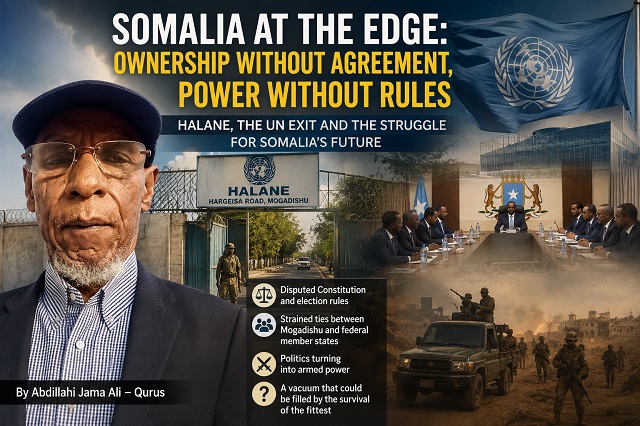
Halane, the UN Exit and the Struggle for Somalia’s Future
By Abdillahi Jama Ali – Qurus
For more than three decades, Somalia’s political life has unfolded under the watchful presence of the international community.
In Mogadishu, Halane became more than a diplomatic enclave. It became a meeting place, a listening post and, in many respects, the political center of gravity for the international community in Somalia. Somali politicians, opposition leaders, diplomats, United Nations officials, foreign governments and international organizations have all passed through its gates.
But the old arrangement is changing.
The United Nations dedicated political mission in Somalia is approaching its end, with greater responsibility increasingly being handed back to Somalia.
This should be a moment of national responsibility and political maturity. Instead, Somalia finds itself deeply divided over the very rules by which political ownership of the state should be exercised.
Who has the authority to govern?
Who determines the Constitution?
Who controls the electoral process?
What is the proper relationship between Mogadishu and the federal member states?
And, ultimately, who owns the Somali state?
These are no longer abstract constitutional questions. They are increasingly becoming questions of power.
If Somali leaders can reach an agreement, the departure of the international political machinery could become an opportunity for genuine Somali ownership.
If they cannot, the vacuum will not remain empty.
It will be filled by power.
And that is where the danger begins.
The End of an Era
The departure of the UN political mission does not mean that the international community is abandoning Somalia.
Halane will remain.
The United States, United Kingdom, European Union, African Union and other international partners will continue to have diplomatic and security interests in Somalia. Humanitarian and development operations will continue, while the security architecture surrounding Somalia will continue to evolve.
But something fundamental is changing.
The international community is increasingly telling Somalia:
The responsibility for your political future must ultimately belong to you.
That principle is difficult to dispute.
After decades of international involvement, Somalia cannot indefinitely depend on outsiders to design its political settlements, resolve disputes between its leaders or determine the rules under which power is transferred.
Somalia must eventually own its politics.
But here lies the paradox.
Ownership Without Agreement
Somalia is being asked to take greater ownership of its political future at precisely the moment when its political elites appear least willing to agree on the rules governing that ownership.
The disagreement is no longer merely about an election date.
It concerns:
- The Constitution
- The presidency
- The electoral system
- The federal structure
- The relationship between Mogadishu and the federal member states
- The control of security forces
- And, ultimately, who has the legitimate authority to speak for the Somali state
The federal government presents its program as an effort to strengthen state institutions and establish a more permanent democratic system.
Its opponents see centralization of power and question the legitimacy of constitutional changes and the extension of political mandates. Several federal member states have their own objections to Mogadishu’s approach.
The result is a political system in which the rules of the game themselves are disputed.
And when political actors cannot agree on the rules, elections can become a struggle for survival rather than a mechanism for transferring power.
When Politics Becomes Power
The danger is that political disputes have already begun to acquire a military dimension.
Mogadishu has experienced armed confrontation. Baidoa has witnessed fighting between forces aligned with opposing political camps. Relations between Mogadishu and federal member states remain deeply strained.
Meanwhile, Al-Shabaab remains an armed and organized adversary.
This creates an extremely dangerous environment.
If political institutions cannot settle disputes, political actors may increasingly look to their security forces, territorial control and alliances for protection.
And once political competition becomes militarized, the question changes.
It is no longer:
Who has the better constitutional argument?
It becomes:
Who has the power to enforce his argument?
That is the point at which a constitutional crisis can become a security crisis.
The Survival-of-the-Fittest Danger
There is therefore a stark choice before Somalia.
If Somali leaders succeed in reaching a political settlement, the departure of the international political machinery could become an opportunity. It could mark the beginning of genuine Somali ownership.
But if they fail — if the government, opposition and federal member states cannot agree on the constitutional order, elections, distribution of power and the rules of the federation — the political vacuum will not remain empty.
It will be filled by power.
And power in a fragile state is not always exercised through institutions.
It can be exercised through armed forces, territorial control, clan mobilization, political alliances and external support.
The alternative to negotiated ownership may therefore become the fittest survival.
Whoever possesses the strongest organization, the most loyal security forces, the greatest territorial control or the most effective alliances could gradually impose his own reality.
That is how a political crisis can evolve into civil conflict.
What Is Halane’s Role Now?
This makes the continuing role of Halane particularly interesting.
The international community is still encouraging Somali leaders to negotiate. It is still urging political dialogue and an agreed electoral roadmap.
But there is a significant difference between facilitating dialogue and owning the political process.
The international community appears increasingly determined to facilitate without taking responsibility for the final settlement.
That is understandable.
But it also creates a dilemma.
What happens if the Somali parties refuse to compromise?
Can Halane continue to mediate?
Can the United Nations intervene politically after the dedicated political mission has disappeared?
Who will bring the parties back to the negotiating table if talks collapse?
Who will prevent constitutional disagreement from becoming an armed confrontation?
And who will stand between competing Somali power centers if the institutions of the federation themselves become the battlefield?
These questions have no easy answers.
Halane Cannot Govern Somalia
There is another fundamental reality that must be recognized.
Halane cannot govern Somalia.
The UN cannot govern Somalia.
The United States cannot govern Somalia.
The European Union cannot govern Somalia.
Nor can the African Union permanently substitute itself for Somali political institutions.
The international community can encourage.
It can mediate.
It can provide financial support.
It can provide security assistance.
It can apply diplomatic pressure.
But it cannot create political consensus where Somali leaders themselves refuse to compromise.
Ultimately, Somalia must decide what kind of state it wants to be.
The Danger of the International Exit
The international community’s withdrawal from the old political model therefore comes at a critical moment.
If Somalia is politically prepared, the transition could be healthy.
If Somali institutions are strong enough to manage disagreements peacefully, international withdrawal could finally mean what the phrase suggests: Somali ownership.
But if the political class remains divided and armed actors become the instruments of political competition, the same transition could expose a dangerous vacuum.
The international community may leave behind a country that has been told to take responsibility for its future — but has not yet agreed on the rules by which that future will be determined.
That is the real danger.
A Choice That Cannot Be Postponed
Somalia therefore faces a choice that can no longer be postponed:
Negotiation or confrontation.
Constitutional compromise or political coercion.
Federal accommodation or centralization.
Institutional politics or armed competition.
If Somali leaders succeed in reaching an agreement, the international community can step back with confidence.
If they fail, the consequences could be far more serious.
Once the international political machinery is reduced, there may be fewer external mechanisms capable of containing a dispute that has already begun to acquire an armed dimension.
And then the country could find itself in the most dangerous situation of all:
A state in which everyone claims ownership, but nobody agrees with the rules of ownership.
That is not genuine sovereignty.
That is a contest for power.
And if politics becomes a contest for power without agreed rules, survival of the fittest may eventually replace constitutional government.
The question facing Somalia is therefore not simply what happens after the UN leaves.
The real question is whether Somalis will be ready to own the responsibility that the international community is handing back to them.
Author Abdillahi Jama Ali – Qurus
abdillahijamac9@gmail.com
Hargeisa, Somaliland