
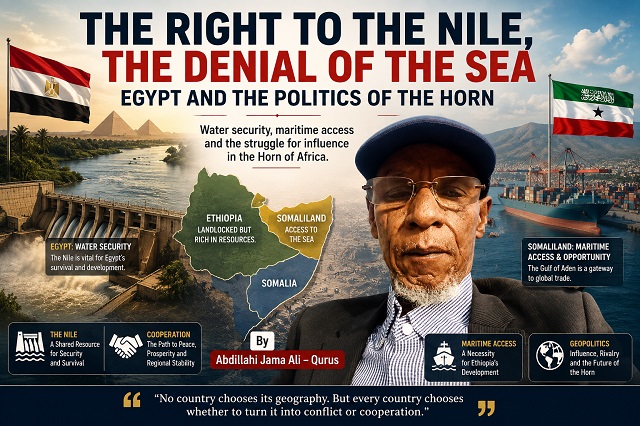
Hargeisa, Somaliland (HornPost) Water for Egypt — But No Sea for Ethiopia? The Right to the Nile, the Denial of the Sea: Egypt and the Politics of the Horn
By Abdillahi Jama Ali – Qurus
No country chooses the natural endowment with which it is born.
One country may possess oil. Another may possess gold, fertile land or strategic minerals. Some are blessed with mighty rivers. Others possess long coastlines and natural harbours. Some control narrow waterways through which global commerce must pass. Others are landlocked.
Nature has never distributed its gifts equally.
The question is not whether countries possess different natural advantages. They do. The real question is whether one country has the right to claim the benefits of another country’s natural endowment while denying that country the right to make use of its own.
This is the central contradiction in the conflict between Egypt and Ethiopia.
Egypt depends on the Nile. Ethiopia is one of the principal sources of the waters that flow toward Egypt. Ethiopia, meanwhile, is landlocked. It has a vast population, a large economy and enormous development potential, but no direct access to the sea.
Egypt insists that its water security must be protected. Ethiopia insists that its water resources must also serve its own development.
Egypt has a legitimate concern over the Nile.
Ethiopia has an equally legitimate right to development.
But a serious question arises when Egypt seeks to preserve what it regards as its historic share of waters originating in Ethiopia while simultaneously opposing Ethiopia’s search for greater access to the maritime economy.
Can Egypt claim a lion’s share of water originating beyond its borders while denying Ethiopia the opportunity to overcome the geographical disadvantage of being landlocked?
That is not merely a question about the Nile.
It is a question about fairness.
It is a question about natural endowment.
And it is increasingly a question about power in the Horn of Africa.
Egypt Wants Water Security. Ethiopia Wants Development.
Egypt has always regarded the Nile as a matter of national survival. That concern is understandable. Egypt is overwhelmingly dependent on the river, and its agriculture, population and economic life have developed along its banks for thousands of years.
But the Nile does not begin in Egypt. A substantial part of its water system originates beyond Egyptian territory, particularly in the Ethiopian highlands. Lake Tana and the Blue Nile form a central part of this system.
Ethiopia is therefore not merely another country standing beside the Nile. It is one of the major sources of the water that flows toward Sudan and Egypt.
Yet for generations, the use of Nile waters was governed by arrangements established under a political order in which the interests of upstream countries were not equally represented.
Ethiopia has challenged this historical arrangement. Its construction of the Grand Ethiopian Renaissance Dam (GERD) represents this challenge in concrete form.
For Egypt, the dam is a potential threat to water security. For Ethiopia, it is a symbol of sovereignty, development and the right to generate electricity for millions of people.
The central principle should be simple:
Egypt has a right to water security.
Ethiopia has a right to development.
Neither right should destroy the other.
The problem begins when one country’s historical use of a shared natural resource is treated as an absolute right while another country’s effort to develop the same resource is treated as an act of aggression.
That is where the Egyptian-Ethiopian conflict becomes difficult to justify.
Egypt cannot reasonably expect Ethiopia to remain permanently unable to develop its own water resources simply because Egypt has historically depended upon the waters flowing downstream.
The Nile must serve both security and development.
Water for Egypt — But No Sea for Ethiopia?
The contradiction becomes even sharper when the question of maritime access is considered.
Egypt is not landlocked.
It possesses access to the Mediterranean Sea and the Red Sea. It also controls one of the world’s most strategically important waterways: the Suez Canal.
Ethiopia has none of these advantages.
It is one of the world’s largest landlocked countries. For Ethiopia, access to ports and the maritime economy is not a luxury. It is a fundamental economic necessity.
A country with more than 100 million people cannot reasonably be expected to depend indefinitely on the geography and infrastructure of other states without seeking alternative access through peaceful agreements.
Ethiopia therefore has the right to negotiate commercial and economic arrangements with its neighbours. It has the right to develop transport corridors. It has the right to invest in ports. And it has the right to participate more fully in the maritime economy.
Of course, Ethiopia has no right to seize the territory of another country or violate another country’s sovereignty. Access must be obtained through agreement.
But agreement is precisely the point.
If Somaliland, for example, freely chooses to enter into an economic and maritime arrangement with Ethiopia, then the two parties have the right to negotiate such an arrangement according to their own interests.
Egypt cannot logically claim that Ethiopia should respect Egypt’s dependence upon Ethiopian water while arguing that Ethiopia must remain permanently cut off from direct access to the sea.
One principle cannot apply to the Nile and another to the Red Sea.
The Question of Natural Endowment
This is where the idea of natural endowment becomes important.
Egypt did not create the Ethiopian highlands.
Ethiopia did not create the Nile.
Somaliland did not create its long coastline on the Gulf of Aden.
None of these geographical realities were chosen. But they exist.
Ethiopia’s natural endowment is not the same as Egypt’s.
Somaliland’s natural endowment is not the same as Ethiopia’s.
Yet these differences do not have to produce conflict. They can produce cooperation.
Ethiopia has what Somaliland needs: a vast hinterland, a large market and economic weight.
Somaliland has what Ethiopia needs: access to the Gulf of Aden and the maritime economy.
This is not an unnatural relationship. It is a geographical complementarity.
The coast and the hinterland belong to different political entities, but their economic interests can meet.
That is how geography should work.
Not through permanent exclusion, but through mutually beneficial cooperation.
The Religious Road to Influence
Egypt’s involvement in the Horn of Africa, however, cannot be understood only through water and military strategy.
For a long time, religion also provided an important channel of influence.
The historical connection between the Coptic Church of Alexandria and the Ethiopian Orthodox Church is a matter of established history. For centuries, the Ethiopian Church remained institutionally connected to the Church of Alexandria, and until the middle of the 20th century, Ethiopian bishops were consecrated through the Egyptian Coptic Church.
This gave Alexandria an extraordinary historical relationship with one of Ethiopia’s most important national institutions.
It would be wrong to reduce this entire religious relationship to political manipulation. The connection was genuine, ancient and spiritual.
But it would also be naïve to pretend that such an institutional relationship had no political significance.
In the Horn of Africa, religion has never existed entirely outside history and politics.
The same principle applies to Al-Azhar’s relationship with the Somali people.
For generations, Somali scholars and students have travelled to Cairo and studied at Al-Azhar. That historical relationship continues today. Al-Azhar itself has long highlighted the education of Somali scholars at its institutions and maintains an important religious and educational presence in Somalia.
Again, this is not in itself a conspiracy.
Religious education is not automatically political manipulation.
But religious influence can create intellectual influence. Intellectual influence can shape political attitudes. And when major religious institutions enter contemporary political questions, their influence cannot simply be described as spiritual.
Religion can become a road into society.
It can create relationships with elites, scholars and communities.
And throughout history, states have understood the value of such influence.
The Somali Question and Egypt’s Strategic Interest
This brings us to the most important question:
Why is Egypt so deeply interested in the political future of Somalia?
The official Egyptian answer is clear: Cairo supports Somalia’s unity, sovereignty and territorial integrity. Egyptian officials have repeatedly reaffirmed this position.
But foreign policy is rarely explained by one principle alone.
Egypt’s position on Somalia must also be examined alongside its much larger strategic conflict with Ethiopia.
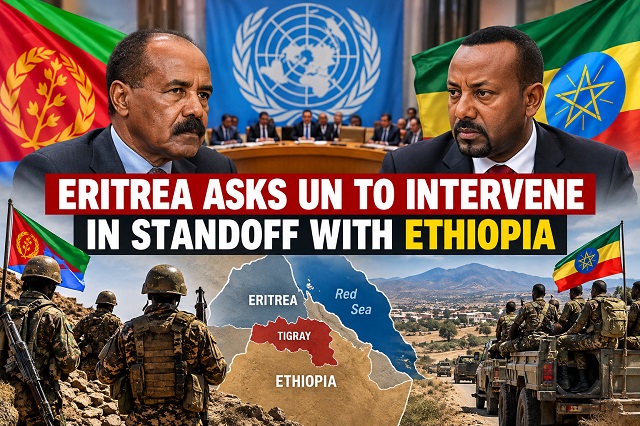
Egypt and Ethiopia are engaged in a deep dispute over the Nile. They are competitors for influence in the Horn of Africa.
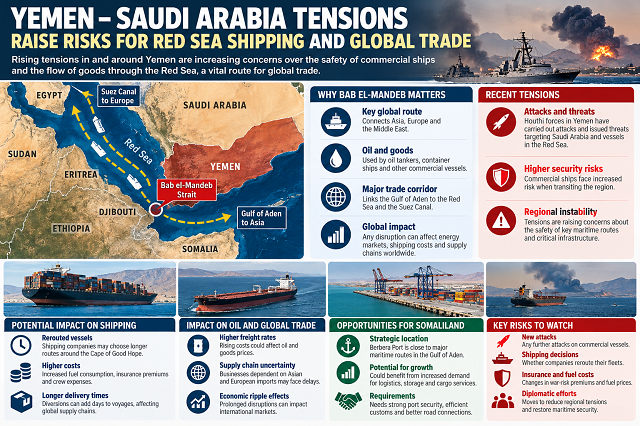
Ethiopia’s growing search for access to the Red Sea and the Gulf of Aden has added a new dimension to that rivalry.
At the same time, Egypt has strengthened its strategic relationship with Somalia.
The facts are therefore clear:
- Egypt supports Somali unity.
- Egypt is in strategic conflict with Ethiopia over the Nile.
- Egypt has expanded its security relationship with Somalia.
- Egypt has repeatedly opposed developments that it believes could strengthen Ethiopia’s maritime position.
The interpretation that follows from these facts is difficult to ignore:
A politically unified Somalia that remains strategically opposed to Ethiopia is useful to Egypt’s regional interests.
This does not mean that every Somali politician or every supporter of Somali unity is acting on behalf of Egypt.
Nor does it mean that Egypt created the Somali-Ethiopian conflict.
The history of conflict between Somalis and Ethiopia is older and more complicated than Egyptian involvement.
But Egypt has a clear strategic interest in a regional environment in which Ethiopia remains pressured on more than one front.
That is the geopolitical reality.
The Cultivation of an Old Conflict
The history of Somalis and Ethiopia contains wars, territorial disputes, competing national claims and memories of violence.
This history is real.
But it has also become politically useful.
A permanently hostile relationship between Somalia and Ethiopia benefits any outside power that wishes to constrain Ethiopia.
A stable economic partnership between the Somali territories and Ethiopia, however, could transform the politics of the Horn.
Imagine a different arrangement.
Ethiopia gains peaceful access to the maritime economy through mutually beneficial agreements.
Somaliland develops its ports, infrastructure and economy.
Trade expands between the coast and the Ethiopian hinterland.
Roads and railways connect the two.
The Gulf of Aden becomes a shared economic opportunity rather than a source of permanent confrontation.
In such a situation, the old politics of Somali-Ethiopian hostility would become less useful.
And this is precisely why regional cooperation matters.
Peace can alter the strategic calculations of outside powers.
Al-Azhar and the Politics of Unity
The relationship between Al-Azhar and Somalia deserves particular attention.
The historical educational influence of Al-Azhar among Somali Muslims is undeniable. Generations of Somali scholars received their education in Cairo, and the institution continues to maintain religious and educational connections with Somalia.
But when religious authority enters an active political dispute, a different question emerges.
Al-Azhar’s influence is no longer confined to theology. It becomes part of the wider intellectual and political environment.
Egypt’s religious institutions therefore form part of a much broader network of Egyptian influence in the Horn.
This is not unique to Egypt.
Major states throughout history have used religion, culture, education and language as instruments of soft power.
The important point is not to accuse every religious scholar of being an agent of the state.
The important point is to recognize that religious influence and national influence can overlap.
The historical connection between Alexandria and Ethiopia, and the modern relationship between Al-Azhar and Somalia, should therefore be studied as part of the broader history of Egyptian influence in the Horn of Africa.
A New Geopolitical Reality
The Horn of Africa is changing.
Old assumptions are being challenged.
Ethiopia is seeking greater access to the sea.
Somaliland is seeking international recognition and wider trade and economic partnerships.
The Red Sea and Gulf of Aden are becoming increasingly important to regional and global powers.
And Egypt is expanding its diplomatic and security engagement across the Horn.
This means that the future of the region cannot be understood simply through old nationalist slogans.
The real question is one of interests.
What does Egypt want?
What does Ethiopia need?
What does Somaliland offer?
And who benefits when old conflicts are kept alive?
These questions must be asked honestly.
The Right to Development Must Be Universal
The principle of natural endowment provides a simple answer.
No country has everything.
Every country has something.
One possesses water. Another possesses a coastline. Another possesses minerals. Another possesses fertile land.
The purpose of regional cooperation should be to turn these differences into mutual benefit.
Egypt should not deny Ethiopia’s right to develop its water resources.
Ethiopia should recognize the legitimate water-security concerns of downstream states.
Ethiopia’s search for maritime access should be based on peaceful and voluntary agreements.
And Somalia and Somaliland should be allowed to determine their own political and economic relationships without external powers using old regional conflicts to dictate the future.
Water should not be a weapon.
Ports should not be a weapon.
Religion should not be a weapon.
And the historical conflict between Somalis and Ethiopians should not be permanently cultivated for the strategic benefit of another state.
Conclusion: The Nile Cannot Flow in One Direction Only
The conflict between Egypt and Ethiopia is ultimately a struggle over a deeper principle:
Can a country demand access to the natural resources of another country while denying that country the right to overcome its own natural disadvantages?
Egypt wants security for the waters flowing from the Ethiopian highlands.
Ethiopia wants development and access to the maritime economy.
Both demands are understandable.
But they must be treated according to the same principle.
If Egypt expects Ethiopia to recognize its dependence upon the Nile, Egypt must recognize Ethiopia’s right to seek solutions to its geographical isolation.
No country chooses the gifts or disadvantages of geography.
But every country chooses whether to cooperate with its neighbours or attempt to use their natural endowment as an instrument of permanent control.
The future of the Horn of Africa should not be built upon the politics of denial.
Egypt cannot own the Nile.
Ethiopia cannot own the sea.
Somaliland cannot be denied the right to use its coastline.
And Somalia and Ethiopia should not remain permanent enemies merely because outside powers find their hostility strategically useful.
The real challenge is to transform natural endowment from a source of conflict into a foundation for cooperation.
That is the new logic the Horn of Africa needs.
And until that logic is accepted, the Nile will continue to flow through the politics of the Horn — not as a river of cooperation, but as a river of rivalry.
By Abdillahi Jama Ali – Qurus
Hargeisa, Somaliland