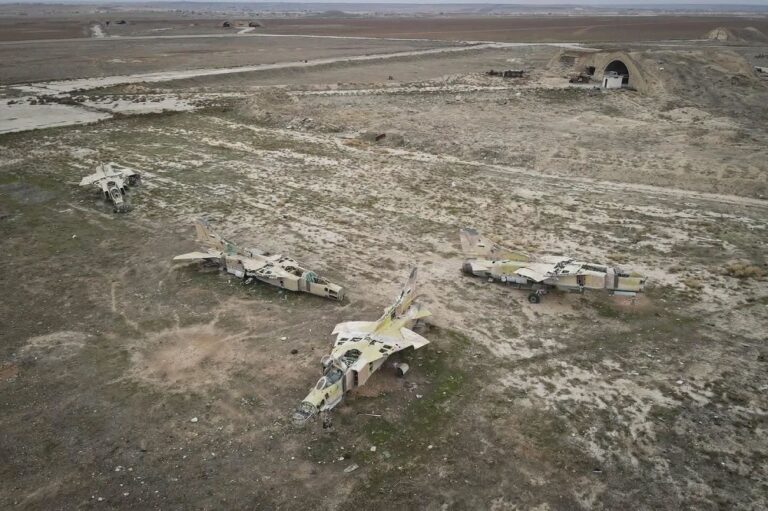
IDLIB, Syria — (HornPost) Israeli airstrikes hit the Abu al-Duhur military airbase in northwestern Syria on Tuesday, causing material damage but no reported casualties, according to Syrian state media and international news reports.
Syrian state television reported that eight Israeli airstrikes targeted the airbase, striking runways and storage facilities.
The attack marked the first reported Israeli strike on Syrian government assets since March, according to Reuters.
The Syrian government condemned the strikes as a violation of the country’s sovereignty.
No immediate statement was issued by the Israeli military, while U.S. Ambassador to Turkey and Special Envoy to Syria Tom Barrack expressed concern, describing the attack as an escalation that could undermine regional stability.
Strategic Military Site.
Abu al-Duhur is located in eastern Idlib province, in a strategically important area between Idlib, Aleppo and Hama.
The military airbase has been largely inactive for years and was heavily damaged during Syria’s civil war. It changed hands several times as government and opposition forces fought for control of the facility.
Opposition forces captured the airbase in 2015 after a lengthy siege. Syrian government forces later retook it in 2018 before losing control again during the opposition offensive that contributed to the fall of President Bashar al-Assad’s government in late 2024.
The facility is now under the authority of Syria’s new government, with Syrian Defense Ministry forces reported to be securing the site. Recent reports also indicated that the base had been undergoing rehabilitation with Turkish support.
Why Did Israel Strike Abu al-Duhur?
Israel has not publicly explained the specific target or objective of Tuesday’s attack.
However, Israel has repeatedly said that its military operations inside Syria are intended to prevent weapons, military equipment and strategic capabilities from reaching groups it considers a security threat.
The latest strikes come amid continued Israeli military activity in Syria following the fall of the Assad government in December 2024.
Israel has also expressed concern about efforts by Syria’s new authorities to rebuild military capabilities, including the country’s air force.
Rising Tensions Over Syria’s Future
The attack highlights the complicated security environment that has emerged in Syria following Assad’s fall.
Syria’s new leadership has sought to avoid a direct confrontation with Israel while rebuilding state institutions and the country’s security forces. Israel, meanwhile, remains wary of the new authorities because of their origins in armed opposition groups that fought against the Assad government.
Turkey, which has close relations with Syria’s current leadership, has also criticized Israeli military actions and called for greater international efforts to prevent further escalation.
The United States has urged restraint and dialogue, adding another diplomatic dimension to the growing tensions between Israel and Syria.
A New Test for Syria’s Sovereignty
The Abu al-Duhur strikes raise a broader question about Syria’s sovereignty and its ability to rebuild an independent national defense system following more than a decade of civil war.
For Damascus, rebuilding military infrastructure is part of restoring state authority. For Israel, preventing the emergence of military capabilities it considers threatening remains a central security concern.
That tension could become increasingly important as Syria’s transitional authorities deepen cooperation with regional powers, particularly Turkey, while seeking improved relations with the United States and other international actors.
Tuesday’s attack therefore represents more than damage to an inactive military airfield. It underscores the continuing struggle over Syria’s security architecture, Israeli military policy, regional influence and the future balance of power in the Middle East.