Hanging from the Cliff: Hassan Sheikh Mohamod and the Uncertain Future of Somali Federalism
Author: Abdillahi Jama Ali – Qurus
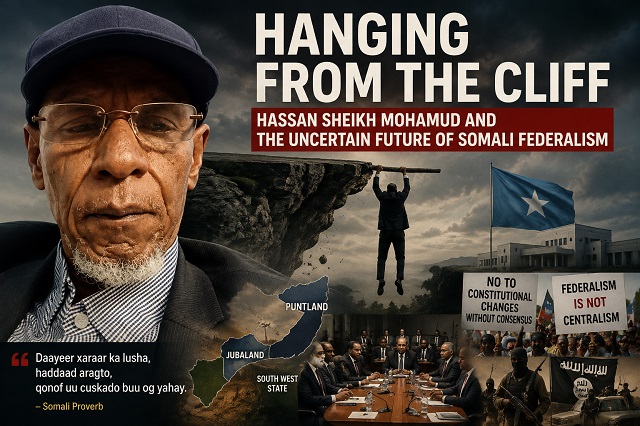
A Somali proverb says:
“Daayeer xaraar ka lusha, haddaad aragto, qonof uu cuskado buu og yahay.”
If you see a monkey hanging from a dangerous cliff, it knows there is a support it can hold on to.
The proverb carries a profound political lesson. What appears reckless to an observer may, in the mind of the person taking the risk, be a calculated move. A man may walk into danger because he knows something others do not. He may see a support that is invisible to those watching him.
Perhaps no Somali political figure today better illustrates this proverb than President Hassan Sheikh Mohamod.
From the outside, he appears to be hanging from a dangerous political cliff.
He has pushed constitutional changes despite serious objections and without broad national consensus. His political relationship with the opposition in Mogadishu has become deeply strained over the electoral process. Relations with major federal member states have deteriorated. He has fought against Jubaland and is now locked in a deep political struggle with Puntland.
In South West State, another dangerous exercise of federal power unfolded. President Abdiaziz Hassan Mohamed Laftagareen was forcefully removed from his seat in Baidoa, and the political confrontation that followed was accompanied by violence and instability.
This was not a minor political disagreement.
It was another demonstration of how far the federal center appeared willing to go in dealing with an independent federal leader.
A federal president may have political differences with a state president. He may oppose him. He may prefer a different political outcome. But when political power is used to forcefully remove an elected leader from his seat, the question is no longer simply about one man.
It becomes a question about the future of federalism itself.
If the president of South West State can be removed through the exercise of federal power, what protection remains for the political independence of the other federal member states?
And what happens when disputes that should be settled through political negotiation move into the streets and are followed by violence?
This is an extraordinary number of risks for one leader to take simultaneously.
And yet Hassan Sheikh continues.
The question is: What is he holding on to?
A President Taking Extraordinary Risks
A government facing such a complicated political environment might normally choose compromise.
It might seek a broad agreement with the opposition over elections. It might try to repair relations with the federal member states. It might avoid opening new political fronts while Al-Shabaab remains a serious security threat.
But Hassan Sheikh has chosen a different path.
He has continued to push forward.
Perhaps he believes constitutional change will ultimately strengthen Somalia. Perhaps he believes his opponents are too divided to stop him. Perhaps he believes the federal member states will eventually return to the negotiating table. Perhaps he believes political resistance can be overcome through patience, pressure or the strength of the federal government.
Or perhaps he knows something that the rest of us do not.
That is where the old Somali proverb becomes relevant.
A monkey hanging from a cliff may look as if it is about to fall. But it may know of a branch that the observer cannot see.
The Cliff Beneath Him
The problem is that the risks are real.
Somalia’s federal system was created to prevent the return of excessive centralization after the collapse of the Somali state. It was supposed to distribute power and reduce the fear that one political center could dominate the others.
Federalism, however, cannot survive merely because the word is written in a constitution.
It survives through agreement.
It survives through trust.
And it survives when the center understands that political unity cannot simply be imposed.
Today, that trust is dangerously weak.
When Puntland and other political actors question constitutional changes, when Jubaland becomes a theater of confrontation, when the president of South West State is forcefully removed from his seat, and when the political opposition in Mogadishu remains outside a national consensus, the crisis is no longer merely about elections or individual leaders.
It becomes a crisis of the system itself.
What kind of federalism will Somalia have if the federal states believe that the center can change the rules without their genuine agreement — or remove regional leaders who refuse to follow its political direction?
That is the question now hanging over the country.
Fighting Too Many Battles
There is another danger.
Al-Shabaab remains one of the most serious threats to the Somali state. No responsible government can ignore the danger posed by an insurgent movement capable of exploiting political divisions and state weakness.
In such circumstances, opening political battles on several fronts is a major gamble.
A government may defeat an opposition group. It may defeat a regional administration. It may force a state president from office. It may win a constitutional argument.
But can it fight everyone at the same time while also fighting Al-Shabaab?
This is the danger of the present moment.
Political divisions create opportunities for the enemy.
Every quarrel between Mogadishu and a federal member state weakens national unity. Every constitutional dispute deepens suspicion. Every political confrontation consumes attention and resources that should perhaps be directed toward the common threat.
The question is not whether the federal government has grievances against its opponents.
The question is whether Somalia can afford to fight so many internal battles at once.
The Regional Storm
Somalia does not exist in isolation.
The Horn of Africa is passing through a period of intense geopolitical competition. Ethiopia, Kenya, Türkiye, Egypt, the Gulf states and other external powers all have interests in Somalia and the wider region.
In such an environment, foreign alliances can provide important support.
But they can also produce dangerous confidence.
A leader who knows that powerful friends are standing behind him may become more willing to take political risks at home.
Perhaps Hassan Sheikh believes he has such support.
Perhaps he believes the international community will not allow Somalia to collapse.
Perhaps he believes powerful friends will remain beside him.
Or perhaps, sitting beside him, his Turkish friends have simply told him:
“Do not worry. We are here.”
Türkiye has become one of the most important external partners of the Somali government. Its military, economic and political relationship with Mogadishu is deep. For any Somali leader, such a relationship can provide enormous confidence.
And perhaps that confidence is the hidden “qonof.”
Perhaps Ankara is the unseen support that allows Hassan Sheikh to continue taking risks that, from the outside, appear extraordinarily dangerous.
Perhaps.
We do not know what is said behind closed doors.
But the possibility raises an important question:
What happens when a man mistakes another man’s hand for a permanent branch?
Foreign powers can support a government.
They can train its forces.
They can invest in its economy.
They can provide diplomatic protection and political assistance.
But no foreign power can permanently replace domestic political legitimacy.
And no outside friend can guarantee the survival of a political system whose foundations are collapsing from within.
The Future of Federalism
The greatest danger is not simply what happens to Hassan Sheikh Mohamod.
Presidents come and go.
The greater question is what happens to Somali federalism.
If constitutional changes can be made without a broad agreement among the major political stakeholders, what precedent does that create for the future?
If the center can use political pressure or force to bring federal member states into line, what will federal autonomy mean?
If regional leaders believe that their political survival depends on fighting Mogadishu rather than cooperating with it, what kind of federation will remain?
Federalism is not tested when everybody agrees.
It is tested when they disagree.
That is the test Somalia is facing today.
The country must decide whether federalism is a genuine political agreement between partners or simply a temporary arrangement that can be reshaped by whoever controls Mogadishu.
This is not a small question.
It concerns the future stability of Somalia itself.
And Then There Is Somaliland
The Somaliland question adds another dimension to the crisis.
For more than three decades, Somaliland has maintained its own political institutions, security structures and democratic system. Whatever one’s position on its claim to sovereignty, it cannot simply be treated as a temporary political problem that will disappear.
A policy of confrontation or destabilization carries risks for the whole region.
Somalia cannot strengthen itself by creating permanent instability in every direction.
Nor can it easily build a strong federal state while simultaneously fighting political battles against federal member states and attempting to undermine the political stability of Somaliland.
There must be priorities.
There must also be realism.
What Does the President Know?
This brings us back to the Somali proverb:
“Daayeer xaraar ka lusha, haddaad aragto, qonof uu cuskado buu og yahay.”
Perhaps Hassan Sheikh knows of a support that the rest of us cannot see.
Perhaps he has a political plan.
Perhaps he believes his opponents will eventually surrender.
Perhaps he believes the federal states can be brought back into line.
Perhaps he believes constitutional changes will create a new political order.
Perhaps he trusts international partners.
Or perhaps the powerful Turks sitting beside him have simply told him:
“Do not worry. Keep hanging on. We are here.”
Perhaps that is his hidden support.
Perhaps it is something else entirely.
The truth is uncertain.
But the consequences of miscalculation are not.
Because the branch may not be as strong as it looks.
And what happens when a man mistakes another man’s hand for a permanent branch?
Hanging from the Cliff
Hassan Sheikh Mohamod is taking an extraordinary political gamble.
He faces constitutional controversy, political opposition, strained relations with federal member states, the forceful removal of a South West State president, serious tension with Puntland and Jubaland, the continuing threat of Al-Shabaab and a difficult regional environment.
Yet he continues to move forward.
Like the monkey in the Somali proverb, perhaps he sees a support invisible to the rest of us.
Perhaps he knows exactly what he is doing.
But perhaps the support he believes will hold him is not permanent.
That is the danger.
For Hassan Sheikh Mohamud may be hanging from the cliff.
But the future of Somali federalism may be hanging there with him.
Analyses by Author: Abdillahi Jama Ali – Qurus