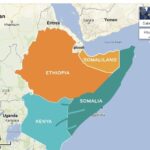

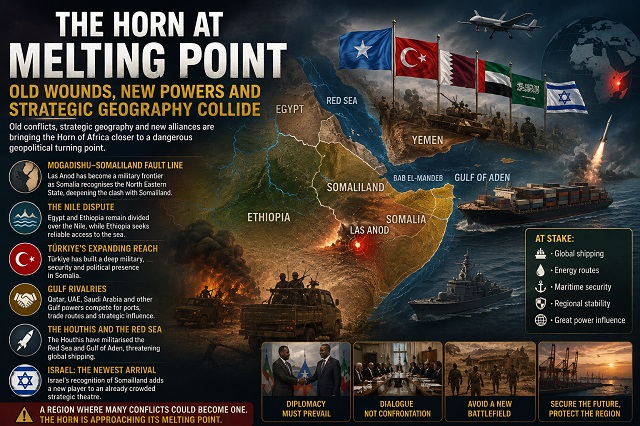
Hargeisa, Somaliland (HornPost) The Horn of Africa faces a dangerous geopolitical convergence as Somaliland, Somalia, Ethiopia, Egypt, Türkiye, Israel, Gulf powers and the Houthis compete for influence.
By Abdillahi Jama Ali – Qurus
How old conflicts, strategic geography and new alliances are bringing the Horn of Africa closer to a dangerous geopolitical turning point
The Horn of Africa is approaching a dangerous moment.
Not because of one country. Not because of one conflict. And not simply because Israel has recognized Somaliland.
The real danger lies in the fact that too many old conflicts, new rivalries and competing foreign interests are beginning to converge in the same geographical space.
The unresolved relationship between Mogadishu and Somaliland remains at the center of the region’s political instability. Egypt and Ethiopia remain divided by the Nile dispute. Ethiopia continues to search for reliable access to the sea. Türkiye has built an expanding military and political presence in Somalia. Qatar maintains deep political and financial connections with Mogadishu. The Houthis have turned the Red Sea and Gulf of Aden into a military theater. Gulf powers are competing for ports, trade routes and strategic influence.
Now Israel has arrived.
But Israel is not the beginning of this story.
Israel is simply the newest arrival in a region that was already becoming one of the world’s most contested strategic spaces.
A Geography That Never Loses Its Importance
The strategic importance of Somaliland’s coast did not begin in 2025 or 2026.
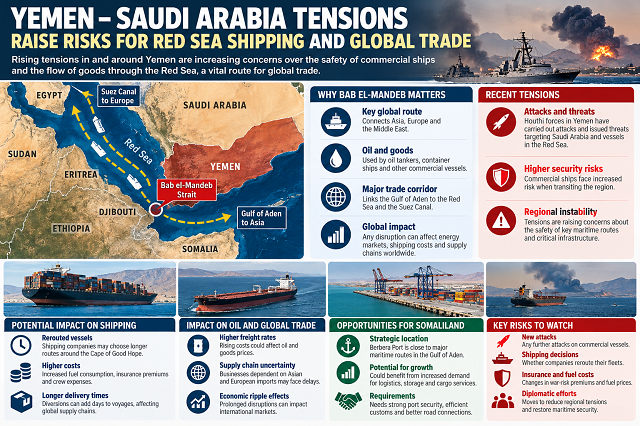
For centuries, foreign powers have understood the importance of the coastline along the Gulf of Aden. It lies opposite Yemen and beside the approaches to the Bab el-Mandeb and the Red Sea, through which a major share of global trade and energy supplies must pass.
Empires have changed.
Flags have changed.
Governments have changed.
But geography has remained unchanged.
The coast remains close to one of the world’s most important maritime corridors. That is why foreign powers repeatedly return to the region.
The Ottoman Empire understood it. Egypt understood it. Britain understood it. European powers understood it. Cold War powers understood it. The Gulf states understand it today.
And now Israel understands it.
This is why it is wrong to believe that Israel’s arrival suddenly made Somaliland strategically important.
The truth is the opposite:
Israel did not make Somaliland strategically important. Somaliland’s geography made Israel interested.
The Old Mogadishu-Somaliland Fault Line
Yet geography alone does not explain the danger.
The Horn already has an unresolved political conflict at its heart: the relationship between Mogadishu and Somaliland.
The roots of the dispute go back to the 1960 union and the subsequent violence that contributed to the collapse of the Somali state in 1991.
Somaliland sees itself as a sovereign state that restored its independence in 1991 following the collapse of the Somali state. Mogadishu sees Somaliland as part of the Federal Republic of Somalia.
For years, this dispute remained largely political. There were negotiations, occasional tensions and diplomatic arguments.
But the situation has gradually changed.
The crisis around Las Anod created a new reality.
The city and the wider Sool region became a battlefield. Somaliland lost control of Las Anod, while new political and military forces emerged.
Mogadishu has since become increasingly involved in the political future of the area.
The Federal Government has recognized and incorporated the North Eastern State into its political structure. Its leader, Abdikhadir Ahmed Aw-Ali Firdhiye, has become an important figure in the emerging political order. Federal political and security activity in the region has also increased.
This has transformed the nature of the dispute.
Las Anod is no longer simply a local conflict zone.
It is becoming a potential military frontier between two competing political systems.
And that makes it potentially dangerous.
The Nile Comes to the Horn
The Egypt-Ethiopia dispute is usually discussed as a conflict over water.
But the Nile dispute cannot be separated from the wider struggle for influence in the Horn of Africa.
Ethiopia’s growing military and economic power concerns Egypt. Addis Ababa’s search for reliable access to the sea has created another strategic dimension.
The memorandum of understanding between Ethiopia and Somaliland demonstrated how Ethiopia’s maritime ambitions could directly affect the political balance of the Horn.
For Egypt, developments in Somaliland cannot always be separated from its wider strategic relationship with Ethiopia.
Cairo does not necessarily need to confront Ethiopia directly. In the modern world, strategic competition can move through diplomacy, local partnerships, military cooperation, political influence, intelligence and economic support.
That is why the situation around Somaliland must be watched carefully.
A weakened or destabilized Somaliland could complicate the situation significantly.
At the same time, any development that strengthens Ethiopia’s position on the coast could become a concern for Egypt.
This does not mean that every local Somali actor is a foreign proxy. That would be an exaggeration without evidence.
But it does mean that local conflicts can become strategically useful to foreign powers.
And that is how small wars become dangerous.
Neo-Ottomanism and Türkiye’s Expanding Reach
Then there is Türkiye.
Türkiye has become one of the most important foreign powers in Somalia. Its involvement is not limited to trade, humanitarian assistance or diplomacy.
Ankara has built a deep military, security and political relationship with Mogadishu.
Turkish influence in Somalia must also be viewed as part of a wider strategic expansion.
From Libya to the eastern Mediterranean, from the Red Sea to Somalia, and from Central Asia to the Caucasus, Türkiye has sought to increase its influence.
The term neo-Ottomanism is therefore useful.
Türkiye is not restoring the Ottoman Empire. But it is seeking a strategic role across a geographical space that once fell within, or was connected to, the wider Ottoman world.
Somalia has become one of the strongest pillars of that influence in Africa.
This means that any serious confrontation between Mogadishu and Somaliland could place Türkiye in a difficult position.
It has invested too much to remain indifferent.
Qatar and the Gulf Powers
Qatar has also become part of the wider political landscape.
Its relationship with Mogadishu is significant, and its influence must be understood within the larger competition among Gulf states.
The UAE, on the other hand, has major commercial and strategic interests in ports across the Horn and the Red Sea. Berbera is one of the most important examples.
Saudi Arabia also has direct interests in Red Sea security.
The result is a complex map of competing partnerships.
There are no simple alliances.
A country may be a friend of another power in one area and a competitor in another.
This overlapping network of interests makes the Horn difficult to understand — but even more difficult to control.
The Houthis and the Red Sea
The Houthi conflict has transformed the security environment.
The Red Sea and Gulf of Aden are no longer simply commercial routes. They have become active military theaters.
Missiles, drones and attacks on shipping have demonstrated that a conflict in Yemen can quickly affect countries far beyond Yemen.
This is particularly important for Somaliland.
The Somaliland coast lies directly across the Gulf of Aden from Yemen. Any serious escalation involving Israeli-linked strategic interests on the coast could eventually bring the Houthis into the equation.
But the Houthis may not fire the first shot.
They may enter a conflict that has already begun elsewhere.
That distinction is important.
Israel: The Newest Arrival
Israel’s recognition of Somaliland has changed the political atmosphere.
But it should not be treated as the original cause of the Horn’s instability.
The problems were already there.
Mogadishu and Somaliland already had an unresolved political conflict.
Egypt and Ethiopia already had the Nile dispute.
Ethiopia already had ambitions for access to the sea.
Türkiye was already deeply established in Somalia.
The UAE already had major interests in Berbera.
The Houthis had already militarized the Red Sea.
The United States, Britain and Europe already had vital maritime interests.
Israel has entered an already crowded strategic theater.
Its arrival has simply added another powerful player to the competition.
The West Cannot Remain Indifferent
The United States, Britain and the European Union cannot afford to remain indifferent bystanders.
The Red Sea is too important.
Global shipping is too important.
The Gulf of Aden is too important.
The Bab el-Mandeb is too important.
And the expansion of rival powers is too important.
The West may not wish to create a new battlefield in the Horn.
But it will not easily abandon its interests.
The United States will seek strategic partnerships.
Britain will protect its historic and contemporary interests.
Europe will focus on maritime security, trade and stability.
This raises an important question:
Do they have proxies?
Perhaps the modern term is not simply proxy.
It is strategic partner.
But the difference can become very small during a conflict.
Military training becomes military assistance.
Military assistance becomes weapons.
Weapons require intelligence.
Intelligence requires a presence.
And a strategic partnership can gradually become an indirect military relationship.
This is how proxy systems develop.
The Horn Is Becoming a Meeting Place of Conflicts
The most dangerous development is not that the region is dividing neatly into two opposing camps.
The danger is that too many conflicts are beginning to overlap.
The Mogadishu-Somaliland conflict is local.
The Nile dispute is regional.
Türkiye’s ambitions are geopolitical.
The Houthi conflict is connected to Yemen and the wider Middle East.
The Gulf powers are competing for influence.
Israel has brought its own strategic calculations.
The West has its maritime interests.
But geography is forcing these separate conflicts closer together.
The Horn is becoming a meeting point.
And this is why the region is approaching what may be called its melting point.
If Diplomacy Fails: The Worst-Case Scenario
The worst-case scenario is not necessarily a sudden great war.
It is a chain reaction.
If diplomacy fails, every major power will face the same problem: no one can simply go home. Everyone has interests to protect.
Türkiye cannot easily abandon its investment in Somalia.
Egypt cannot ignore Ethiopia’s growing influence in the Horn.
Ethiopia cannot abandon its search for strategic access to the sea.
The Gulf powers cannot ignore the ports and maritime routes.
Israel cannot ignore the security of the Red Sea.
The Houthis cannot ignore Israeli interests across the Gulf of Aden.
The United States, Britain and Europe cannot abandon one of the world’s most important maritime routes.
And local Somali actors cannot escape the consequences of these rivalries.
So where might the first serious spark appear?
Not necessarily at sea.
It may come from the land.
It may come from Las Anod.
A new confrontation there could draw Mogadishu and Somaliland into a deeper military conflict.
Then outside powers could face pressure to protect their partners and interests.
The local conflict would become the match.
The wider geopolitical rivalries would become the fuel.
The Houthis might enter later if Israeli-linked facilities or strategic interests on the Somaliland coast became targets.
At that point, several conflicts could begin to merge:
- The Somaliland-Mogadishu dispute
- The Nile dispute
- Ethiopia’s search for maritime access
- Türkiye’s expanding influence
- Gulf rivalries
- The Houthi conflict
- Israel’s new presence
- The security interests of the West
And that is the real danger.
The Horn at Melting Point
The Horn is not yet another Syria.
But it contains some of the ingredients that made Syria such a devastating geopolitical battlefield: local conflict, outside interests, military alliances and foreign powers that believe they cannot afford to lose.
The greatest danger is not that one power will deliberately begin a regional war.
The greatest danger is that a local conflict will begin to draw in larger powers, one after another.
Las Anod could be the match.
The Mogadishu-Somaliland dispute could be the fuel.
The Nile rivalry could be the fuel.
Neo-Ottoman ambition could be the fuel.
Ethiopia’s search for the sea could be the fuel.
The Red Sea and the Houthis could be the fuel.
Israel’s arrival could add another layer to the fire.
The question is therefore no longer whether the Horn is strategically important.
The question is whether the many powers now competing for influence can manage their differences before one local conflict ignites them all.
The Horn of Africa is not facing one crisis.
It is approaching the point where many crises may become one.
That is why the Horn is approaching its melting point.
Author Abdillahi Jama Ali – Qurus
Hargeisa, Somaliland