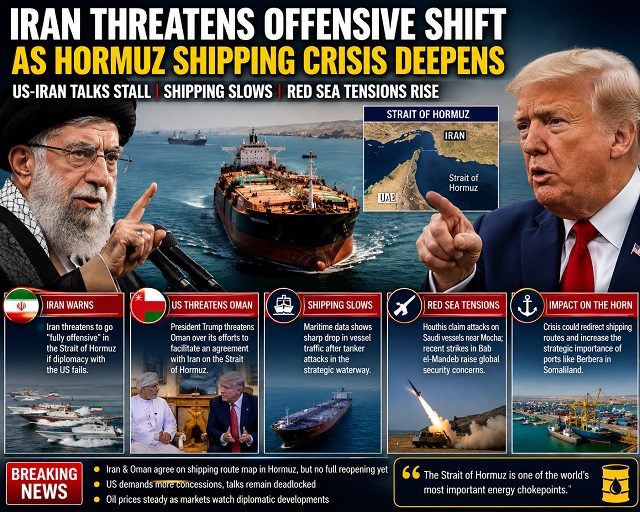
DUBAI/WASHINGTON — Aug. 17, 2026 — Tensions between Iran and the United States have escalated sharply after Tehran warned it could shift from a defensive posture to a “fully offensive” strategy in the Strait of Hormuz if diplomatic efforts fail, adding new uncertainty to an already severe global shipping crisis.
The warning came as the latest U.S.-Iran diplomatic efforts appeared to stall following the expiration of a 60-day memorandum of understanding that was intended to support a ceasefire and broader negotiations. Both sides have accused the other of violating the agreement.
Iran and Oman seek a route for commercial shipping
Despite the growing confrontation, Iran and Oman have reached an understanding on a shipping route map for vessels transiting the Strait of Hormuz, according to Iranian officials.
Oman has played a central role in attempts to mediate between Tehran and Washington and to restore commercial maritime traffic through the strategic waterway.
However, the arrangement does not yet amount to a full reopening of Hormuz. The United States has continued to demand broader concessions from Iran, while Tehran has rejected Washington’s pressure and maintained its own conditions for normalizing shipping.
Trump threatens Oman
The diplomatic situation took another dramatic turn Monday after U.S. President Donald Trump threatened Oman over its efforts to facilitate an agreement with Iran on the Strait of Hormuz.
Trump has also demanded that Iran surrender, while Washington maintains pressure on Tehran over the conflict and its nuclear program.
The threats place Oman in an increasingly difficult position as it attempts to mediate between Washington and Tehran while also protecting its own regional security and maritime interests.
Shipping through Hormuz nearly stalls
Commercial shipping through the Strait of Hormuz has slowed dramatically following attacks on tankers.
Reuters reported that maritime tracking data showed a sharp reduction in vessel traffic over the weekend, highlighting the growing reluctance of shipping companies to risk the strategic waterway.
Oil prices remained relatively steady Monday despite the continuing crisis, with markets closely watching diplomatic developments and the possibility of further disruption to energy supplies.
The Strait of Hormuz is one of the world’s most important energy chokepoints, carrying a significant share of global oil and gas shipments. Prolonged disruption could increase transportation costs and put further pressure on fuel prices and global supply chains.
Red Sea and Bab el-Mandeb face renewed pressure
The Hormuz crisis is also increasingly connected to security developments farther west in the Red Sea and Gulf of Aden.
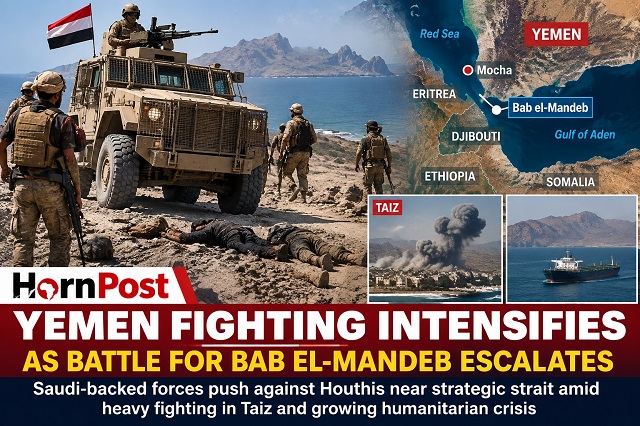
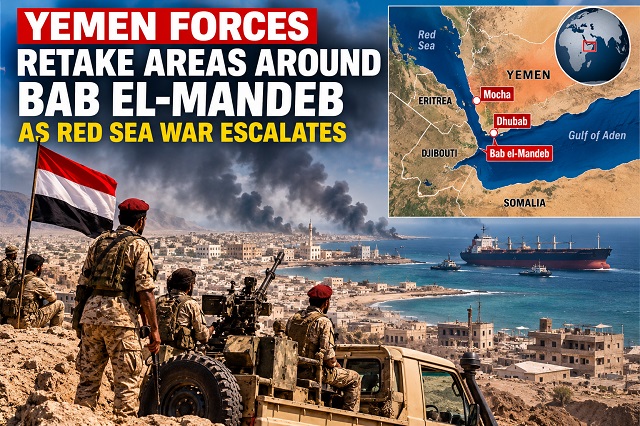
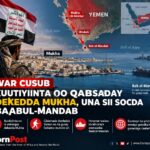
Yemen’s Iran-aligned Houthi movement said Monday that it had attacked what it described as a Saudi military vessel and four escort ships near Mocha, close to the Bab el-Mandeb Strait. The claim could not immediately be independently verified.
Earlier this month, four crew members were killed in an attack on a cargo vessel in the Bab el-Mandeb, according to Reuters, while two Yemeni rescuers were also reported killed.
The developments raise concerns that instability around Hormuz could increasingly affect the Bab el-Mandeb, Gulf of Aden and Red Sea, creating additional risks for international shipping.
Implications for Somaliland and Berbera
For the Horn of Africa, the growing maritime security crisis is strategically significant.
A prolonged disruption in the Strait of Hormuz could encourage shipping operators to reassess routes through the Gulf of Aden, Bab el-Mandeb and Red Sea, potentially increasing the importance of alternative ports and logistics hubs in the region.
That could put greater attention on Berbera Port in Somaliland, as well as ports in Djibouti and other locations along the Gulf of Aden.
However, any potential increase in commercial traffic would also depend on security conditions in the Red Sea and Bab el-Mandeb, where Houthi attacks have already affected international shipping.
What happens next?
The immediate question is whether Iran, the United States and Oman can reach an arrangement that allows commercial vessels to transit Hormuz safely while preventing the conflict from expanding.
With Iran threatening a more offensive posture, Washington increasing pressure on Tehran, and shipping traffic already sharply reduced, the Strait of Hormuz remains one of the world’s most closely watched geopolitical flashpoints.
Prepared by:
HornPost Staff
info@hornpost.com
www.hornpost.com